A SWOT analysis for small business is a structured way to look at your company’s Strengths, Weaknesses, Opportunities, and Threats before you make a decision that matters — a hiring call, a price increase, a new location, a loan application. Strengths and weaknesses are internal, things you control; opportunities and threats are external, things happening in your market whether you act or not. Run correctly, a small business swot analysis turns a decision you’d otherwise make on gut feel into one you can defend with a page of specifics, and it does that without needing a consultant, a strategy team, or a single meeting.
If you’re reading this, you’re probably staring down a decision bigger than your usual day-to-day — whether to take on debt, raise your prices, drop a product line, or finally hire your first employee. You’ve probably opened a blank four-box grid and stared at it, not sure what belongs where, especially with no team to bounce ideas off. The common misconception is that a SWOT analysis for small business only works with a room full of people and a whiteboard. It doesn’t — it works solo, on a laptop, in under an hour, if you follow the right sequence, and this guide is built around exactly that sequence. That gap matters: 58% of business leaders say their companies base at least half of their regular decisions on gut feel rather than data (Business.com), and having any written plan changes the odds more than most owners realize — half of businesses with a written plan report growth, compared to just 27% of those without one (Gallup). This guide walks through a SWOT analysis for small business you can run alone, a free template, real examples by industry, the mistakes that make most SWOTs useless, and how to turn the finished grid into an actual decision — including using it in a loan application.
One more thing before you start: a SWOT analysis for small business is not a substitute for a full business plan, a financial model, or a market study — it’s a fast diagnostic that tells you where to point those bigger tools next. Treat it as the first hour of a decision, not the whole decision. If the exercise below surfaces a weakness or threat serious enough to change the direction of the business, that’s the signal to slow down and do the deeper work, not a sign the SWOT failed.
What Is a SWOT Analysis for Small Business? (And Why It Matters)
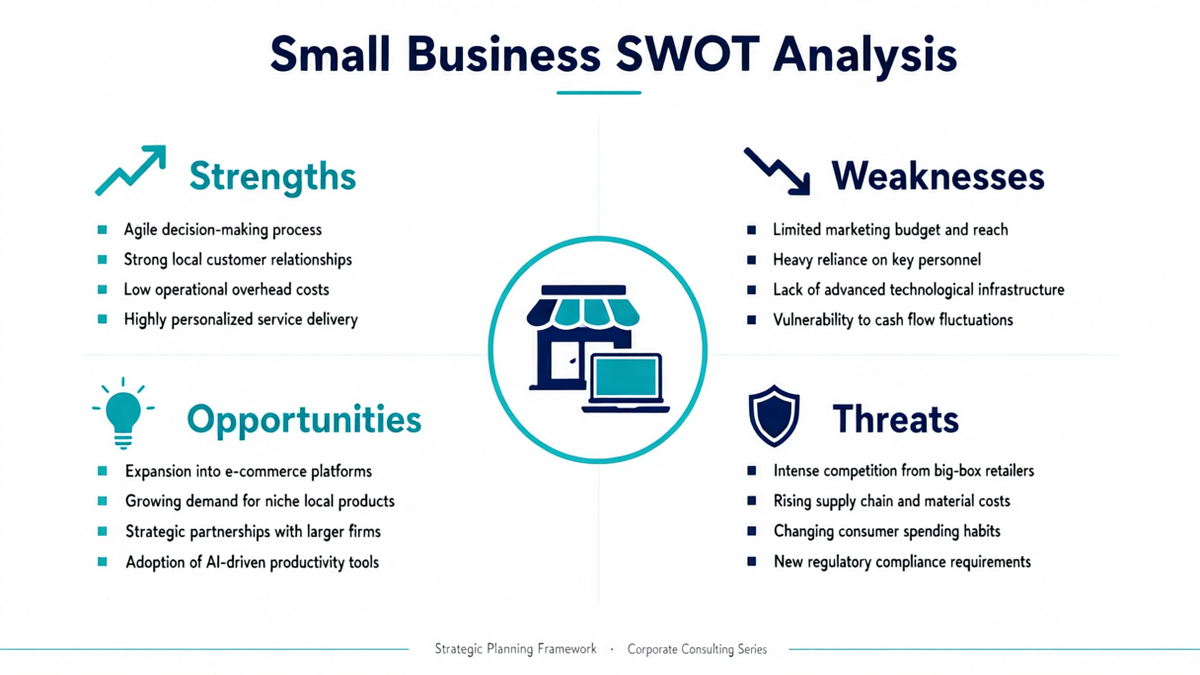
A SWOT analysis for small business is a four-part framework — Strengths, Weaknesses, Opportunities, and Threats — that gives you an organized picture of your business before a decision, instead of a gut call made under pressure. Strengths and weaknesses are internal factors: your reputation, your cash position, your product quality, your team (or lack of one) — anything inside your four walls that you could change yourself if you decided to. Opportunities and threats are external factors: a competitor closing, a new regulation, a shift in what your customers want — things happening in your market whether you act on them or not. A small business swot analysis earns its hour of your time by forcing that internal-versus-external split, which is what stops you from treating a market shift like a personal failure and stops you from treating a fixable internal problem like bad luck nobody could have seen coming.
The framework itself isn’t new or trendy — strategy teams have used some version of it since the 1960s, precisely because it’s simple enough to run without formal training. What’s changed is who’s using it. A generation ago, running a SWOT analysis for small business assumed you had a strategy department to run it for you. Today it’s just as likely to be one person at a kitchen table deciding whether to renew a lease, and the framework holds up exactly as well at that scale — the questions don’t get easier or harder depending on headcount. What changes with company size is discipline, not difficulty: a solo owner has to supply the objectivity a team would normally provide by arguing with each other.
It matters because most small business decisions still aren’t run through any framework at all. 58% of business leaders say their companies base at least half of their regular decisions on gut feel rather than data (Business.com), which is exactly the gap a focused SWOT analysis for small business closes in about an hour — not by replacing your instinct, but by giving it something concrete to check itself against before money moves.
The Four Parts of a SWOT Analysis, Explained Simply
Each of the four categories in a SWOT analysis for small business answers a different question, and confusing two of them is the single most common error people make on their first attempt:
- Strengths (internal factors) — What do you do better than competitors, right now, with proof? (best reviews, lowest cost structure, fastest turnaround, a loyal repeat-customer base)
- Weaknesses (internal factors) — Where do customers, cash flow, or your own numbers show you’re falling short? (thin margins, a single point of failure, no backup plan, outdated equipment)
- Opportunities (external factors) — What’s changing outside your business that you could act on? (a competitor closing, a new local ordinance, a supplier shortage elsewhere pushing customers your way)
- Threats (external factors) — What’s changing outside your business that could hurt you if you don’t act? (rising input costs, a new competitor moving in, a platform algorithm change cutting your traffic)
The test for sorting an item correctly: if you could fix it yourself without anyone else’s cooperation, it’s internal — a strength or a weakness. If it would happen regardless of what you personally do, it’s external — an opportunity or a threat. Employee turnover, for example, is a weakness, not a threat, because it’s inside your control even when it doesn’t feel that way at 11pm the night before a big order ships. Getting this sorting test right at the start is what gives every other step in a SWOT analysis for small business its accuracy — misclassify a handful of items and the priority scoring later on (see the weighted scoring section below) will rank the wrong things first.
A useful gut-check for the sorting test: ask “would this still be true if I sold the business tomorrow and someone else ran it exactly the same way?” If yes, it’s external — an opportunity or threat that exists independent of who’s in charge. If the answer changes depending on who’s running the business, it’s internal — a strength or weakness attached to how this specific owner operates. This single question resolves most of the borderline cases a SWOT analysis for small business runs into, from “our landlord is difficult” (usually external, a threat) to “we’re bad at following up on quotes” (internal, a weakness, and a fixable one).
How to Do a SWOT Analysis for a Small Business by Yourself
You can complete a SWOT analysis for a small business alone in under an hour by working through each quadrant with a fixed time limit and one specific question, then getting a single outside pair of eyes on the result before you act on it. The process doesn’t need a conference room — it needs a blank page, forty-five focused minutes, and the discipline to write down things you don’t like about your own business, which is the part most owners quietly skip.
Who Should Be Involved, Even When You’re Solo
If you’re the only person in the business, you’re still allowed to run a small business swot analysis — and you’re in more company than it feels like: 78.4% of all U.S. business establishments have no employees at all (U.S. Census Bureau), which means most SWOT analyses for solopreneurs in America are already being done by exactly one person, alone, at a kitchen table or a laptop after hours. What changes when you’re solo isn’t whether you can run the exercise — it’s how you check your own blind spots once the grid is full.
The same self-audit discipline behind a customer experience strategy for solopreneurs applies here: you’re grading your own work, so the Weaknesses and Threats quadrants — the two categories people are worst at judging honestly about themselves — need an outside check even if the rest of the exercise doesn’t. This isn’t optional politeness; it’s a correction for a documented blind spot covered in the mistakes section below, where owners systematically overrate their own strengths.
That outside check doesn’t require hiring anyone or scheduling a formal meeting. A trusted customer who’ll tell you the truth, a vendor who sees your operations from a different angle, a free SCORE mentor specifically trained to ask the questions you won’t ask yourself, or even a competitor-turned-friend running a business in a different market can each poke one useful hole in your assumptions in fifteen minutes flat. When one small consulting practice owner in our reader community implemented exactly this step — a fifteen-minute call with a former client before finalizing her Weaknesses list — two items she’d rated as minor turned out to be the actual reason a prospect had walked away the month before. You’re not looking for a committee. You’re looking for one person willing to disagree with you.
The Step-by-Step Process
Run these eight steps in order, in one sitting, for a complete SWOT analysis for small business:
- Set a 45-minute timer and one objective. Name the actual decision this SWOT will inform — “should I hire,” “should I raise prices,” “should I sign this lease” — before you write a single word. Without a named objective, every quadrant fills up with things that feel urgent instead of things that are relevant.
- List five strengths, each with a number or a quote attached. “Good service” doesn’t count as a strength you can act on. “4.9 stars across 210 reviews” does, because it’s a claim you could put in a loan application or an ad without anyone challenging it.
- List five weaknesses you’d disclose to a buyer. If you sold the business tomorrow, what would you have to admit during due diligence? Start there — it strips out the polite half-truths people default to when grading themselves.
- Scan three outside sources for opportunities. A competitor’s recent reviews, a local business journal, an industry newsletter — fifteen minutes each, no more. You’re looking for one concrete, dated fact per source, not a general impression.
- Scan three outside sources for threats. Same sources, opposite question: what’s about to make this specific business harder to run in the next twelve months?
- Cut every quadrant down to your top three. A fifteen-item list is a brainstorm, not an analysis — force the prioritization now, using the weighted scoring method later in this guide if two items feel tied.
- Get one outside gut-check. Fifteen minutes with your Weaknesses and Threats lists in front of someone who isn’t you, per the solo section above.
- Save it with today’s date. An undated SWOT is one you’ll never know when to redo — see the review-cadence section near the end of this guide.
A word on pacing: most first-time owners try to slow down inside each step, second-guessing whether an item belongs, and end up spending two hours on what should take one. The timer in step one isn’t a suggestion — a SWOT analysis for small business benefits from speed, because your fastest, least-edited answers are usually your most honest ones. If you’re still staring at a blank Weaknesses box after five minutes, that’s data too: it usually means you’re avoiding an answer you already know, not that the box is genuinely empty.
SWOT Analysis Template for Small Business Owners (Free)
The fastest small business swot analysis template is a simple 2×2 grid — Strengths and Weaknesses on top, Opportunities and Threats on the bottom — that you can copy directly into a blank document or spreadsheet in under a minute and reuse every time you redo the exercise. half of businesses with a written plan report growth, compared to just 27% of those without one (Gallup), and a free swot analysis template is what turns a mental list into a document you’ll actually reopen next quarter instead of rebuilding the whole thing from scratch.

| Strengths (internal, positive) 1. 2. 3. | Weaknesses (internal, negative) 1. 2. 3. |
| Opportunities (external, positive) 1. 2. 3. | Threats (external, negative) 1. 2. 3. |
Copy this small business swot analysis template, fill in your top three per quadrant from the step-by-step process above, label each item with the number or quote that backs it up, and you have a complete, dated document you can hand to a mentor, a lender, or your future self at the next quarterly check.
Small Business SWOT Analysis Examples by Industry
Generic examples don’t transfer well — a swot analysis for a freelancer looks nothing like one for a retail shop, and borrowing someone else’s quadrant items is the fastest way to end up with a document that doesn’t actually describe your business. Three realistic, industry-specific examples:
Freelance consultant (service business): Strength — repeat clients covering 70% of revenue, meaning acquisition cost is low relative to lifetime value. Weakness — all delivery knowledge lives in one person’s head with no documented process, so a health issue or vacation stalls every active project. Opportunity — a competitor recently raised prices 20%, creating room to compete on value for price-sensitive prospects. Threat — a single client leaving would cut revenue by a third, an unusually concentrated risk for this business type.
Small e-commerce shop: Strength — sub-48-hour fulfillment on 90% of orders, a genuine differentiator against larger, slower competitors. Weakness — 60% of traffic comes from one ad platform, a dependency that could disappear with one algorithm change. Opportunity — a supplier shortage is pushing customers toward smaller, faster-shipping sellers like this one. Threat — a shipping-cost increase from the primary carrier eating directly into already-thin margins.
Local restaurant: Strength — a loyal weekday-lunch crowd that’s been stable for three straight years, providing predictable base revenue. Weakness — weekend staffing gaps causing table turns to slow, which caps peak-period revenue below its real ceiling. Opportunity — a competing restaurant two blocks over just closed, freeing up its regular customers. Threat — a new food-delivery commission structure cutting take-home margin specifically on delivery orders, a channel this restaurant has come to depend on.
Each of these swot analysis examples applies the same self-scoring discipline behind tools like our AI maturity assessment for small business: score what’s actually true with a number attached, not what sounds good written down.
Common SWOT Analysis Mistakes Small Business Owners Make
The most common swot analysis mistake small business owners make is treating the exercise as a brainstorm instead of a filter — writing down everything that comes to mind and never cutting the list down to what actually changes a decision. Four specific mistakes show up constantly in SWOT analysis for small business attempts:
- Overloading every quadrant. Fifteen items per box isn’t rigor, it’s avoidance — you’re listing instead of deciding. Cap each quadrant at three to five items, ranked by impact, per the step-by-step process above.
- Misclassifying internal and external factors. Employee turnover, a lease renewal, an unpaid invoice — these are internal weaknesses, not external threats, no matter how much they feel like something that happened to you rather than something inside your control.
- Overestimating your own strengths. This mistake is measurable, and the data isn’t flattering: 81% of entrepreneurs rate their odds of success at 70% or higher, while roughly 75% of new businesses no longer exist after five years (Emerald Publishing). If every item in your Strengths box would make a stranger roll their eyes, go back to the outside-check step from the solo section before you finalize anything.
- Stopping at the list. A finished grid that never becomes a decision is a wasted hour — the next section exists specifically to fix that.
- Never setting a redo date. A SWOT analysis for small business done once and filed away goes stale the moment your market moves — see the review-cadence guidance later in this guide for a concrete schedule instead of an open-ended “sometime.”
Most of these mistakes share a root cause: doing the exercise from memory instead of from evidence. Vague statements like “good customer service” or “strong reputation” feel true but don’t survive contact with a lender, a buyer, or even your own skepticism a month later. Every item that makes it into your final SWOT analysis for small business should be able to answer “how do I know that’s true?” in one sentence — a number, a review count, a specific incident, a dated fact. If it can’t, it’s a feeling, not a finding, and it doesn’t belong in the final three per quadrant.
How to Turn Your SWOT Analysis Into an Action Plan
A SWOT analysis for small business only pays off once it produces a written action step for each item you kept — a name, a date, and a next action, not just an insight sitting quietly in a grid. The move from “we noticed this” to “we’re doing this by Friday” is the entire value of running a SWOT analysis for small business in the first place, and it’s the step most owners skip because it’s the least fun one.
SWOT vs TOWS: Which Should You Use?
SWOT tells you what’s true about your business right now. SWOT vs TOWS comes down to what happens next: TOWS takes the same four categories through a second pass that pairs them into strategy — Strength+Opportunity, Weakness+Threat, and so on — so the analysis produces a move, not just a description.
| Approach | What it produces | Best for |
|---|---|---|
| SWOT | A four-quadrant snapshot of your current position | A fast, first-pass gut-check before a decision |
| TOWS | Paired strategies (e.g., use Strength X to capture Opportunity Y) | Turning an existing SWOT into concrete next moves |
In practice, run SWOT first to see the full picture, then run one TOWS pass — pairing your top strength with your top opportunity, and your top weakness with your top threat — to get two concrete strategic moves instead of four disconnected lists sitting in separate boxes. SWOT is one of several structured business analysis techniques worth knowing beyond this pairing, particularly once a decision gets more complex than a single grid can hold on its own.
Worked example: a local bookkeeping firm’s top strength is a 95% client-retention rate; its top opportunity is two competing firms recently closing. The SWOT-only version stops at listing both facts. The TOWS pass turns them into a move: use the retention rate as proof-of-quality marketing aimed specifically at the displaced clients of the two closed firms — a concrete campaign, not just two isolated observations sitting in different boxes of the same SWOT analysis for small business.
A Simple Weighted Scoring Method for Prioritizing Findings
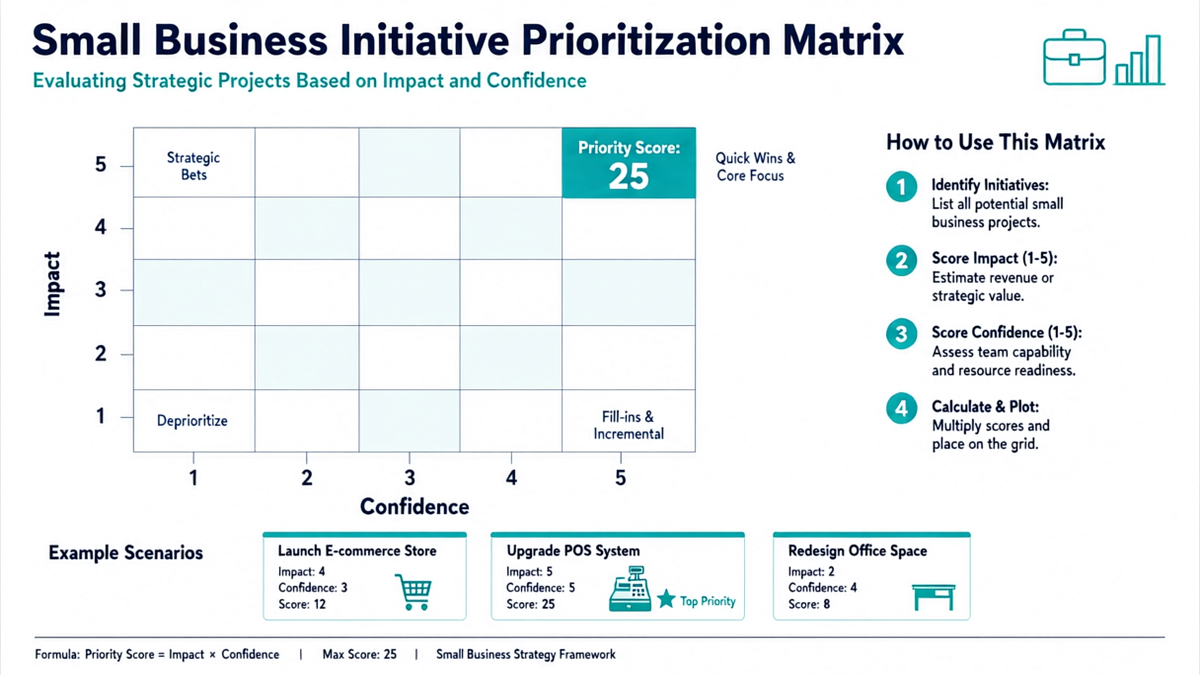
To prioritize a small business swot analysis without guessing, score each item on two 1-5 scales — Impact (how much this affects revenue or risk) and Confidence (how sure you are it’s real) — and multiply the two numbers together. An item scoring Impact 5 x Confidence 5 (25) beats one scoring Impact 5 x Confidence 2 (10) even though both looked equally dramatic on the page before you scored them. Work down the list in order of score, not in order of how loudly each item feels in the moment.
Then write the score down as an actual commitment, not just a number sitting in a spreadsheet cell: people who write down their goals are 42% more likely to achieve them (Dominican University of California). Turn your top two or three scored items into a one-line commitment each — what you’ll do, by when — and put a specific date on your calendar to check it, not just a note in a document you’ll never reopen.
Using a SWOT Analysis for a Small Business Loan or Funding Application
A SWOT analysis for small business belongs in the Company Description or Market Strategy section of a loan application or business plan, because it’s the fastest way to show a lender you understand your own risk before they have to point it out to you. Lenders read dozens of applications a week — a clear-eyed Threats section, written by you before anyone asks, reads as competence rather than confession.
The stakes here are real: only 42% of small business loan applicants receive the full amount of financing they request, and 22% receive none at all (Federal Reserve Small Business Credit Survey). Underwriters are already discounting applications that look unaware of their own weaknesses; a specific, numbered SWOT analysis for small business does the opposite of what most owners fear — it doesn’t expose you, it credentials you. Be specific rather than vague (“98% five-star reviews on Google,” not “great reputation”), quantify wherever the numbers exist, and show at least one line connecting a weakness to how you’re actively addressing it. If you haven’t already documented how customers actually move through your business, a customer journey mapping for small business exercise is a strong input for filling the Opportunities and Threats quadrants with the kind of specific detail lenders respect.
Placement matters too: most lenders expect the SWOT inside or immediately after the Company Description section, ahead of the financials, so it reads as context for the numbers rather than an afterthought tacked onto the back of the document. Keep it to one page. A three-page SWOT analysis for small business buried in appendices signals padding, not diligence — the same three-per-quadrant discipline from the step-by-step process above applies just as much here as it does to your working copy.
How Often Should You Redo Your SWOT Analysis?
A small business should redo its SWOT analysis at least once a year on a fixed calendar date, plus immediately after any major trigger event — a new competitor opening nearby, a large contract won or lost, a pricing change, or a shift in your primary supplier or sales platform. Annual-only reviews miss the events that actually change the picture; trigger-based reviews catch them within the window where the information is still useful for a decision.
Most businesses undershoot this badly: 48% of leaders spend less than one full day each month discussing strategy at all (Spider Strategies). For a small business swot analysis specifically, a good rule is a 20-minute quarterly check against the dated grid you saved in the step-by-step section — did anything move enough to change your top three per quadrant? — with a full redo any time a trigger event hits, regardless of where you are on the calendar.
Trigger events worth naming specifically, because “keep an eye on things” is too vague to act on: a competitor opening within your service radius, a key supplier changing terms or pricing, a platform you depend on for sales or traffic changing its algorithm or fee structure, a lease renewal or rent increase, or losing (or landing) a client that represents more than 15% of revenue. Any one of these is a standalone reason to run a fresh SWOT analysis for small business that week, not wait for the next quarterly check.
Conclusion
A SWOT analysis for small business is only worth the hour it takes if it ends in a decision, not a document sitting in a folder. Run it alone using the step-by-step process above, keep every quadrant to three items backed by a number, score what you find instead of reacting to whichever item feels loudest, and put a date on the calendar for when you’ll check it again. That’s the difference between a SWOT analysis for small business that gathers dust and one that actually changes what you do next — whether that’s a hire, a price change, or the next line in a loan application.
Before you close this tab, a five-point checklist for a SWOT analysis for small business you can trust:
- Every item is backed by a number, a review count, or a specific dated fact — not a feeling
- Each quadrant is cut down to three items, ranked, not a fifteen-item brainstorm
- Someone other than you has reviewed the Weaknesses and Threats lists
- Your top items are scored (Impact x Confidence) and turned into a one-line commitment with a date
- The document itself is dated, saved, and scheduled for a redo — quarterly at minimum, immediately after any trigger event
Run through that list and you have a SWOT analysis for small business that holds up whether it’s read by you next quarter, a mentor next week, or a lender next month.
More from CorporatePlaybookPro.com
→ Business Strategy Frameworks: The Complete Guide for Business Leaders
→ Business Analysis Techniques: The Complete Guide for Business Leaders and Teams
→ What is Six Sigma: The Complete Guide to Quality Excellence (2025)
→ The Art of Business Process Optimization: A Systematic Approach to Operational Excellence
→ AI Maturity Assessment for Small Business: A Simple Self-Scoring Guide
→ What Is Digital Transformation? The Complete Guide for Business Leaders
→ Claude vs ChatGPT for Small Business: Which AI Actually Fits Your Workflow? (2026)
→ How to Use Claude AI for Business: The Complete 2026 Guide
Frequently Asked Questions
What tools can I use to create a SWOT analysis for a small business?
Canva, Google Docs or Sheets, Lucidchart, or Notion all work for a small business SWOT analysis — the tool matters far less than finishing the 2×2 grid and keeping items to three per quadrant. Free tiers of any of these are enough.
Is a SWOT analysis still effective for a small business in 2026?
Yes — the framework’s simplicity is exactly why it survives. A 2026 SWOT analysis for a small business should treat AI-driven competition, tariff-related cost swings, and platform algorithm changes as first-class entries in your Threats and Opportunities quadrants.
How long should a SWOT analysis take for a small business?
A focused small business SWOT analysis takes 45–60 minutes solo, plus a separate 15-minute outside gut-check before you finalize it.
What’s a good SWOT analysis approach for a home-based small business?
Treat blurred work/life boundaries as a specific weakness to name outright — lower overhead is a real strength, but so is burnout risk without a physical office to leave.
Can a SWOT analysis help me decide whether to close a struggling small business?
Yes — it forces you to separate fixable internal weaknesses from external threats you can’t outlast, which clarifies a close-or-continue decision.
How should a seasonal small business handle threats in a SWOT analysis?
Date-stamp the Threats quadrant by season and run a lightweight SWOT at the start of each season rather than relying on one generic annual version.
Should I share my small business SWOT analysis with my employees?
Share Strengths and Opportunities freely; share Weaknesses and Threats selectively with the specific people who can act on each item.
How specific should each item in a small business SWOT analysis be?
Specific enough that a stranger could verify it — a number, a review count, or a dated fact, not an adjective.
What’s the difference between a SWOT analysis and a business plan?
A SWOT analysis is a one-hour diagnostic snapshot; a business plan is a full document covering financials, operations, and market strategy, and the SWOT typically feeds into one section of it.
Can I combine a SWOT analysis with a PESTLE analysis?
Yes — SWOT covers your specific business while PESTLE scans the broader external environment feeding your Opportunities and Threats quadrants.
Should a SWOT analysis include financial numbers?
Wherever possible — numbers turn a vague weakness like ‘thin margins’ into a specific, verifiable one like ‘18% gross margin, down from 24% last year.’
Is there a difference between a personal SWOT analysis and a business SWOT analysis?
The four categories are identical, but a personal SWOT analysis scores an individual while a business SWOT analysis scores the company as a whole.