A customer experience strategy for solopreneurs is a repeatable system — not a to-do list — for how a one-person business earns trust, resolves problems, and keeps clients coming back at every stage of working together, from the first inquiry to the tenth invoice. Unlike enterprise CX programs built around dedicated teams and six-figure platforms, a solo CX strategy has to run entirely inside the hours you already have, using tools you can justify on a single income stream. It is the difference between reacting to whatever a client throws at you today and running a system that quietly protects the relationship whether you’re having a good week or a terrible one.
You’re already answering client emails at 9pm, chasing a testimonial you never got around to requesting, and wondering if that one clipped, slightly annoyed reply to a difficult customer cost you a referral. The common assumption — that real customer experience work requires a CX manager, a helpdesk subscription, and a quarterly survey program — is exactly backwards for a business of one. 81.9% of U.S. small businesses operate with zero employees (Forbes Advisor), which means most CX advice written for teams simply doesn’t apply to the businesses that need it most. This playbook gives you a five-stage customer experience strategy for small business owners, a real tool budget, and a 90-day plan built specifically for one person to run alone — no headcount, no department, no six-figure platform required.
This guide is written for freelancers, consultants, coaches, and small agency owners who handle sales, delivery, and support themselves — anyone whose “customer experience team” is a single inbox and a to-do list. If you’ve ever lost track of whether you followed up with someone, or realized a client renewed with a competitor without ever telling you why, a customer experience strategy for solopreneurs is the missing piece, not a nice-to-have layered on top of everything else you’re already managing.
The Solo CX Framework: A Strategy Any One-Person Business Can Run
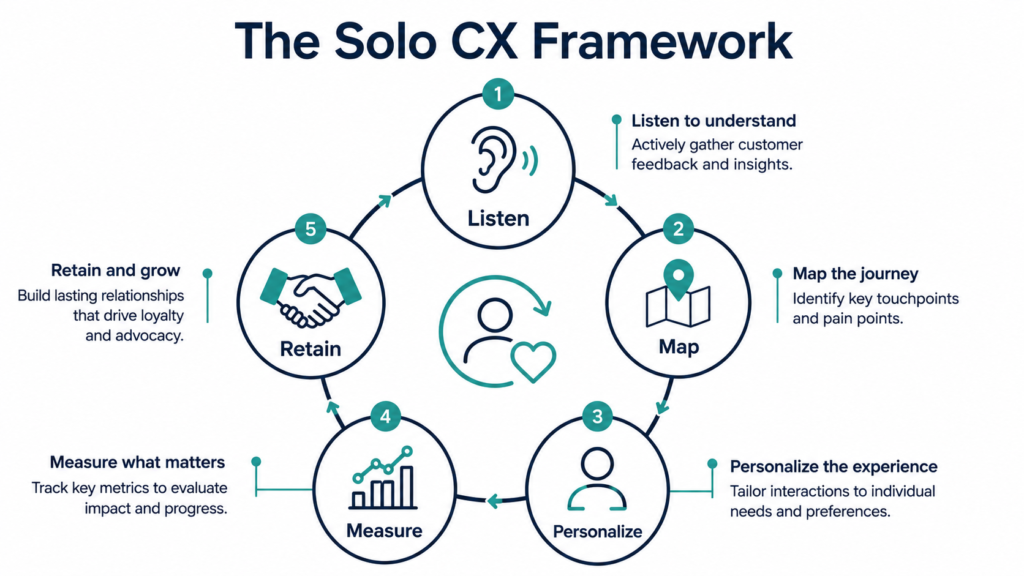
A customer experience strategy framework for solo business owners only works if it survives contact with a day that has no spare hours. The Solo CX Framework breaks the work into five stages — Listen, Map, Personalize, Measure, Retain — each scoped to what one person can realistically execute between client work, not what a ten-person CX team would build. It’s a customer experience strategy for solopreneurs in the truest sense: same outcomes as an enterprise program, a fraction of the overhead, built for a one-person business where every hour spent on process is an hour not spent billing a client.
CX maturity for a business of one doesn’t look like a scorecard with twenty dimensions — it looks like five habits running reliably in the background. A solopreneur one month into this framework might only have Listen and Map running; a solopreneur a year in has all five compounding, and the gap between those two states is almost entirely about consistency, not sophistication.
Nearly 90% of buyers say the experience a company provides matters as much as its products or services (Salesforce) — for a solopreneur competing against businesses with bigger budgets and bigger names, that experience gap is often the only lever you control completely. Customer service, in this context, is the individual interactions; customer experience is the sum of everything a client feels across the entire relationship, and the distinction matters because most solo operators only actively manage the first one while the second one quietly decides whether the client ever comes back.
Even companies famous for customer experience prove this scales down, not just up — Basecamp’s co-founders have written for two decades about personally answering support tickets long after the company had implemented dedicated tools, precisely because direct, personal contact was the advantage they refused to outsource. A solopreneur already has that advantage by default; the framework below just makes sure you don’t waste it.
Listen — capture a client’s real problem before you propose anything. Map — know the exact path a stranger takes from finding you to becoming a repeat client. Personalize — apply what you actually know about a specific person, not a generic script. Measure — track two or three numbers that genuinely predict churn. Retain — turn satisfied clients into referral sources, deliberately rather than by accident. Each stage below stands on its own — implement Listen this week and Retain next quarter, in whatever order matches where your one-person business is currently thinning out most.
→ Full guide: Customer Experience (CX): The Complete Playbook for Business Leaders and Consultants
How to Map the Customer Journey as a Solo Business Owner
How to map the customer journey as a solo business owner starts with writing down the five moments a client actually experiences you — not the moments your marketing describes. Customer journey mapping for small business gets complicated fast when you borrow templates built for multi-department companies, full of swim lanes, persona decks, and stakeholder interviews; a solo operator needs five honest checkpoints and thirty uninterrupted minutes, not a workshop.
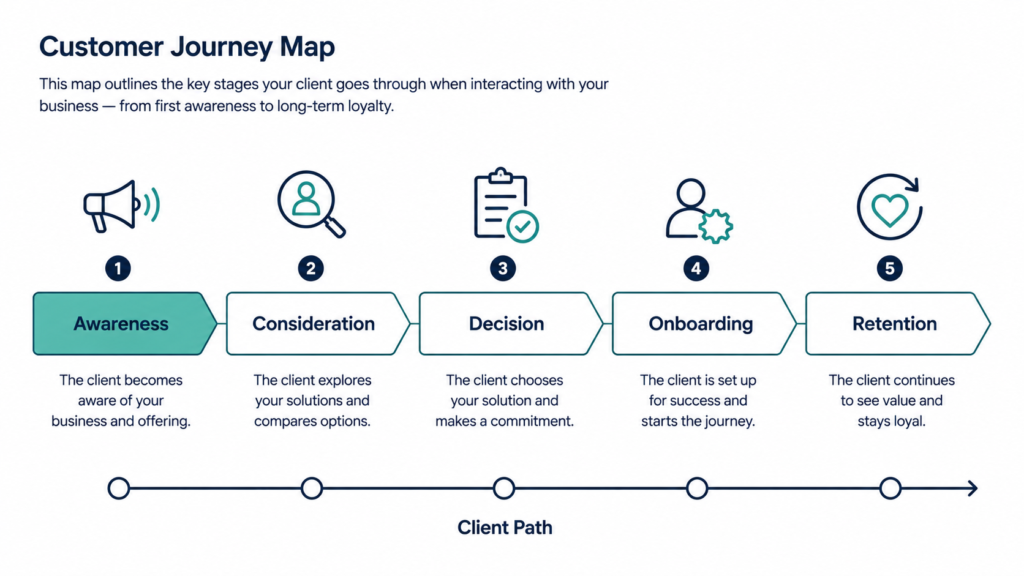
Every client passes through the same rough sequence: an awareness stage where they first hear your name, a consideration stage where they compare you against alternatives (including doing nothing), a decision stage where money changes hands, an onboarding stage where expectations get set, and a retention stage where they either renew or quietly disappear. Mapping means writing down, honestly, what happens — or doesn’t happen — at each touchpoint along that path, in your own business, this month, not in theory.
Most solopreneurs can name their awareness-stage touchpoint instantly — the referral, the search result, the social post — but go blank when asked what happens between “they said yes” and “the project started.” That gap, the one you can’t immediately describe, is usually the exact place a journey map earns its keep.
Build your map in this order:
- Note where clients first hear about you
- List every question they ask before buying
- Write the exact moment they decide to pay
- Record what happens in their first week
- Mark the point they either renew or vanish
- Ask one real client to walk you through it
- Fix the worst gap first, not every gap
1 in 3 customers say they’ll leave a brand they love after a single bad experience (PwC), and for a solopreneur, that single bad experience is usually a mapping gap you never noticed — a follow-up email that never sent, a pricing question left unanswered for four days, an invoice that arrived with no context. Walking your own path as if you were the client, once a quarter, catches these gaps before someone else has to point them out for you, and it costs nothing but the half hour it takes to do it honestly.
Building a Customer Onboarding Process for Solopreneurs
Customer onboarding process for solopreneurs should answer three questions inside the first 24 hours: what happens next, when, and who to contact if something’s unclear. Customer onboarding for small business fails most often not from lack of care but from lack of a repeatable sequence — you remember the welcome sequence for client three but forget it for client eleven because you’re mid-project on someone else’s work and onboarding lives entirely in your memory instead of a document.
Build a single onboarding sequence once — a welcome message, a rough timeline, a clear way to ask questions — and reuse it for every new client without rewriting it from scratch each time. A saved email template or a simple checklist does more for consistency than memory ever will, and it frees your attention for the actual work you were hired to do. This is also where your first real opportunity for personalization lives: swap in the client’s name, their project specifics, and one detail from your discovery call so the template doesn’t read like one, and make sure the first week in particular is over-communicated rather than under-communicated — new clients read silence as a warning sign, even when nothing is wrong.
Write the onboarding sequence once, on a slow day, not in the ten minutes after a new client signs — that’s exactly when it gets rushed, generic, and forgettable. Treat it as a small, reusable asset you’re building for every future client, not a one-off email you’re sending to this one.
Building a Customer Feedback System for Solopreneurs Without a Team
Customer feedback system for solopreneurs without a team means one short question, asked consistently, beats an elaborate survey asked never. Most solo operators either skip feedback entirely — too busy, too nervous about the answer — or overbuild it with a twelve-question form nobody finishes. Customer feedback strategy for small business owners works best as a single, standing habit attached to something you already do every week, rather than a separate initiative competing for the same limited hours as client work.
Three feedback moments that fit into a solo workflow without adding a new task to your list:
- Ask one direct question at project delivery: “What’s one thing I could have done better?”
- Send a short post-purchase survey — two questions — 30 days after a purchase or engagement ends
- Read your own reviews and DMs monthly, and reply to every single one, positive or negative
The goal isn’t a dashboard — it’s a running log, even a plain document, of what direct client feedback actually says versus what you assumed clients would say. Patterns show up after five or six responses, and that’s usually enough signal for a business your size to act on. Ask early, ask briefly, and always ask before the relationship formally ends, not after — a client who has already moved on rarely answers, and the feedback you need most is the kind you have to go looking for.
Feedback is also the cheapest research a solopreneur will ever do. A customer experience strategy for solopreneurs that skips this stage ends up guessing at what clients value, and guessing is expensive — it means investing time in polish nobody asked for while the actual friction point, often something small like invoice clarity or response speed, goes unaddressed for months.
Affordable Customer Experience Tools for Solopreneurs on a Budget
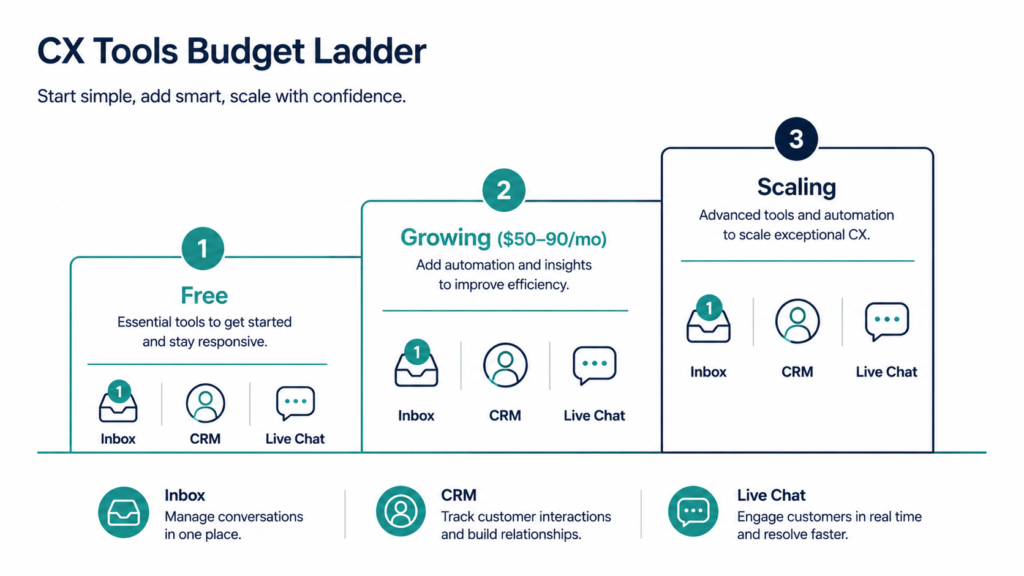
Affordable customer experience tools for solopreneurs on a budget means picking the free or entry tier of one tool per job — inbox, scheduling, feedback — rather than a bundled enterprise suite priced for a department that doesn’t exist in your business. Customer experience tools for small business are often marketed with contact-center features — queue routing, multi-seat licensing, advanced reporting dashboards — a one-person operation will never touch; you end up paying for headcount you don’t have and never will at this stage.
| Job to be done | Free / low-cost option | When to upgrade |
|---|---|---|
| Centralized inbox | Free-tier helpdesk software or a shared inbox tool | When you’re missing messages across 3+ channels weekly |
| Client relationship tracking | Free-tier CRM (contacts, notes, reminders) | When you can’t recall a client’s history from memory alone |
| Live chat / instant reply | Free live chat widget on your site | When chat volume exceeds a few conversations a day |
| Feedback collection | A free form tool with 2–3 questions | When you need an automation workflow for post-purchase sequencing |
| Self-service answers | A static FAQ page | When repeat questions justify a searchable knowledge base |
Start at the free tier for every category, and upgrade only the single tool that’s costing you real time each week — never the whole stack at once, and never because a sales email suggested it. That’s what a genuinely affordable customer experience strategy for small business looks like in practice: spend that scales with actual usage, not capacity you’re buying on the hope you’ll grow into it someday.
How Much Does Customer Experience Software Cost for a Small Business?
How much does customer experience software cost for a small business depends entirely on seat count and add-ons, but a genuinely solo setup — one shared inbox helpdesk software plan, one lightweight CRM, one chat widget — typically runs free to around $50–$90 a month once you outgrow the free tiers each tool offers. Customer experience software pricing scales sharply with “team” features rather than with the volume a single person actually needs, and a basic automation workflow connecting your form tool to your inbox rarely costs anything extra at this scale.
The practical rule: if a plan’s price jumps because of a feature description that includes the word “team,” “seats,” or “agents,” you’re paying for infrastructure built for a business that isn’t yours yet, and probably won’t be for a while. Re-evaluate your tool stack every 90 days on a fixed schedule, not every time a sales email arrives promising a discount if you upgrade this week.
Most solopreneurs overspend here not out of carelessness but because vendor pricing pages are built to make the mid-tier plan look like the obvious, safe choice. Read the feature list literally: if a listed feature doesn’t correspond to a task you personally do every week, you don’t need the plan that includes it, no matter how the comparison table is designed to make you feel about the free tier.
How to Personalize Customer Experience With Limited Time and Resources
How to personalize customer experience with limited time and resources comes down to reusing three or four pieces of information you already have about a client — not gathering more of it. Personalized customer experience for small business owners doesn’t require a data platform; it requires a habit of glancing at your notes for thirty seconds before you hit send on anything.
Before any client call or email, check for: their name, spelled correctly, always; their last stated priority; one detail from a previous conversation; and their preferred communication channel. That’s the whole system. Solopreneurs already have a structural advantage here that larger companies spend real money trying to simulate through CRM tagging and segmentation — you likely know your clients’ actual preferences as individuals because you deal with every single one of them directly, and that kind of personal touch is genuinely difficult for a business with a rotating support queue to replicate at scale.
Personalization at this scale isn’t about grand gestures — it’s about not making a client repeat information they already gave you. Referencing a detail from three emails ago signals more genuine attention than an expensive gift ever could, and it costs you nothing but the habit of actually reading your own notes before you reply. A short “client preferences” line at the top of each contact record — how they like to be contacted, what they’ve complained about before, what they’ve praised — turns this from something you have to remember into something you simply check.
How to Build Customer Trust as a Solopreneur With No Reviews Yet
How to build customer trust as a solopreneur with no reviews yet means substituting specificity for the social proof and credibility signal you haven’t earned yet. Building customer trust for small business owners without a track record works through three levers: transparent pricing shown upfront with no hidden steps, a clear description of exactly what happens after someone books or buys, and prompt, honest replies — including admitting openly when you don’t know something yet rather than guessing.
Ask your first three clients directly for a short testimonial once the work is delivered and they’re genuinely satisfied; most will say yes if you make it a two-minute ask with a specific question (“What result surprised you most?”) rather than a vague “leave us a review” that people tend to postpone indefinitely. Trust compounds over time — the goal in month one isn’t ten reviews, it’s one honest, specific one you can point a hesitant new prospect toward.
Customer Experience Metrics Small Business Owners Should Track
Customer experience metrics small business owners should track start with two numbers, not ten: a simple satisfaction score after each engagement, and how many clients return or refer within twelve months. Customer experience KPIs for small business are frequently borrowed wholesale from enterprise dashboards — first-contact resolution rate, average handle time, ticket deflection rate — metrics that assume a support queue and a reporting team you don’t operate.
| Metric | What it tells you | How a solopreneur tracks it |
|---|---|---|
| CSAT (satisfaction score) | Was this specific interaction good enough? | One question, 1–5 scale, sent after delivery |
| NPS-style referral question | Would they recommend you to someone else? | Ask once per client relationship, log the answer |
| Repeat/referral rate | Are relationships compounding or staying one-off? | Track manually in a spreadsheet or CRM tag |
| First response time | Are people waiting too long to hear back from you? | Spot-check your own inbox weekly, honestly |
Review these four numbers monthly, on a fixed date, so it becomes a habit rather than a task you keep quietly postponing. A dip in any one of them is your earliest warning that something upstream in the framework — mapping, personalization, or the feedback loop — needs attention before a client actually leaves rather than after.
Resist the urge to track more than four numbers when you’re running a customer experience strategy for solopreneurs alone. Every additional metric is another spreadsheet column you’ll eventually stop updating, and a metric nobody looks at is worse than no metric at all — it creates the illusion of measurement without the substance of it.
Customer Retention Strategy for Solopreneurs and One-Person Businesses
Customer retention strategy for solopreneurs and one-person businesses matters more than acquisition strategy for a simple, well-documented reason: acquiring a new customer can cost 5 to 25 times more than keeping an existing one (Harvard Business Review). Customer retention strategies for small business owners rarely need to be complicated to work — they need to be consistent, which is precisely the part solo operators drop first the moment things get busy.
Three retention habits that don’t require new software or a bigger budget: check in with past clients on a fixed cadence — a quarterly email, no pitch attached — to keep the relationship warm; make renewing or rebooking noticeably easier than starting fresh with a stranger; and tell long-term clients about changes to your process or pricing before they notice on their own. At this scale, retention is mostly about consistently not disappearing between projects, which sounds simple and is exactly why most solo operators still get it wrong.
Repeat customers are also the fastest way to grow without spending on acquisition at all — a client who already trusts you needs far less convincing than a stranger, and a healthy referral rate compounds that further by putting your name in front of prospects who arrive half-sold before you ever speak to them.
How to Handle Negative Reviews as a Small Business Owner
How to handle negative reviews as a small business owner starts with responding publicly, briefly, and without defensiveness — ideally within 24 to 48 hours. Responding to negative reviews for small business owners is a visible trust signal to every future prospect reading that page, not just to the unhappy reviewer; how you handle criticism in public often matters more to a stranger deciding whether to hire you than the original complaint itself.
Acknowledge the specific issue by name, state clearly what you’ll do differently or offer to make it right, and move the detailed back-and-forth to a private message rather than a public thread. Never argue in public, and never simply ignore it as a review recovery strategy — an unanswered negative review reads as quiet confirmation to everyone who reads it after the reviewer has moved on.
A calm, specific public response often does more for your credibility than the string of five-star reviews around it, because it’s the one piece of evidence a hesitant prospect can use to predict how you’ll treat them if something goes wrong on their project too.
Self-Service Customer Support Setup for Solo Entrepreneurs
Self-service customer support setup for solo entrepreneurs means building one page that answers your ten most-asked questions, so clients can help themselves before you’re even awake. Self-service customer support for small business owners is arguably the single highest-leverage move on this entire list, because it reduces incoming message volume without you touching a single reply.
Set it up in four steps:
- List your ten most repeated client questions
- Write one clear, direct answer to each one
- Publish them as a simple FAQ page or a lightweight knowledge base on your site
- Link to it in your onboarding sequence and your email signature
Update the page every time a new question repeats three times in a month — that’s your reliable signal it belongs there permanently. This single page routinely eliminates a meaningful share of routine questions before they ever reach your inbox, which is time you get back for the client work that actually generates revenue.
Self-service is the one part of a customer experience strategy for solopreneurs that keeps working while you sleep, travel, or focus on a single demanding project — it’s infrastructure you build once and it keeps paying you back in reclaimed hours every single week after. Resist the urge to make it exhaustive on day one; ten genuinely useful answers beat forty half-written ones that nobody reads past the third bullet.
Common Customer Experience Mistakes Small Business Owners Make
Common customer experience mistakes small business owners make usually trace back to doing everything reactively — replying only once a client complains, asking for feedback only after a project has already gone sideways instead of building it into the normal workflow. Customer experience mistakes to avoid start with treating CX as a single email template rather than a full-relationship system that covers onboarding through renewal.
The five most common, in order of how often they show up in a rushed CX audit: no onboarding sequence at all, so every new client starts from a blank page; no feedback loop until something has already broken; copying tools built for teams instead of solo operators and paying for capacity you don’t use; ignoring negative reviews instead of responding to them; and measuring nothing at all until revenue drops with no data available to explain why. None of these require a big fix — most are a quick win once you’ve actually named them.
Every one of these mistakes is a symptom of the same root cause: a customer experience strategy for solopreneurs that only exists in your head instead of somewhere you can actually check it, update it, and hand it to your future, busier self. Writing any single piece of it down — even just the onboarding email — is the fix for most of the list above.
Customer Experience Checklist for Small Business Owners
Customer experience checklist for small business owners, to run as a monthly review:
- Onboarding sequence sent to every new client this month — check
- Feedback asked at delivery and again 30 days later — check
- Four core metrics reviewed on the fixed date — check
- Every review, positive or negative, answered — check
- FAQ page updated with any newly repeated question — check
A customer service checklist for small business owners like this one takes about fifteen minutes as a quarterly audit and reliably catches the drift that causes most of the mistakes above before they compound into an actually lost client.
Your 90-Day Customer Experience Implementation Plan for Small Business Owners
Your 90-day customer experience implementation plan for small business owners rolls the framework out across three manageable phases instead of trying to fix everything the same week. A 30-60-90 rollout timeline matters more than raw speed here — a solo operator who tries to launch all five framework stages simultaneously usually abandons all five within a month, exhausted before any of them become habit.
Days 1–30: Build your onboarding sequence and your customer journey map. These two alone fix the most common first-impression gaps that quietly cost referrals.
Days 31–60: Set up your feedback loop and publish your self-service FAQ page. You’re now capturing real signal and reducing incoming volume at the same time, with almost no added daily effort.
Days 61–90: Choose your four metrics, start the monthly review habit on a fixed date, and run your first structured retention check-in with past clients who haven’t heard from you recently.
By day 90 you have a working customer experience strategy for small business — not a binder nobody opens, a system that runs quietly in the background of a business that’s still just you, one person, doing the work that pays.
Running this framework alongside AI-assisted workflows can multiply the time savings even further — see Claude AI for Solopreneurs: The One-Person Operator’s Setup Guide for how to automate the onboarding and feedback steps covered above. If your business is scaling past a single operator, Why Customer Centricity Should Drive Digital Transformation covers the next stage of this journey, and Voice-First Customer Experience explores where conversational AI fits once volume outgrows a single inbox.
A customer experience strategy for solopreneurs isn’t about matching what a large company can spend on CX software or headcount — it’s about being deliberate with the direct client access a one-person business already has by default. Start with one stage of the framework this week, not all five at once. The businesses that outlast their competitors on customer experience for small business owners generally aren’t the ones with the biggest CX budget; they’re the ones who never let a client wonder, even once, where they stand.
Pick the single weakest stage from the five above — the one you winced at while reading — and give it thirty minutes before the week is out. A customer experience strategy for small business only becomes real once one piece of it exists outside your head, and the framework works exactly as well as the first stage you actually finish. Momentum here beats completeness every time; a half-built onboarding sequence you actually send is worth more than a perfect five-stage system that only ever lives in a notes app.
Frequently Asked Questions
Can one person really deliver good customer experience alone?
Yes — solopreneurs often deliver better customer experience than larger competitors precisely because every interaction goes through one consistent person instead of a rotating support queue. The challenge isn’t capability, it’s consistency: without a repeatable system, quality varies with how busy or tired you are on a given day. A structured customer experience strategy for solopreneurs closes that gap by turning good instincts into a repeatable process.
What is the difference between customer service and customer experience?
Customer service is the individual interactions — a reply, a call, a resolved issue. Customer experience is the cumulative feeling a client has across the entire relationship, from their first email to their tenth renewal. A small business can deliver excellent customer service in isolated moments while still having a poor overall customer experience if onboarding, follow-up, or consistency is missing between those moments.
How often should a solopreneur ask for customer feedback?
Twice per client relationship at minimum: once at project delivery with a single direct question, and once about 30 days after the engagement ends. Asking more often than that risks feeling like a survey burden; asking less often means you miss the window while the experience is still fresh in the client’s mind. This cadence is deliberately light so it never competes with actual client work for your time.
What is a good customer satisfaction score for a small business?
On a simple 1–5 CSAT scale, a small business should aim for an average around 4.5 or higher, since solo operators typically serve far fewer, more relationship-based clients than a large company’s support queue. Any score below 4 on an individual response is worth a direct follow-up conversation, not just a note in a spreadsheet. Trends matter more than any single score — a slow decline over three months is a stronger signal than one low outlier.
Do I need a CRM if I only have a handful of clients?
If you can currently recall every client’s history, preferences, and last conversation from memory, a simple spreadsheet is enough. Once you’re mid-project juggling five or more active relationships, a free-tier CRM prevents the memory gaps that erode personalization — forgetting a detail a client already told you is one of the fastest ways to make a relationship feel less attentive than it actually is.
How do I map a customer journey when I have no formal training in CX?
You don’t need training — you need to honestly write down five moments: how clients find you, what they ask before buying, how they pay, what happens their first week, and whether they renew. This is exactly how to map the customer journey as a solo business owner without a consulting background: walk your own process as if you were the client and note every gap you notice along the way.
What should a solopreneur include in a client onboarding email sequence?
A solid customer onboarding process for solopreneurs needs four elements in the first email: a warm welcome that uses the client’s name and project specifics, a rough timeline of what happens next, a clear point of contact for questions, and one detail from your discovery call that shows you were listening. Build it once as a reusable template rather than writing it fresh for every new client.
How much should a solo consultant budget monthly for customer experience tools?
Most genuinely solo setups run entirely on free tiers until client volume grows, then typically land between $50 and $90 a month once a shared inbox, a lightweight CRM, and a chat widget are combined. Affordable customer experience tools for solopreneurs on a budget means upgrading one tool at a time, only when it’s costing real hours weekly — never the whole stack at once.
Should I respond publicly or privately to a negative review as a one-person business?
Both — respond publicly first with a brief, non-defensive acknowledgment of the specific issue, then move detailed back-and-forth to a private message. This is the core of how to handle negative reviews as a small business owner: the public response is really for future prospects reading the page, not just the original reviewer, so it needs to be calm and specific rather than lengthy.
How do I build a self-service FAQ page with no technical or design skills?
List your ten most repeated client questions, write one direct answer to each, and publish them as a plain page on whatever website builder you already use — no special tooling required. This self-service customer support setup for solo entrepreneurs works with the simplest possible page; update it whenever a new question repeats three times rather than trying to anticipate every question up front.
What are the best customer experience tools for small business owners?
The best customer experience tools for small business are the free or entry-tier versions of a shared inbox, a lightweight CRM, and a live chat widget — not the enterprise suites built for support teams with multiple seats. Match each tool to one specific job, and resist bundled platforms priced for headcount you don’t have.
What are common customer retention strategies for small business?
Common customer retention strategies for small business include a fixed-cadence check-in with past clients, making renewal easier than starting fresh with someone new, and proactively communicating changes before clients notice them independently. For a solopreneur, retention is less about loyalty programs and more about simply not disappearing between projects.
How do you measure customer experience KPIs for small business?
Customer experience KPIs for small business owners come down to four trackable numbers: a satisfaction score after delivery, a referral-likelihood question, a repeat/referral rate, and first response time. Review all four monthly on a fixed date rather than sporadically — consistency in tracking matters more than the sophistication of the metric itself.