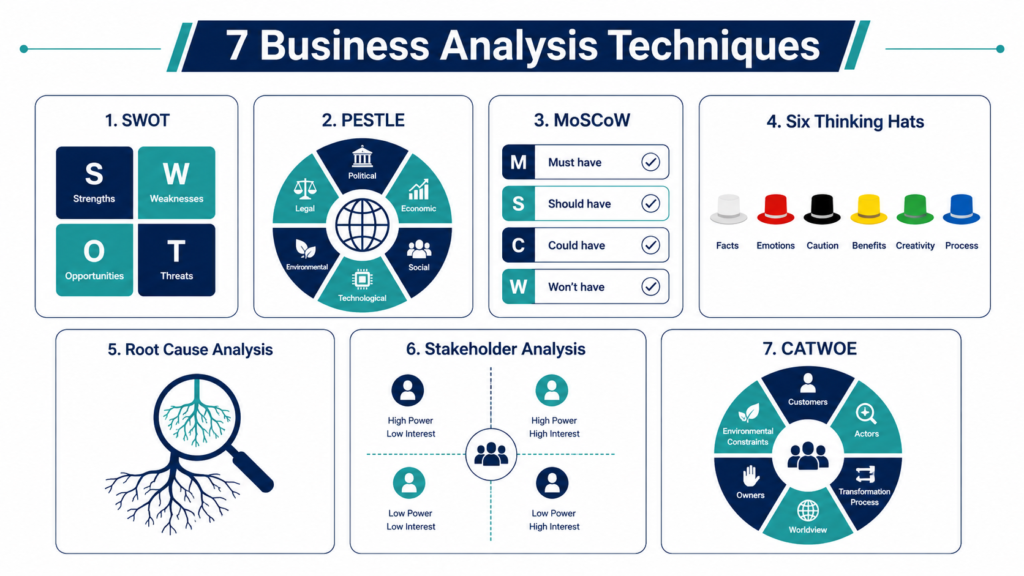
Business analysis techniques are structured methods for examining a business problem, decision, or change before you commit to it — frameworks like SWOT, PESTLE, MoSCoW, root cause analysis, stakeholder analysis, Six Thinking Hats, and CATWOE that turn scattered opinions into an organized picture you can act on. Each technique gives a decision a repeatable shape: what to look at, in what order, and what question to answer before moving. Business analysis techniques for business leaders and teams differ from analyst-certification material in one important way — they’re designed to be run by the person who owns the decision, not delegated to a specialist.
Here’s the situation that probably brought you to this page. You’re facing a call that matters — a market entry, a shrinking budget, a reorg, a product line that keeps missing dates — and the decision process so far has been a meeting, a spreadsheet, and a gut feeling. You’re not alone, and the data says the gut-feel approach is failing quietly across the board: only 20% of executives say their organizations excel at decision making (McKinsey), while 47% of unsuccessful projects fail due to poor requirements management (PMI). The common misconception is that fixing this requires hiring a business analyst or sending someone off for certification. It doesn’t. Bain’s research on nearly 800 companies found a 95% correlation between decision effectiveness and top-tier financial results (Bain & Company) — and the techniques that drive that effectiveness take an afternoon to learn.
This guide covers seven core techniques, a worked example for each, a straight answer on which to use when, and a step-by-step walkthrough for running your first session. By the end you’ll know exactly which technique fits the decision on your desk this week.
Why Business Analysis Techniques for Decision Making Beat Gut Instinct
Business analysis techniques for decision making outperform instinct for one simple reason: they force a decision out of someone’s head and onto a page, where it can be checked, challenged, and improved before it becomes a commitment. Instinct is fast but unexaminable. A framework is slightly slower and completely visible — every assumption sits in the open where a colleague can point at it and say “that’s not true anymore.”
The cost of unstructured deciding is measurable. McKinsey estimates that for a typical Fortune 500 company, ineffective decision making burns about 530,000 days of managers’ time a year — roughly $250 million in annual wages (McKinsey). You don’t need Fortune 500 scale to feel a proportional version of that. Every re-litigated priority call, every project post-mortem that blames “communication,” every strategy meeting that ends where it started — that’s the same waste at your scale.
Formal business analysis methods attack the problem at its root. They don’t replace your judgment — you still make the call. What changes is the input quality: instead of deciding on whichever facts happened to come up in conversation, you decide on a deliberately assembled picture. That’s the entire promise of structured decision making, and it’s why consultancies charge so much to run these exact exercises for their clients.
There’s a second, quieter benefit that shows up after a few sessions: shared language. Once your leadership team has run a SWOT and a MoSCoW together, “that’s a should-have, not a must-have” becomes a sentence everyone understands instantly — and a whole class of recurring arguments collapses into a vocabulary. Teams that adopt business analysis techniques as working habits don’t just make individual decisions better; they compress the time every future decision takes, because the negotiation about how to decide has already happened.
A note on logistics before the toolkit itself, because it applies to all seven techniques: most of them need fewer people than instinct suggests. Three to six participants who each see a genuinely different part of the business produce better output than a twelve-person meeting where half the room stays quiet. Budget 45 to 90 minutes depending on the technique, and always assign one person to write — a session that produces only conversation evaporates the moment everyone leaves the room.
Types of Business Analysis Techniques Every Leader Should Know
The types of business analysis techniques every leader should know fall into three working groups. Situation-scanning techniques — SWOT and PESTLE — map where you stand, internally and externally. Prioritization and decision techniques — MoSCoW and Six Thinking Hats — structure what to do next and how to discuss it. Diagnostic and change techniques — root cause analysis, stakeholder analysis, and CATWOE — dig into why problems recur and whether a change will actually stick.
Professional bodies catalogue far more — the BABOK guide lists around 50 business analysis tools and techniques — but most are built for full-time analysts documenting software requirements. The seven in this guide are the subset a business leader, CTO, or strategy consultant can run personally, without training, and get value from the same day. If you learn only these seven, you can put structure around practically any decision a growing business faces.
What are the five most-used techniques, since that’s the version of the question searchers ask most? SWOT, PESTLE, MoSCoW, root cause analysis, and stakeholder analysis cover the overwhelming majority of real leadership situations. Six Thinking Hats and CATWOE are the two specialists — one for conversations that go in circles, one for changes that cross departmental lines. This guide covers all seven because the two specialists solve exactly the problems the big five leave behind.
SWOT Analysis in Business Analysis
SWOT analysis in business analysis is a four-quadrant scan of your Strengths, Weaknesses, Opportunities, and Threats — the fastest way to get a scattered set of opinions about a business onto one page. Strengths and weaknesses are internal: your team, product, cost structure. Opportunities and threats are external: competitor moves, regulation, market shifts. It’s the first technique most leaders learn, and the one most misuse.
The misuse is stopping at adjectives. “Strong team” and “rising costs” are not analysis — they’re wall decoration. A useful SWOT analysis framework forces specificity: not “strong team” but “the only team in our market with in-house compliance expertise.” One is a mood; the other is something you can build a strategy around. The discipline matters more than ever because decisions keep getting harder to hold in one head: 65% of decisions now involve more stakeholders or choices than they did two years ago (Gartner). A one-page map of internal and external factors is the cheapest antidote to that complexity.
Treat SWOT as an input, never a conclusion. Once the quadrants are mapped, the output feeds the next technique — a MoSCoW pass on what to act on first, or a stakeholder map of who needs to buy in. Run it before any significant strategic commitment and refresh it at least yearly; an eighteen-month-old SWOT describes a company that no longer exists.
Sequence matters inside the session too. Start with strengths and weaknesses — the internal half — because the room warms up faster on facts it controls, then move outward to opportunities and threats once the honest tone is established. Reverse the order and the conversation tends to drift into speculation about competitors before anyone has admitted an uncomfortable truth about the business itself.
SWOT Analysis Example for Business Decision Making
Here’s a SWOT analysis example for business decision making from a mid-sized logistics firm weighing a fleet upgrade. First pass, the room produced generic entries: “experienced drivers” (strength), “old vehicles” (weakness). Pushed for numbers, the same room landed on “average driver tenure of 7 years against a 2-year industry norm” and “38% of the fleet past optimal replacement age, with maintenance cost per mile up 22% in two years.” Opportunities: a competitor’s service failures in two regions. Threats: a fuel-cost regulation arriving within 18 months.
Notice what the specific version enables. The tenure figure became a hiring pitch. The fleet numbers became a replacement business case the CFO could actually evaluate. The generic version supported neither. If you use a SWOT analysis template, add one rule to it: every entry needs a number, a name, or a date — anything without one goes back for rework. That single rule converts SWOT from a feel-good exercise into competitive position evidence.
→ Full guide: SWOT Analysis for Small Business: How to Use It to Make Better Decisions (coming soon)
PESTLE Analysis in Business Analysis
PESTLE analysis in business analysis structures the outside world into six lenses — Political, Economic, Social, Technological, Legal, Environmental — and walks you through them one at a time. Where SWOT tells you an external threat exists, PESTLE tells you which category it belongs to and roughly how much warning you’ll get. Tax policy (Political) telegraphs itself months ahead; customer sentiment (Social) can turn in weeks.
The lens-by-lens walk is the value. Most teams have someone watching technology and someone watching the economy; almost nobody is assigned to legal drift or environmental exposure until one of them bites. A quarterly pass through a PESTLE analysis framework catches the slow-moving risk nobody owns. CTOs get particular value here before entering regulated territory — healthcare data, financial services, anything with compliance overhead — where the Legal lens alone can reshape the plan. The same external environment scan also feeds bigger initiatives: if a transformation program is on your roadmap, the sobering base rate — transformation efforts fail roughly 70% of the time (McKinsey) — argues for scanning the terrain before you commit, and pairing the scan with a proper digital transformation roadmap.
Don’t treat the six-box worksheet as the output. The output is the discipline of checking a lens you’d otherwise skip — and the short list of dated, owned risks that comes out of it.
PESTLE also pairs naturally with SWOT, and the pairing order is fixed: PESTLE first, SWOT second. The external scan populates SWOT’s opportunities and threats quadrants with researched entries instead of guesses, which upgrades the whole exercise. Run them as back-to-back sessions a week apart and you have a genuinely defensible situational picture for the cost of three meeting slots.
PESTLE Analysis Example for Strategic Planning
A concrete PESTLE analysis example for strategic planning: a B2B software firm considering a move into the EU healthcare market ran all six lenses in a 90-minute session. Political: procurement rules favoring EU-hosted vendors. Economic: hospital budget cycles locking purchases to Q4. Social: clinician resistance to new tooling after a wave of failed rollouts. Technological: interoperability standards (HL7/FHIR) as a hard entry requirement. Legal: GDPR plus the EU AI Act’s health provisions. Environmental: sustainability reporting now appearing in tender scoring.
Two of those six — the interoperability requirement and the tender sustainability criteria — were completely absent from the company’s draft plan. Finding two plan-changing macro factors in ninety minutes is a typical result the first time a team does this deliberately. A PESTLE analysis template helps, but the non-negotiable part is assigning each identified risk an owner and a review date; an unowned risk list is just a longer way of writing “we knew.”
→ Full guide: PESTLE Analysis Explained: How to Assess External Risks for Your Business (coming soon)
MoSCoW Method in Business Analysis
The MoSCoW method in business analysis sorts any list of competing demands into four explicit buckets. Run it in four steps:
- List every candidate item — features, projects, requirements.
- Sort each into Must have, Should have, Could have, Won’t have.
- Cap the Must bucket at roughly 60% of capacity.
- Write the Won’t-have list down — with reasons.
The fourth category is the whole trick. “Won’t have this time” is a documented decision, not a quiet omission — and it’s what prevents the three-months-later argument about why something never got done. Requirements chaos is expensive in a very countable way: organizations waste $51 million for every $1 billion spent on projects due to poor requirements management (PMI). MoSCoW prioritization is the lightest-weight tool that attacks that waste directly, because it makes scope control a visible group decision instead of a silent accumulation.
Watch for the classic failure mode: everything migrates into Must the moment its sponsor speaks up loudly enough. Hold the 60% cap. A Must list that covers 100% of capacity is just the old unprioritized list wearing a new name. A useful forcing question for every contested item: “what breaks, and for whom, if this ships next quarter instead of this one?” If the answer is silence or vagueness, it isn’t a Must — and asking it out loud spares you from arbitrating the argument personally.
MoSCoW Prioritization Example for Project Requirements
A working MoSCoW prioritization example for project requirements: a 14-person SaaS team lost a third of its engineering capacity to a hiring freeze with 12 roadmap items in flight. A forty-minute session produced: Must — the two client-facing commitments with contractual dates and the security patch backlog. Should — the onboarding flow rebuild, if capacity allowed. Could — two internal dashboards. Won’t (this quarter) — five items, each with a one-line reason, including the CEO’s pet reporting feature.
Writing that last line in front of the whole team ended the debate in a way that quiet neglect never does. When the CEO asked about the feature six weeks later, the answer was a documented decision with a revisit date — not an awkward silence. That’s the difference between a MoSCoW method example on paper and requirements prioritization as an actual operating habit: the Won’t list does more work than the Must list.
→ Full guide: MoSCoW Method: How to Prioritize Business Requirements That Actually Matter (coming soon)
Six Thinking Hats Technique in Business Analysis
The Six Thinking Hats technique in business analysis fixes a failure mode every leader has watched: five people arguing from five different angles at once, so the loudest register wins. Edward de Bono’s format has the whole room wear one “hat” at a time — facts (white), emotion (red), caution (black), optimism (yellow), creativity (green), and process control (blue) — so disagreement happens within one mode of thinking instead of across all of them simultaneously.
The problem it solves is bigger than it looks. In a survey of 182 senior managers, 71% said meetings are unproductive and inefficient (Harvard Business Review) — and circular, multi-register argument is a leading reason why. The Six Thinking Hats method replaces the circle with a sequence: five minutes purely on numbers, five purely on risks, five purely on upside, each person contributing to the same lens rather than defending a fixed position. It’s parallel thinking in the most literal sense.
Use it for the decisions that historically go sideways in your team — the ones where the optimist and the skeptic have repeated the same exchange for a month. Thirty structured minutes usually covers more ground than four unstructured hours, and it de-personalizes the caution: the black hat criticizes because it’s the black hat’s turn, not because someone is “being negative.”
Six Thinking Hats Example for Team Decision Making
A Six Thinking Hats example for team decision making: a leadership team split for weeks on whether to sunset a legacy product line ran the full sequence in thirty-five minutes. White hat: the line was 11% of revenue, 31% of support tickets, and shrinking 8% yearly. Red hat: the founder admitted the product felt like “selling the family house” — said aloud, the sentiment lost half its grip on the debate. Black hat: three enterprise contracts had renewal clauses tied to the product. Yellow hat: freed capacity would cover the roadmap gap from the last planning cycle. Green hat: someone proposed a maintenance-mode licensing deal with a partner — an option nobody had raised in a month of argument. Blue hat kept time and captured actions.
The outcome mattered less than the shape of the conversation: every angle got its turn, including the emotional one that had been silently steering everything. That’s what a good Six Thinking Hats example demonstrates — the technique doesn’t suppress group decisions dynamics, it schedules them.
→ Full guide: Six Thinking Hats: How to Use De Bono’s Method for Better Team Decisions (coming soon)
Root Cause Analysis in Business Analysis
Root cause analysis in business analysis exists because most “fixed” business problems come back within a quarter — the fix treated a symptom, not the mechanism underneath. The simplest version, the 5 Whys, asks “why” repeatedly against a problem statement until the answers stop describing circumstances and start describing a process gap. The pattern is everywhere once you look: 47% of unsuccessful projects fail due to poor requirements management (PMI) — and “poor requirements” is itself usually a symptom of an unowned step somebody never traced.
Two root cause analysis methods cover most leadership needs. The 5 Whys handles single-thread problems fast. The fishbone diagram handles messier ones — it maps a problem against categories like people, process, technology, and environment so a multi-cause issue doesn’t get pinned on a single scapegoat. A CTO investigating repeat production incidents might discover that “engineer error” (people) is really downstream of “no staging environment matching production” (technology) — a more useful and less blame-shaped place to aim the fix. For the full statistical treatment of process quality, that’s DMAIC territory — covered in our Six Sigma complete guide; the standalone techniques here are the right scale for everyday leadership problems.
One warning: tone decides everything. Run a Whys session as an interrogation of the person whose name surfaces at why number three, and your team learns to hide problems instead of reporting them. Frame every question as “why did the process allow this,” never “why did you do this.”
5 Whys Root Cause Analysis Example in Business
A standard 5 Whys root cause analysis example in business: a consultancy missed a client deadline. Why? The final report was late. Why? The data arrived two days after its internal deadline. Why? The provider wasn’t chased. Why? Nobody owned the follow-up. Why? The handoff between account manager and analyst has no assigned owner for third-party dependencies. Five questions, and the fix — assign a named owner to every external dependency at project kickoff — is structural, cheap, and permanent.
Compare that with the fix the team almost shipped after “why” number one: “start the report earlier.” That would have absorbed the same failure again with more slack in it. A good 5 Whys example always shows this contrast — the first answer produces effort, the fifth produces a system change. Keep sessions to fifteen minutes and stop when the answer becomes a fixable process gap; going past that point usually yields philosophy, not action.
→ Full guide: Root Cause Analysis for Small Business: The 5 Whys Method Explained (coming soon)
Stakeholder Analysis in Business Analysis
Stakeholder analysis in business analysis answers the question that sinks more initiatives than any technical failure: who actually needs to be on board for this to work, and who’s being ignored until it’s too late? The core tool is a two-axis grid — each stakeholder plotted by influence over the outcome and interest in it. High influence, high interest: manage closely as partners. High influence, low interest: keep satisfied without drowning them in detail. Low influence, high interest: keep informed. Low both: monitor.
The technique earns its place through the change-failure statistics. With roughly 70% of transformation efforts failing (McKinsey) — and people-side resistance a dominant cause — stakeholder mapping is the cheapest insurance available. Most stakeholder disasters aren’t caused by opposition; they’re caused by nobody drawing the map at all, so a reorg or vendor change blindsides someone who should have been consulted three weeks earlier. The quiet, high-influence names are what the grid surfaces: the long-tenured lead everyone informally defers to, the account manager who’ll field the angry calls on announcement day.
Keep the map alive. Influence shifts — a champion gets promoted, a skeptic changes teams. Revisit the grid at each major milestone, not just at kickoff, so decisions don’t route through someone who no longer holds the influence you assumed. That habit, plus a simple communication plan per quadrant, is 80% of professional stakeholder engagement practice.
Power Interest Grid Example for Stakeholder Analysis
A power interest grid example for stakeholder analysis: a mid-sized firm consolidating two departments under one leader mapped eleven names before announcing. The two department heads landed in high-power/high-interest — obvious. The surprises were elsewhere: a 15-year team lead with no formal authority but enormous informal pull (high power, low current interest — nobody had told him yet), and the client-facing account manager who would absorb every customer question (low power, very high interest).
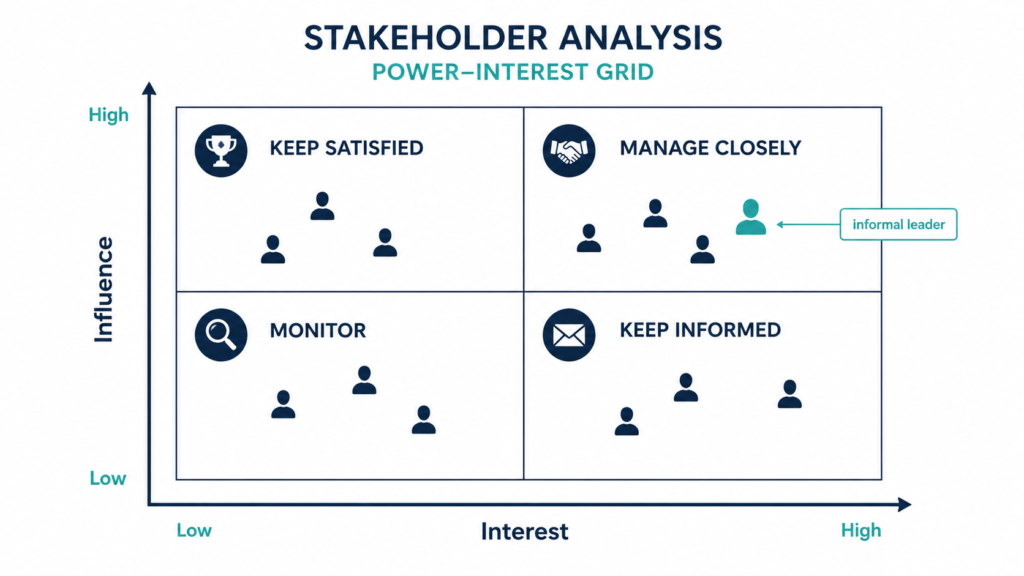
The map changed the rollout order. The team lead got a one-on-one before the announcement instead of after it, converting a probable blocker into the change’s most credible messenger. The account manager got a briefing pack and a two-week head start on talking points. Total cost: one hour of mapping. A power interest grid doesn’t make the politics disappear — it makes the politics visible early enough to work with, which is the practical difference between managed change and change resistance discovered live.
→ Full guide: Stakeholder Analysis: How to Map and Manage Stakeholders for Any Project (coming soon)
CATWOE Technique in Business Analysis
The CATWOE technique in business analysis is the least familiar name on this list and the most useful for genuinely messy change — a reorg, a system migration, anything touching several departments at once. It forces six answers before you commit: Customers (who’s affected), Actors (who executes), Transformation (what actually changes), World view (why this matters — and whether everyone agrees it does), Owner (who can stop it), and Environmental constraints (what limits you).
World view is the question every other framework skips and CATWOE makes unavoidable: does everyone affected agree on why this change matters? A cost program that finance reads as “protecting the business” and operations reads as “abandoning quality” is heading for resistance no timeline can fix. The exposure is common because deep problem-definition discipline is rare — only one in five organizations reports high requirements-management maturity (PMI). Running a CATWOE analysis is, in effect, borrowing that maturity for one decision at a time, using a checklist born in soft systems methodology.
Use it whenever a change is technically sound but somehow keeps not happening. Nine times out of ten the six answers reveal either a World-view mismatch or an Owner nobody actually confirmed.
CATWOE Analysis Example for Business Change
A CATWOE analysis example for business change: a company replacing its CRM defined Customers as both the sales team living in the tool and the end clients whose data it holds. Actors: IT plus every department touching customer records — not just IT, which was the original plan’s assumption. Transformation: fragmented spreadsheets into a single source of truth. World view: sales saw “less admin,” leadership saw “pipeline visibility” — close enough to align, but only after being stated. Owner: the COO, who could veto the cutover date. Environmental constraints: data-residency compliance and a contract lock-in ending in March.
Answering the six questions took under an hour and caught two plan-breakers — the residency requirement and the unconsulted departments in Actors — before the vendor contract was signed rather than after. That’s the pattern a useful CATWOE example repeats: it doesn’t generate brilliance, it catches omissions, and omissions are what kill change initiatives.
→ Full guide: CATWOE Analysis: A Practical Framework for Business Change Decisions (coming soon)
How to Choose the Right Business Analysis Technique
Knowing how to choose the right business analysis technique comes down to matching the technique to the shape of your situation: scanning techniques (SWOT, PESTLE) when you need a picture, prioritization techniques (MoSCoW) when you have too many options, discussion structure (Six Thinking Hats) when the conversation itself is the problem, diagnostics (root cause analysis) when a problem keeps returning, and change techniques (stakeholder analysis, CATWOE) when the risk lives in people and definitions rather than facts.
Which technique is best? The honest answer: the one that matches the decision in front of you — there is no universally best business analysis technique, and anyone selling you one framework for everything is selling the framework, not the outcome. What the evidence does support is using some structured method rather than none: Bain’s research across hundreds of firms found decision effectiveness correlates 95% with top-tier financial performance (Bain & Company), measured across revenue growth, return on capital, and shareholder return.
Techniques also combine more than single-framework guides admit. A market entry rarely stops at PESTLE: the external scan feeds a SWOT, the SWOT feeds a stakeholder map of who signs off, and a MoSCoW pass separates launch-critical capabilities from year-two wishes. Treat the seven as one toolkit you reach into repeatedly across a single decision. And if you use AI tools to accelerate the work, structure still comes first — a vague question fed into Claude or a similar AI assistant returns a vague answer faster; run the framework, then let the AI deepen each box.
A worked build-versus-buy scenario shows the toolkit in motion. A CTO weighing an in-house tool against a vendor platform runs SWOT on each option first — build plays to control and exact fit but risks a permanent maintenance burden; buy delivers speed and support but invites lock-in. With a direction emerging, a stakeholder map surfaces that engineering, finance, and the daily end users each hold different influence and different interest — skipping that step is how a technically correct decision becomes a rollout nobody wanted. Finally, a MoSCoW pass on the requirements stops both options from ballooning in scope. Three techniques, one decision, applied in the order the decision actually unfolds — that’s how business analysis techniques for business leaders and teams work in practice, as a sequence rather than a menu.
Which Business Analysis Technique to Use for Which Situation
Here’s the shortcut for which business analysis technique to use for which situation — bookmark this table and reach for it mid-decision:
| Your situation | Reach for | Time needed |
|---|---|---|
| Hiring freeze, shrinking budget, too many priorities | MoSCoW Method | 40–60 min |
| Considering a new market, product, or major investment | SWOT + PESTLE together | 2 × 60–90 min |
| A problem keeps coming back after being “fixed” | Root Cause Analysis (5 Whys) | 15–30 min |
| A reorg or process change is meeting quiet resistance | Stakeholder Analysis | 60 min |
| A change touches multiple departments or systems | CATWOE | 45–60 min |
| Discussions go in circles or turn tense | Six Thinking Hats | 30–40 min |
| Comparing two strategic options before a board meeting | SWOT on each option | 2 × 45 min |
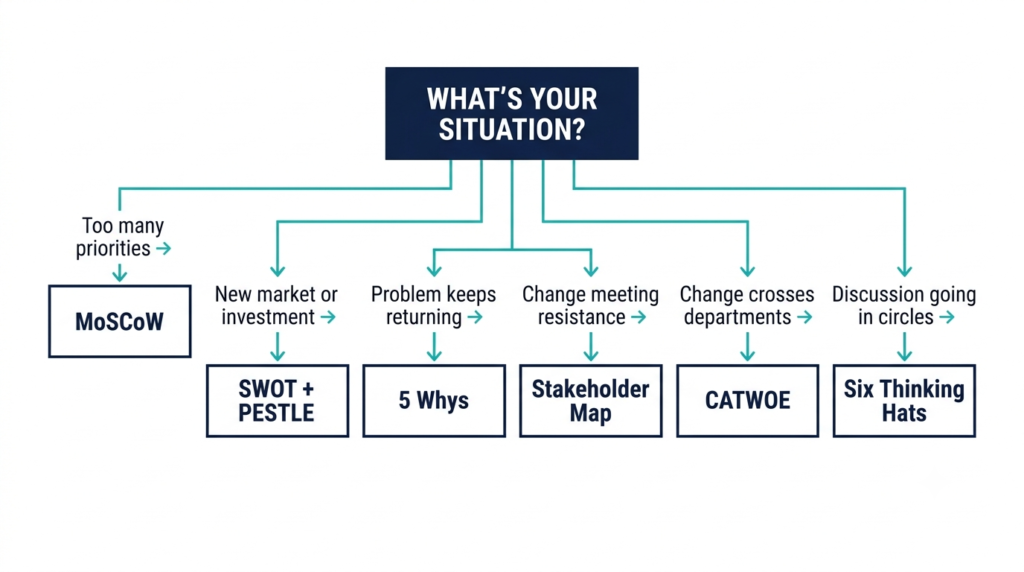
A quick business analysis techniques comparison like this beats memorizing all seven definitions — the skill worth building is pattern recognition, matching a live situation to its decision matrix row faster each time.
How to Run Your First Business Analysis Session Step by Step
Here’s how to run your first business analysis session step by step — the same sequence works for any technique in this guide:
- Pick one live decision — never a hypothetical.
- Choose the matching technique from the table above.
- Invite 3–6 people with genuinely different vantage points.
- Book 60 minutes; assign one person to write.
- Run the technique’s structure strictly — no freeform drift.
- End with owners and dates on every action.
- Send the one-page output the same day.
Two of those steps carry most of the weight. Step one — a live decision — is what keeps the session honest; teams that practice on hypotheticals learn the vocabulary but never the judgment, because nothing is at stake when the answer is wrong. And step seven, the same-day send, is what converts a good conversation into an organizational record: the one-pager is what gets forwarded, challenged, and referred back to when the decision is questioned in three months.
Group size deserves emphasis too: three to six people who see different parts of the business beat twelve people who think alike, half of whom stay silent. And the writing role is non-negotiable — a session that produces conversation but no document evaporates by Friday. This is the same discipline that separates decision-making “winners” in McKinsey’s research, where top-quartile organizations are twice as likely as the rest to report superior returns from their recent decisions (McKinsey) — they decide fast, execute fast, and keep the record.
Where does this fit in your broader business analysis process? The session is the repeatable unit. String sessions together as decisions demand them — scan, prioritize, diagnose — and you have a lightweight operating rhythm that scales from a single hire decision up to the process-improvement programs covered in our business process optimization guide. Keep a standing workshop agenda template and the setup cost of session two drops to nearly zero.
Common Mistakes When Using Business Analysis Techniques
The common mistakes when using business analysis techniques cluster into four patterns, and every one of them is avoidable on the first attempt.
Mistake one: running the technique once and filing the output in a deck nobody reopens. A SWOT from eighteen months ago describes a dead company. Scanning techniques hold value on a cadence — quarterly, or at each major decision — while diagnostics like the 5 Whys and CATWOE are naturally one-off. Mistake two: letting the session become another bad meeting. The failure is generic: 65% of senior managers say meetings keep them from completing their own work (Harvard Business Review) — which is exactly what happens when a framework session drops its structure and reverts to freeform discussion. The structure is the point; defend it.
Mistake three: over-matching the tool to the problem. A two-person scheduling conflict doesn’t need CATWOE, and a company-wide restructuring deserves more than a five-minute whiteboard SWOT. Match rigor to stakes. Mistake four: treating outputs as verdicts instead of inputs. Every technique here produces a better-informed decision, not a decision itself — the judgment call stays yours, which is precisely why these facilitation checklist habits work for leaders without an analyst on staff. Absorb those four corrections and you’re operating ahead of most formal business analysis best practices guidance from day one.
Frequently Asked Questions
1. Is business analysis the same as business analytics?
No. Business analysis examines a specific problem, decision, or change using structured techniques like SWOT, PESTLE, or root cause analysis. Business analytics is the broader discipline of using data, statistics, and reporting tools to track performance over time. A leader without a dedicated analyst typically needs business analysis techniques far more often than analytics software.
2. How many business analysis techniques are there?
The BABOK Guide — the professional standard for business analysts — catalogues around 50 techniques. Most are designed for full-time analysts documenting software requirements. For business leaders making their own decisions, seven cover nearly every situation: SWOT, PESTLE, MoSCoW, Six Thinking Hats, root cause analysis, stakeholder analysis, and CATWOE.
3. Do you need a business analyst to do business analysis?
No. Every technique in this guide was designed as a facilitation tool that a business leader, CTO, or consultant can run personally with a whiteboard and 45–90 minutes. A dedicated analyst adds value on large software projects with heavy requirements documentation, but for strategic and operational decisions the decision owner running the technique directly is often better, because context never gets lost in translation.
4. What is the most widely used business analysis technique?
SWOT analysis is the most widely used business analysis technique — it appears in virtually every strategy toolkit because it works for almost any question and takes minutes to learn. Its popularity is also its weakness: most SWOT sessions stop at vague adjectives. Pair it with a follow-up technique like MoSCoW or stakeholder analysis to convert the map into action.
5. Can small business owners use business analysis techniques without formal training?
Yes — every technique in this guide can be learned from a single explanation and run the same day, with no certification, software license, or analyst on staff. SWOT, MoSCoW, and stakeholder mapping were built as group facilitation tools, not specialist exercises. The skill that matters is choosing the technique that fits the situation, which comes from practice rather than coursework.
6. How long does a SWOT or PESTLE session take with a leadership team?
Budget 60–90 minutes for a leadership-team SWOT and about 90 minutes for a full six-lens PESTLE. Groups of three to six people with different vantage points work best. Add 15 minutes at the end to assign owners and dates to every finding — a session without assigned actions is the single most common reason these exercises produce nothing.
7. Which business analysis techniques work best for a startup with a small team?
MoSCoW and SWOT deliver the most immediate value for early-stage companies, because startups mostly face prioritization under scarce resources and fast-shifting competitive positions. Root cause analysis becomes valuable once operational problems start recurring. Six Thinking Hats and CATWOE earn their place after the team grows past the point where one founder makes every call alone.
8. How often should a business revisit its SWOT or PESTLE analysis?
Refresh SWOT and PESTLE at least once a year, and immediately before any major decision — a market entry, a significant hire, a new competitive threat. An analysis older than about eighteen months describes a business and a market that no longer exist. Treat both as living documents on a standing cadence, not one-time exercises filed after the first session.
9. Can business analysis techniques be used for personal or career decisions?
Yes — the frameworks transfer directly. A personal SWOT maps your skills against market demand before a career move, MoSCoW sorts competing goals when time is the scarce resource, and the 5 Whys works on recurring personal bottlenecks exactly as it does on business ones. The only adjustment is honesty: with no colleagues in the room, you have to challenge your own entries.
10. What are the main types of business analysis?
Business analysis work falls into four broad types: strategic analysis (SWOT, PESTLE — where the business stands), requirements analysis (MoSCoW, user stories — what a solution must do), process analysis (root cause analysis, process mapping — why things break), and stakeholder analysis (power-interest mapping, CATWOE — who is affected and how). Most real decisions draw on two or more types in sequence.
11. What is a business analysis framework?
A business analysis framework is a repeatable structure that tells you what to examine, in what order, and what question to answer before committing to a decision. SWOT, PESTLE, MoSCoW, and CATWOE are all frameworks in this sense. The value isn’t the boxes on the worksheet — it’s that the structure forces assumptions into the open where they can be checked.
12. What tools are used for business analysis?
Most business analysis techniques need nothing more than a whiteboard or shared document. When teams scale the practice, common tools include Miro or Mural for SWOT and stakeholder mapping workshops, Jira or Confluence for MoSCoW-prioritized requirements, and spreadsheet templates for PESTLE risk registers. Choose the technique first, then the tool — never the reverse.
Business Analysis Techniques for Business Leaders and Teams: Start This Week
The fastest way to learn business analysis techniques for business leaders and teams is to run one against a live decision this week — not to study all seven first. Pick the row in the table that matches what’s on your desk, book the hour, assign the writer. The value compounds: a team that has run one MoSCoW session moves faster in the next one, and a leader who has mapped stakeholders once starts spotting the quiet high-influence person in every room without the worksheet. That’s the real endpoint of these business analysis techniques — not the documents, but the habit of testing judgment against structure before it hardens into commitment. Each technique above has a dedicated deep-dive guide coming in this series; bookmark this page as the map.