A digital transformation framework is a structured model that organises how a business plans, sequences, and executes large-scale change across technology, processes, people, and data — so that the transformation delivers measurable outcomes instead of expensive activity. Frameworks give leadership teams a shared language for deciding what to change, in what order, and how to tell whether it is working. Without one, transformation defaults to whichever executive shouts loudest about their department’s priorities.
You have probably already felt the pain this article addresses. Your company committed budget to digital transformation frameworks compared in a strategy deck somewhere — McKinsey 7S, TOGAF, Gartner, maybe a Deloitte maturity assessment — and the result was a consultant-heavy kickoff, a set of PowerPoints, and adoption that quietly stalled at 30%. The framework got blamed. But the framework was rarely the problem. The problem was picking a model designed for a 50,000-person enterprise when your company has 400 people, or choosing one built for technology architecture when your real gap is cultural transformation.
Here is the misconception worth challenging: there is no “best” framework model. Every ranking that declares a single winner is selling you the framework they consult on. The real question — the one this article answers — is which framework fits your business size, maturity stage, and dominant risk. 70% of digital transformation efforts fail to meet their objectives, according to McKinsey. That number barely moves year over year because companies keep selecting frameworks based on brand recognition rather than fit.
This article breaks down six major frameworks side by side — McKinsey 7S, TOGAF, Gartner, Deloitte, BCG, and Kotter — with honest assessments of what each does well, where each breaks down, and which business context each actually belongs in. You will also get a comparison table, a decision guide by company size, a hybrid approach for combining frameworks, the specific failure modes at small and mid-sized companies, and what AI is doing to the framework selection calculus in 2026. If you are a CTO, strategy consultant, or business executive choosing a digital transformation approach, this is the comparison your next strategy meeting needs.
What Is a Digital Transformation Framework and Why Choosing the Right One Matters
A digital transformation framework is a structured set of dimensions — typically covering strategy, technology, process, people, and measurement — that guides how a business designs and sequences its transformation. It is not a project plan. It is the logic layer that sits above the project plan and tells you whether the projects add up to something coherent. The difference between a framework and a random collection of digital initiatives is strategic alignment: a framework ensures every workstream pulls in the same direction.
Why does the choice matter so much? Because organisations that prioritise structured approaches to change achieve 5.3 times higher success rates than those focusing solely on technology, according to McKinsey’s transformation research. A digital transformation framework definition that sounds academic on paper becomes the difference between a coordinated transformation and an expensive set of disconnected technology bets when applied to a real organisation with politics, legacy systems, and a finite budget.
Frameworks also solve a coordination problem that becomes visible only when digital transformation frameworks compared against each other reveal how differently each function defines “transformation.” Without a shared model, each function optimises for itself. The CTO modernises the stack. The CHRO runs a change programme. The COO redesigns processes. None of them connect. A cross-functional integration framework forces those conversations before the budget is spent, not after. The framework you choose shapes which conversations happen first, which risks get surfaced, and which blind spots stay hidden. That is why this choice is strategic, not administrative.
A digital transformation model also sets expectations. Some frameworks emphasise speed of execution. Others emphasise diagnostic depth. Picking one tells your organisation what kind of transformation this is — and what “done” looks like. Get that signal wrong at the start, and you spend the next two years correcting misaligned expectations across the leadership team.
Six Digital Transformation Frameworks Every Business Leader Should Evaluate
Six digital transformation frameworks every business leader should evaluate cover the range of what matters: organisational alignment, enterprise architecture, outcome linkage, maturity benchmarking, ROI quantification, and change management. Each serves a different primary purpose. The best-fit models for your situation depend on where your dominant risk sits — not on which framework has the most brand recognition. Below is what each one actually does, who it works for, and where it falls short.
McKinsey 7S Framework for Diagnosing Digital Transformation Alignment Gaps
The McKinsey 7S framework examines seven interdependent elements — Strategy, Structure, Systems, Shared Values, Skills, Style, and Staff — to diagnose where an organisation is misaligned. For digital transformation, its strength is revealing the soft-side failures that technical frameworks miss entirely. You might have the right cloud architecture and the right data platform, but if Skills, Style, and Shared Values are not aligned to the new operating model, adoption stalls.
Projects that used structured alignment frameworks like the 7S achieved 68% operational adoption rates after 18 months, compared to 42% without one, according to organisational alignment research. That gap is not marginal. More telling: 54% of failing transformation projects exhibited weak links between Strategy and Structure, per McKinsey 7S analysis — exactly the misalignment the 7S model is designed to surface.
The McKinsey digital transformation framework works best for first-time transformations, single business units, and organisations where the dominant risk is organisational alignment rather than technology architecture. Its limitation: it was not designed specifically for digital transformation, so it does not prescribe technology architecture decisions. You diagnose alignment gaps with 7S, then pair it with a more prescriptive model for execution. Think of it as the starting diagnostic, not the full playbook.
TOGAF Enterprise Architecture for Large Scale Digital Transformation
TOGAF enterprise architecture for large scale digital transformation is the framework of choice when the dominant challenge is technology complexity. TOGAF — The Open Group Architecture Framework — provides a detailed methodology for designing, planning, implementing, and governing enterprise information technology architecture. It breaks the architecture into four domains: Business, Data, Application, and Technology, each with defined deliverables and governance gates.
Over 80% of Fortune 500 companies use TOGAF’s methodology, with more than 150,000 certified practitioners globally, according to The Open Group. That adoption rate reflects TOGAF’s strength: it brings rigour and standardisation to technology decisions that would otherwise be made ad hoc across dozens of teams. For large enterprises running hundreds of applications across multiple business units, TOGAF provides scalable architecture governance that prevents the technology estate from becoming unmanageable.
The limitation is equally clear. TOGAF is architecture-heavy and can feel abstract to non-technical executives. Process optimization and cultural change are acknowledged but not deeply prescribed. If your dominant risk is people and culture rather than technology complexity, TOGAF alone will not solve it. The TOGAF digital transformation approach works best for large enterprises (1,000+ employees), heavily regulated industries, and organisations with significant technology debt. Pair it with a change management overlay — Kotter or Prosci — to cover the human side. The enterprise architecture framework gives you the structure; you still need the change engine.
Gartner Digital Business Framework for Linking Transformation to Outcomes
The Gartner digital business framework maps digital capabilities to business outcomes through a structured capability taxonomy. Where McKinsey 7S diagnoses alignment and TOGAF governs architecture, Gartner’s model excels at connecting technology investments to the business outcomes they are supposed to deliver. It defines a set of digital capabilities — from capability mapping to customer experience to operating model design — and scores each on maturity, so leadership can see exactly where gaps exist and where investment should flow.
Worldwide IT spending is projected to reach $6.37 trillion in 2026, up 14.2% from 2025, according to Gartner. The Gartner digital transformation framework exists partly to help organisations make sure that spending produces results. Its capability-maturity approach is particularly useful for IT-led transformation programmes where the CIO or CTO needs to justify investment against clear benchmarks.
The weakness: Gartner’s model is analyst-heavy and can anchor too much on technology maturity without giving equal weight to culture and business model innovation. It works best for technology-forward enterprises where the CIO has a seat at the strategy table, and less well for organisations where the transformation is driven by business model change or customer experience redesign. If your dominant question is “are we investing in the right technology capabilities?”, Gartner’s framework answers it. If your question is “how do we get 5,000 people to work differently?”, you need a different model.
Deloitte Digital Maturity Model for Benchmarking Transformation Readiness
The Deloitte digital maturity model measures readiness across five business dimensions — Customer, Strategy, Technology, Operations, and Organisation & Culture — to establish where a company actually sits before it commits to transformation. It is diagnostic rather than prescriptive: it tells you what your current state is with granular detail, so you can design a transformation that starts from where you are, not where you wish you were.
Only 30% of digital transformations meet or exceed their target value, according to BCG’s transformation research. The Deloitte model aims to improve those odds by preventing the most common starting error: overestimating readiness. Companies that skip maturity assessment often design transformation programmes calibrated to a maturity level they have not reached, then wonder why execution stalls in year one.
The Deloitte digital transformation approach is strongest as a pre-transformation diagnostic — run it before you pick your execution framework, not after. Its digital maturity scores give leadership a shared, evidence-based view of current state that replaces the usual political negotiation about “where we really are.” The limitation: it benchmarks where you are, but it does not prescribe how to move forward. Pair it with an execution-oriented framework (McKinsey, TOGAF, or a hybrid) for the action plan. Think of Deloitte’s model as the MRI scan — essential before surgery, but not the surgery itself. As a transformation maturity model, it sets a credible baseline that every subsequent decision can reference.
BCG Digital Acceleration Index for Quantifying Transformation ROI
The BCG digital acceleration index measures digital maturity across 42 sub-dimensions and scores organisations on a 1-to-100 scale, benchmarking them against industry peers and identifying the highest-ROI pathways forward. Where Deloitte diagnoses readiness, BCG quantifies return — making it the framework of choice when the CFO’s primary question is “what is the financial payoff?”
The data behind the DAI is compelling. Digitally advanced companies — the top 25% in BCG’s sample — outperform the bottom 25% by 22 percentage points in enterprise value since 2019, according to BCG’s Digital Value Gap research. More specifically, future-built companies achieve 1.7x revenue growth and 3.6x three-year total shareholder return compared to laggards, per BCG’s 2025 analysis. Those are not incremental differences — they are compounding advantages that widen every year.
The BCG digital transformation model works best for boards and CFOs who need to justify transformation spend in financial terms. Its continuous improvement scoring allows you to re-measure quarterly and show progress in the language finance teams understand. The limitation: the DAI is proprietary, assessment-driven, and typically requires BCG engagement to run at full depth. For a self-directed transformation, the publicly available methodology can still frame your digital transformation ROI thinking, but the full diagnostic needs external support.
Kotter Eight Step Model for Leading Digital Transformation Change
The Kotter eight step model for leading digital transformation change is not a digital framework at all — it is a change management methodology that maps directly onto the human side of transformation. The eight steps — Create Urgency, Form a Coalition, Create a Vision, Communicate the Vision, Remove Obstacles, Create Short-Term Wins, Build on Change, Anchor in Culture — address the exact sequence in which organisational change either builds momentum or collapses.
70% of change initiatives fail, and the failures almost always stall at the same early steps — insufficient urgency and inadequate coalition-building, according to Kotter’s foundational research. The model matters for digital transformation because technology is never the actual adoption bottleneck — people are. A technically perfect cloud migration that the organisation resists using has delivered nothing. Kotter’s model explains why resistance happens and prescribes the sequence of leadership actions that overcome it.
The Kotter change management model is the strongest available overlay for the human side of transformation. It works best when paired with a technically prescriptive framework — TOGAF for architecture, Gartner for capability — as the cultural transformation layer. Its limitation: it does not address technology architecture, data strategy, or digital capability design. It solves adoption, not architecture. Use it alongside, not instead of, a digital-specific framework. As a change management framework, it is the standard that every other change model benchmarks against.
If you are asking which framework is best for change management in digital transformation, the answer is Kotter for the change sequence and Prosci ADKAR for individual adoption tracking — they complement rather than compete.
Digital Transformation Framework Comparison Table by Business Size and Maturity
The digital transformation framework comparison table below maps each framework against business size, maturity stage, primary strength, and best-fit scenario. Use it as a starting filter — not a final answer — for narrowing your shortlist.
| Framework | Best Business Size | Best Maturity Stage | Primary Strength | Primary Limitation | Pairs Well With |
|---|---|---|---|---|---|
| McKinsey 7S | SME to Mid-Market | Early to Mid | Organisational alignment diagnosis | No tech architecture guidance | TOGAF, Gartner |
| TOGAF | Large Enterprise (1,000+) | Mid to Advanced | Technology architecture governance | Heavy, abstract for non-tech execs | Kotter, ADKAR |
| Gartner | Mid-Market to Enterprise | Mid to Advanced | Capability-to-outcome mapping | Analyst-heavy, under-weights culture | McKinsey 7S, Kotter |
| Deloitte | Any (diagnostic) | Pre-transformation | Maturity benchmarking | Diagnostic only, not prescriptive | Any execution framework |
| BCG DAI | Mid-Market to Enterprise | Any | ROI quantification, board-level reporting | Proprietary, needs external support | Kotter, internal execution |
| Kotter 8-Step | Any | Any | Change management and adoption | No tech or architecture guidance | TOGAF, Gartner, BCG |
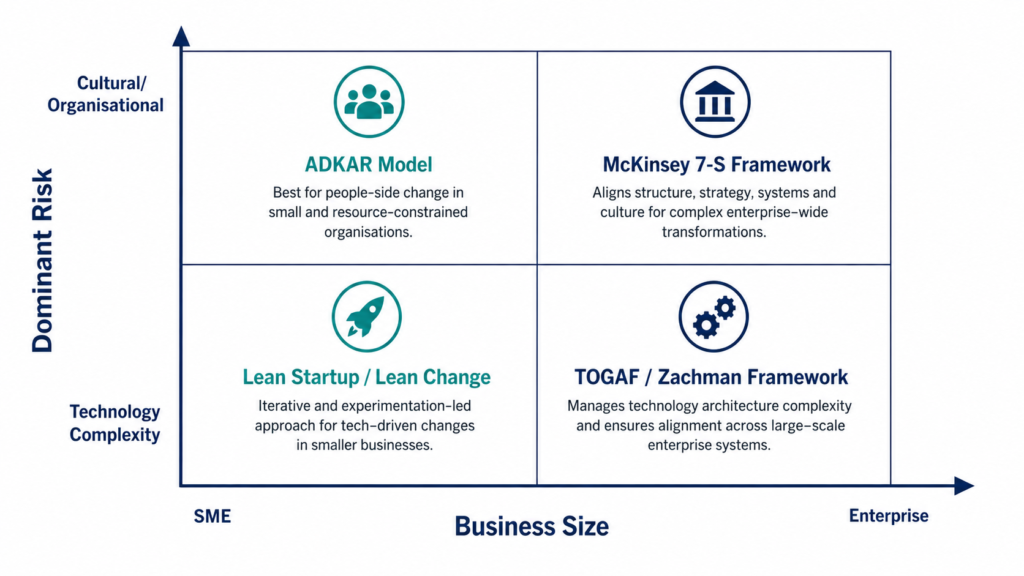
A digital transformation framework comparison that stops at the table above is incomplete. The table tells you what each framework is designed to do; it does not tell you which combination to use. Most successful transformations use two or three models in tandem — a diagnostic (Deloitte or BCG DAI), an execution framework (McKinsey 7S, TOGAF, or Gartner), and a change overlay (Kotter). The pairing matters more than the individual choice — and seeing digital transformation frameworks compared in this way shifts the conversation from “which one is best?” to “which combination covers our gaps?”
The difference between TOGAF and McKinsey 7S for digital transformation comes down to where your risk sits. TOGAF governs what you build; McKinsey 7S diagnoses whether the organisation is aligned to use what you build. One is architecture-forward; the other is alignment-forward. Companies with significant technology debt start with TOGAF. Companies with capability mapping gaps and cultural misalignment start with 7S. Most companies have both problems — which is why the hybrid approach (H2-5 below) is usually the right answer. A digital readiness assessment before framework selection prevents picking a model that solves the wrong problem.
How to Choose the Right Digital Transformation Framework for Your Company Size
How to choose the right digital transformation framework for your company size comes down to four decision criteria that filter the six frameworks above into a shortlist of one or two. When you see digital transformation frameworks compared by business size, the selection mistake most leaders make becomes obvious: starting with the framework’s reputation instead of starting with their own organisation’s constraints. Choosing a digital transformation framework is not a brand decision — it is a fit decision.
Here are the four criteria that matter, in decision order:
1. Dominant risk. What is most likely to kill this transformation? If it is technology complexity and legacy debt, lean toward TOGAF or Gartner. If it is cultural resistance and organisational alignment, lean toward McKinsey 7S plus Kotter. If it is inability to quantify ROI for the board, lean toward BCG DAI. Name the risk first; the framework follows.
2. Company size and resources. TOGAF requires certified architects and sustained governance — realistic for large enterprises, burdensome for a 200-person company. McKinsey 7S and Kotter are lighter, more adaptable, and executable without external consultants. Match the framework’s overhead to your capacity.
3. Maturity stage. If you have never run a formal transformation, start with Deloitte’s maturity assessment to establish baseline, then pick an execution framework calibrated to your score. If you have already run one cycle and are scaling, Gartner or BCG DAI add the measurement rigour your second phase needs. Framework selection criteria should account for where you are, not just where you want to be.
4. Internal vs. external execution. Some frameworks (BCG DAI, Gartner) are designed around analyst or consultant engagement. Others (McKinsey 7S, Kotter) can be self-directed. If your digital strategy framework budget does not include external consultants, pick models your leadership team can run internally with available talent.
A practical shortcut: run Deloitte’s maturity assessment first. Use the scores to identify your dominant risk. Match the risk to the framework comparison table. Then overlay Kotter for change management. This three-step process — assess, select, overlay — gets most organisations to a defensible framework choice within two weeks, not two months. The goal is not to find a perfect framework. The goal is to find one that is good enough to start — and then adapt it as you learn. Business outcomes improve when the framework matches the organisation, not the other way around.
How to Combine Digital Transformation Frameworks Into a Hybrid Approach
How to combine digital transformation frameworks into a hybrid approach is where most successful transformations actually land. The six frameworks above are not competing products — they are different lenses on the same problem. Using one alone leaves blind spots. Using all six creates paralysis. The practical answer is a two-to-three framework combination tailored to your specific context.
The most common hybrid patterns that work in practice:
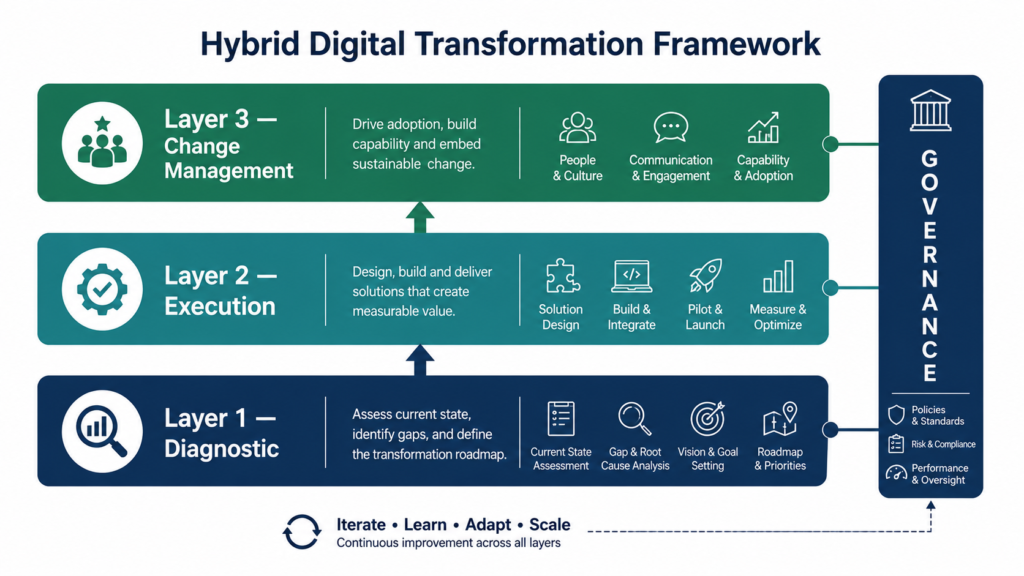
Diagnostic + Execution + Change. Start with Deloitte or BCG DAI to assess maturity and quantify the opportunity. Move to TOGAF (if architecture-led) or McKinsey 7S (if alignment-led) for execution design. Layer Kotter across both for adoption. This three-layer hybrid digital transformation approach covers assessment, action, and adoption — the three failure points where single-framework approaches typically break.
Architecture + Alignment. For large enterprises with both technology debt and cultural challenges: use TOGAF to govern technology decisions and McKinsey 7S to govern operating model alignment. Run them in parallel — architecture decisions in one workstream, alignment diagnostics in another — with a shared governance body ensuring they do not drift apart.
ROI + Change. For board-sceptical environments where the CFO needs continuous proof of value: use BCG DAI for quarterly measurement and Kotter for adoption sequencing. Every DAI score improvement gets linked to a specific change initiative, creating a narrative the board can follow.
The key discipline in any hybrid is governance. With multiple frameworks in play, someone — usually the transformation lead or a small steering committee — must ensure the models reinforce rather than contradict each other. Process optimization decisions made under TOGAF must align with the people-readiness signals from the 7S diagnostic. Phased implementation timelines from the execution framework must sync with the urgency-building sequence from Kotter. Without that coordination layer, a hybrid approach fragments into competing methodologies rather than complementary ones.
One final point: the hybrid is not permanent. Most organisations evolve their framework combination as the transformation matures. An early-stage transformation might lean heavily on diagnostic and alignment models. A scaling transformation shifts weight toward execution and measurement models. Build the hybrid for where you are now, plan to revisit it every 12 months, and remember that having digital transformation frameworks compared against your evolving context is what keeps the approach relevant as the organisation matures.
Why Digital Transformation Frameworks Fail at Small and Mid-Sized Companies
Why digital transformation frameworks fail at small and mid-sized companies is a question with an uncomfortable answer: most frameworks were designed for large enterprises and were never adapted downward. The assumptions baked into McKinsey, TOGAF, Gartner, and BCG models — dedicated transformation teams, multi-year budgets, formal governance structures, certified architects — do not match the reality of a 50-to-500-person company where the CTO is also the head of operations and the transformation budget comes from next quarter’s margin.
48% of companies with fewer than 100 employees are not pursuing digital transformation at all, compared to just 3.2% of companies with 1,000+ employees, according to digital transformation research on size heterogeneity. That gap is not about ambition — it is about framework accessibility. The digital transformation failure reasons at SMEs cluster around three patterns that enterprise frameworks do not address.
Pattern 1: Overhead exceeds capacity. Enterprise frameworks demand governance structures, steering committees, and formal deliverables that consume more bandwidth than a small company has. The framework becomes the work instead of enabling the work. Stakeholder engagement processes designed for 12 executive sponsors collapse when there are three.
Pattern 2: All-or-nothing scope. Enterprise frameworks assume transformation touches the whole organisation simultaneously. Small companies need to transform one process or one customer journey at a time, prove value, fund the next step from the savings, and compound. Sequential, self-funding transformation is the viable model at smaller scale — and almost no major framework prescribes it.
Pattern 3: External dependency. BCG DAI and Gartner models assume consultant or analyst involvement. SMEs cannot fund that engagement, and the self-service versions lack the depth to be useful. The result: small companies either skip frameworks entirely (and lose the coordination benefit) or adopt one that does not fit (and waste months on misaligned governance).
Do small businesses need a digital transformation framework? Yes — but the answer is a lightweight adaptation, not a full enterprise deployment. McKinsey 7S with simplified governance and Kotter’s 8 steps with a founder-led coalition are the most viable starting points. The key is preserving the framework’s coordination value — ensuring technology, process, and people change happen in sync — while stripping the enterprise overhead that SMEs cannot absorb. Cultural transformation at a 100-person company is a conversation series with the founder, not a multi-year change programme.
Digital Transformation Framework Implementation Steps for Leaders Without Dedicated IT
Digital transformation framework implementation steps for leaders without dedicated IT require a different playbook than what the enterprise frameworks prescribe. If you do not have a CIO, a transformation office, or a team of enterprise architects, the standard implementation path will not work. What follows is the adapted sequence — tested in mid-market and growth-stage companies — that delivers framework value without enterprise overhead.
- Run a 2-week lightweight maturity assessment. Use Deloitte’s five dimensions (Customer, Strategy, Technology, Operations, Culture) as a checklist, scored 1–5 by your leadership team in a single workshop. You do not need the full proprietary diagnostic — you need an honest shared view of where you are. Output: a one-page maturity snapshot.
- Identify your top-two stakeholder engagement risks. From the assessment, name the two dimensions where the gap between current state and required state is largest. These are your transformation priorities — everything else waits.
- Select one execution framework and one change overlay. McKinsey 7S for alignment-led transformations; a simplified TOGAF Architecture Development Method (ADM) for technology-led ones. Layer Kotter’s first four steps (Urgency, Coalition, Vision, Communication) for change management.
- Design three 90-day sprints, not a 3-year roadmap. Each sprint targets one measurable outcome tied to one of your top-two risks. Phased implementation at this scale means proving value fast enough to fund the next phase from the results of the current one.
- Assign ownership to existing leaders, not new hires. The CEO or founder owns the transformation. The most technically capable leader owns technology decisions. The most people-oriented leader owns adoption. You do not need new roles — you need existing leaders with explicit accountability.
- Measure monthly against three KPIs. One business outcome KPI (revenue, cost, retention), one adoption KPI (tool usage, process compliance), and one speed KPI (cycle time of the process you are transforming). Three numbers. Monthly review. Course-correct if any two are off track.
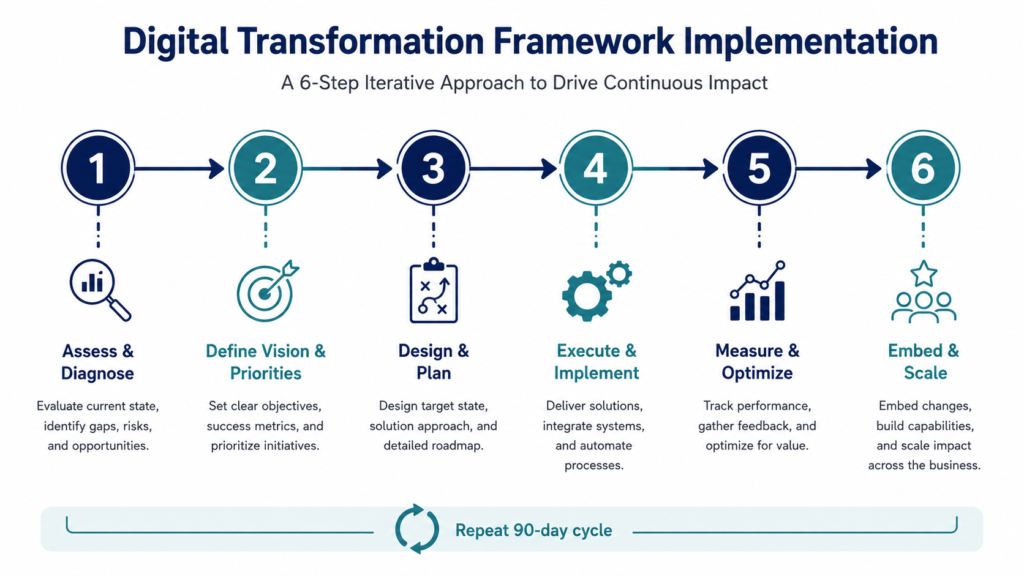
The digital transformation implementation steps above compress what enterprise frameworks spread across 18 months into a repeatable 90-day cycle. Transformation governance at this scale is a monthly leadership meeting with three KPIs on one slide — not a programme management office. The discipline is the same; the structure is sized to the organisation.
How AI Is Changing Which Digital Transformation Framework to Use in 2026
How AI is changing which digital transformation framework to use in 2026 is the question every framework comparison written before 2025 missed entirely. Generative and agentic AI have shifted the transformation landscape enough that framework selection criteria need updating — not because the frameworks themselves are obsolete, but because the capabilities available to transformation programmes are fundamentally different.
McKinsey estimates that generative AI could contribute up to $4.4 trillion in annual global productivity gains across corporate use cases, per McKinsey’s generative AI research. Gartner predicts over 60% of enterprise applications will embed generative AI by 2026, according to Gartner’s IT spending forecast. Those numbers reshape framework selection in three specific ways.
First, technology adoption speed has compressed. Pre-AI, the technology pillar of a transformation took 12–18 months to stand up. With AI-native tools, some capability deployments now take weeks. Frameworks that assume multi-year technology buildouts — like full TOGAF ADM cycles — need adaptation for this compressed timeline. The architecture principles remain valid; the sequencing and governance cadence need acceleration.
Second, the skills gap has shifted. AI handles tasks that previously required specialist headcount — data analysis, content generation, code writing, customer service triage. This changes what the People pillar of a framework needs to address. The reskilling conversation moves from “learn the new tool” to “learn to work alongside AI agents” — a fundamentally different capability requirement.
Third, ROI measurement has become faster. An AI digital transformation framework can show productivity gains within weeks of deployment, not quarters. BCG DAI and Gartner capability maturity models that assumed quarterly measurement cadences can now incorporate real-time AI-driven analytics. This makes the ROI conversation with the board stronger earlier — which changes the funding dynamics of the transformation itself.
The practical implication: if you are selecting a framework in 2026, add an AI-readiness filter to your decision criteria. Does the framework account for AI as a capability accelerator, not just another technology investment? Does it address the governance, ethics, and workforce implications of AI deployment? Frameworks that treat AI as an add-on will produce transformations that are already outdated by the time they scale. The ones that embed AI as a core scalable architecture principle — alongside cloud, data, and process — are the ones calibrated for where transformation is actually heading.
Conclusion
The digital transformation frameworks compared in this article — McKinsey 7S, TOGAF, Gartner, Deloitte, BCG DAI, and Kotter — are not competing religions. They are tools, each designed for a specific type of problem. McKinsey 7S diagnoses alignment. TOGAF governs architecture. Gartner maps capabilities to outcomes. Deloitte benchmarks maturity. BCG quantifies ROI. Kotter drives adoption. The right answer for most organisations is a hybrid of two or three, selected based on dominant risk, company size, and maturity stage — not brand recognition.
The pattern behind the 30% of digital transformation frameworks deployments that succeed is consistent: leadership that stays engaged, a framework matched to the organisation’s actual constraints, structured change management layered on top, and honest measurement from day one. The pattern behind the 70% that fail is equally consistent: a framework chosen for its name, governance that exceeds capacity, culture left unaddressed, and measurement that tracks activity instead of outcomes.
Start with a maturity assessment. Name your dominant risk. Match it to the comparison table. Overlay change management. Then adapt as you learn. For the full picture of what digital transformation actually means and how it fits into your broader strategy, start with the Hub guide. For a deep dive into building your transformation roadmap, see the digital transformation roadmap guide. And for assessing where your organisation stands right now, the digital maturity assessment gives you the baseline your framework selection needs.
More from CorporatePlaybookPro.com
→ What Is Digital Transformation? The Complete Guide for Business Leaders
→ Digital Transformation for Small Business: A Practical, Phased Guide
→ Digital Transformation Culture and Change Management (2026 Guide)
→ How to Create a Successful Digital Transformation Roadmap: A Leader’s Guide
→ Digital Maturity Assessment: Benchmark Your Organization’s Transformation Readiness (2025 Guide)
→ The 90-Day Digital Transformation Sprint: Quick Wins That Build Long-Term Success
→ Business Strategy Frameworks: The Complete Guide for Business Leaders
→ The AI Maturity Assessment Framework Every Business Leader Needs
Frequently Asked Questions
What is the difference between TOGAF and McKinsey 7S for digital transformation?
TOGAF governs technology architecture — it defines how systems, data, and applications are structured and governed across an enterprise. McKinsey 7S diagnoses organisational alignment across seven interdependent elements including strategy, structure, skills, and shared values. TOGAF answers “what do we build and how?” while 7S answers “is the organisation aligned to use what we build?” Most successful transformations pair both: TOGAF for the architecture decisions, 7S for the alignment diagnostic.
How many digital transformation frameworks are there?
There are dozens of digital transformation frameworks available, but six have broad adoption and credible track records: McKinsey 7S, TOGAF, Gartner Digital Business Framework, Deloitte Digital Maturity Model, BCG Digital Acceleration Index, and Kotter’s 8-Step Change Model. Beyond these, MIT Sloan, Capgemini, Prosci ADKAR, and several proprietary consulting models exist. The number matters less than the fit — choosing one or two that match your organisation’s size, maturity, and dominant risk is what drives results.
What are the 4 pillars of digital transformation?
The four pillars of digital transformation are technology, process, people and culture, and data and insights. Technology provides the modern infrastructure; process redesign strips out and rebuilds workflows before automating them; the people pillar drives adoption, skills development, and cultural change; and the data pillar provides the measurement and intelligence layer. All four must advance in parallel — neglecting any one pillar causes the transformation to stall on that dimension.
Which digital transformation framework works best for companies under 500 employees?
For companies under 500 employees, McKinsey 7S paired with Kotter’s 8-step change model delivers the best fit. Both are lightweight enough to run without dedicated transformation teams, do not require external consultant engagement, and cover the two areas where smaller organisations fail most often: organisational alignment and change adoption. TOGAF and BCG DAI are typically too resource-heavy for this scale. Start with a simplified Deloitte maturity self-assessment to identify your gaps before picking an execution model.
Can you use multiple digital transformation frameworks at the same time?
Yes — and most successful transformations do. The practical pattern is to combine a diagnostic framework (Deloitte or BCG DAI) with an execution framework (TOGAF, McKinsey 7S, or Gartner) and a change management overlay (Kotter). The key discipline is governance: someone must ensure the frameworks reinforce rather than contradict each other. Two to three models in tandem is the sweet spot; more than three creates overhead that outweighs the benefit.
What is the Prosci ADKAR model for digital transformation?
Prosci ADKAR is a change management model that tracks individual adoption through five stages: Awareness, Desire, Knowledge, Ability, and Reinforcement. It complements Kotter’s organisational-level 8-step model by giving leaders a way to assess whether individual employees are progressing through the change. In digital transformation, ADKAR is most useful for tracking adoption of specific tools or processes at the team level, while Kotter manages the broader organisational change sequence.
How long does it take to implement a digital transformation framework?
Framework implementation typically takes 8–16 weeks for the initial diagnostic and design phase, with execution spanning 12–36 months depending on scope and organisation size. Lightweight frameworks like McKinsey 7S can produce actionable diagnostics within two weeks. Full TOGAF architecture cycles at enterprise scale take 6–12 months before execution begins. The critical variable is not the framework — it is how quickly the leadership team commits to decisions and allocates resources.
What is the cheapest digital transformation framework to implement?
McKinsey 7S and Kotter’s 8-step model have the lowest implementation cost because both can be self-directed by an internal leadership team without external consultants or proprietary tools. Deloitte’s maturity model can also be adapted into a self-assessment workshop at minimal cost. BCG DAI and full Gartner engagements typically require analyst or consultant involvement, making them significantly more expensive. Cost should not be the primary selection criterion — fit matters more — but for resource-constrained organisations, self-directed frameworks deliver genuine value.
How do you measure whether a digital transformation framework is working?
Measure framework effectiveness through three lenses: business outcome KPIs (revenue, cost, retention), adoption KPIs (tool usage, process compliance, active users), and speed KPIs (cycle time, time-to-value). Set these before the transformation starts — not after. Review monthly for adoption and speed, quarterly for business outcomes. If adoption metrics are trending up but business outcomes are flat after two quarters, the framework may be driving activity without producing results — that is the early warning signal to recalibrate.
Which digital transformation framework is best for healthcare?
Healthcare organisations typically benefit from TOGAF for architecture governance (due to complex regulatory and interoperability requirements) paired with Kotter for change management (due to entrenched clinical workflows and professional culture). Deloitte’s maturity model is also widely used in healthcare for pre-transformation readiness assessment. The critical addition for healthcare is a compliance overlay — HIPAA, HITECH, and data governance requirements must be embedded in the framework from day one, not retrofitted.
What is the difference between digital transformation and digital strategy?
Digital strategy is the plan — it names the business outcomes the organisation is targeting and the digital investments required to reach them. Digital transformation is the execution of that plan across the full operating model: technology, process, people, and data. A strategy without transformation is a deck that never ships. A transformation without a strategy is activity without direction. The strategy sets the destination; the framework structures the journey; the transformation is the journey itself.
Do enterprise digital transformation frameworks work for startups and scale-ups?
Enterprise frameworks like TOGAF and BCG DAI are too heavy for startups, but the principles behind them apply. Startups benefit from a lightweight McKinsey 7S alignment check at each growth stage and Kotter’s urgency-coalition sequence when introducing major operational changes. The practical adaptation is to use framework thinking — structured assessment of strategy, technology, process, people, and data — without the full enterprise governance apparatus. Scale-ups crossing 200–500 employees should begin formalising their framework choice, as informal approaches break down at that threshold.