An AI maturity assessment framework is a structured diagnostic tool that measures how effectively an organization has embedded artificial intelligence across its strategy, operations, data, technology, governance, and culture — and how much real business value that embedding is actually producing.
That definition sounds straightforward. The reality facing most organizations in 2026 is anything but.
Global enterprise AI spending is projected to hit $665 billion this year, (source: Yahoo Finance)yet three out of four AI deployments fail to achieve their projected return on investment. Boards keep approving budgets. Vendors keep promising transformation. Leaders keep launching initiatives. And most organizations keep staring at dashboards that show plenty of AI activity — and very little AI impact.
The technology is not the problem. The foundation is. According to RAND Corporation’s analysis of over 2,400 enterprise AI initiatives, 80% of AI projects fail to deliver their intended business value — twice the failure rate of regular IT projects — and that number has barely moved in three years. The pattern cuts across industries, geographies, and company sizes. What separates the organizations pulling ahead from those burning budget is not access to better models or deeper pockets. It is maturity — and knowing exactly where your organization sits on that curve before committing to the next initiative.
73% of failed AI projects had no agreed definition of success before launch. 61% were approved on projected ROI that was never measured after deployment.(source : RAND Corporation) These are not technical failures. They are maturity failures — organisations attempting Level 4 execution on Level 1 foundations, with no diagnostic in between.
That diagnostic gap is precisely what this article addresses.

What is CPP AI Maturity Assessment Model ?
The CPP AI Maturity Model™ is a seven-dimension, five-level assessment framework built specifically for business leaders who need to assess AI maturity with precision, not platitudes. It scores your organization at the dimension level, draws a hard line between AI readiness and AI maturity, and — unlike most existing models — accounts for the agentic AI era that has fundamentally changed what organizational maturity actually means.
If you have been wondering how to measure AI maturity in your business in a way that is honest, actionable, and built for 2026 — this is the framework for that question.
Why Existing AI Maturity Models Fall Short — And What a Better Framework Looks Like
Let’s be direct about something uncomfortable: the major AI maturity frameworks — Gartner’s, McKinsey’s, Deloitte’s, PwC’s — are serious tools produced by serious organisations. They are also increasingly inadequate for the moment most businesses are actually in right now.
Here is why.
Why Most AI Maturity Models Measure Inputs, Not Business Outcomes
Gartner’s AI maturity model assesses organizations across strategy, data, technology, governance, talent, and business value, grouping them into five stages from Foundational through to Transformational. McKinsey maps twelve scaling practices across six dimensions. Both frameworks ask the right categories of questions. But here is the problem they share: they assess whether you have a strategy, a governance framework, a data pipeline, and a dedicated AI leader, and measure how many employees have logins to AI-powered tools. These are necessary inputs — but they do not tell you whether AI is actually doing anything. An organization can score perfectly on strategy and governance readiness while delivering zero business impact.
Having an AI policy pinned to a SharePoint page is not maturity. It is administration.
The AI Pilot to Production Gap: Why 95% of Enterprise AI Never Scales
Here is a number that should alarm every executive sitting in an AI steering committee: while 80% of organisations have explored generative AI tools and 40% report some form of deployment, only 5% of custom enterprise AI solutions ever reach production.(Source: MIT Media Lab) The gap between a promising pilot and an operational capability is where most AI investment quietly disappears — yet existing maturity models do not score this transition as a distinct, measurable dimension. They capture whether pilots exist. They do not tell you why those pilots are dying on the table.
Why Existing Frameworks Miss Agentic AI Readiness Entirely
This is the gap that makes most existing frameworks feel genuinely dated. Most maturity models were built for the era of AI assistants — tools that augment human work. But the frontier has shifted. The defining question of AI maturity in 2026 is no longer “are your people using AI tools?” It is “is AI doing independent work?” Any model that does not distinguish between AI as an assistant and AI as an autonomous agent is measuring your organisation against yesterday’s standard. That is not a minor gap — it is a structural blind spot.
The CPP AI Maturity Matrix™ closes all three gaps. It scores value realisation as a standalone dimension with its own diagnostic questions. It identifies where the pilot-to-production gap originates at the dimension level. And it places agentic AI readiness at Level 5 — not as a future consideration, but as the defining marker of what genuine AI maturity looks like today.
The CPP AI Maturity Model™: A Seven-Dimension AI Maturity Assessment Matrix Built for 2026
Every serious maturity model in existence — from TM Forum’s Digital Maturity Model to Gartner’s AI capability framework — is built on the same foundational logic: define the dimensions that matter, define the levels of progression within each, and score the organisation at the intersection. TM Forum’s approach asks people across the entire organisation to assess maturity in each area, with the flexibility to account for differences in vision, strategy, and business imperatives — creating a baseline of existing capabilities and a target level to work toward.
That structure works. The CPP AI Maturity Matrix™ inherits it. What it adds is different.
Where most frameworks treat AI maturity as a single organisational score, the CPP AI Maturity Matrix™ scores seven distinct dimensions independently. This matters because AI maturity is rarely uniform. Your data infrastructure may be operating at Level 4 while your governance sits at Level 2 and your workforce fluency has barely cleared Level 1. A single composite score hides those gaps. A dimension-level score surfaces them — and that is where the actionable insight lives.
The framework is structured as follows.
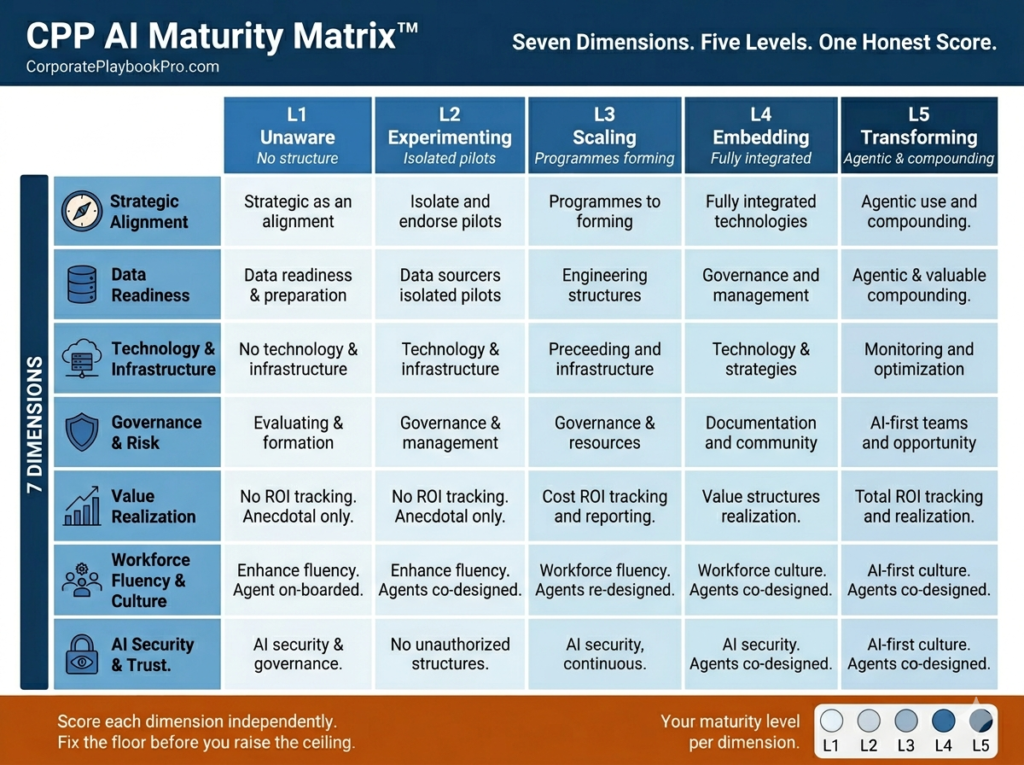
Seven AI Maturity Assessment Dimensions — the horizontal axis.
Each one represents a distinct organisational capability that determines whether AI delivers real business value or simply generates activity:
- Strategic Alignment — whether AI is genuinely connected to business outcomes, or operating as a parallel IT project nobody in the boardroom owns
- Data Readiness — the quality, governance, and accessibility of the data your AI systems actually depend on, not on paper but in production
- Technology and Infrastructure — your cloud environment, tooling, MLOps pipelines, and readiness to deploy and manage agentic AI systems
- Governance and Risk — the policies, ethics frameworks, risk classification systems, and regulatory compliance posture that determine whether your AI operates responsibly at scale
- Value Realization — not whether AI is deployed, but whether it is producing measurable, reportable business value
- Workforce Fluency and Culture — not headcount with AI licences, but the depth of capability across your organisation
- AI Security and Trust — model integrity, adversarial resilience, explainability, and the degree to which outputs can be audited and challenged
Five AI Maturity Assessment Levels — the vertical axis.
Each level has a name designed for business language, not academic taxonomy:
- Level 1 — Unaware: AI is discussed but not deployed in any structured way
- Level 2 — Experimenting: Pilots are running but isolated, ungoverned, and unmeasured
- Level 3 — Scaling: AI moves from projects to programmes with executive ownership and early ROI
- Level 4 — Embedding: AI is integrated into core workflows, culture, and financial reporting
- Level 5 — Transforming: Agentic AI operating autonomously; AI is a documented competitive differentiator
One important note before you begin scoring: uneven scores across dimensions are normal — they are, in fact, expected. Not every organisation needs Level 5 across all dimensions. Target maturity is a function of your organisation’s mission, resources, and business strategy. The matrix does not tell you where you must be. It tells you where you are — and what moving forward requires.
The Seven Dimensions of AI Maturity Assessment : What Your Organisation Must Get Right
Each dimension below represents a distinct layer of organisational capability. Read each one carefully before scoring. The diagnostic questions at the end of each dimension are designed to surface honest answers — not the answers your organisation wishes were true.
Dimension 1: Strategic Alignment — Connecting AI to Business Goals
Strategic alignment is the degree to which artificial intelligence is deliberately connected to your organisation’s business objectives, owned at the executive level, and resourced as a strategic priority rather than managed as a technology experiment.
This is the dimension most organisations overestimate. It is easy to point to an AI strategy document. It is much harder to demonstrate that AI initiatives are tied to specific, measurable business outcomes — and that someone in the C-suite is accountable for whether those outcomes are achieved. The most AI-mature organisations do not ask “what AI tools do we have?” They ask “where does intelligence sit inside the workflow?” — and that question only gets asked when AI is anchored to strategy, not floating beside it.
The difference between Level 2 and Level 3 on this dimension is not the existence of an AI roadmap. It is executive ownership. A roadmap without an owner is a document. A roadmap with an executive sponsor, defined KPIs, and a board reporting cadence is a strategy.
At Level 5, strategic alignment means AI is not just supporting the business model — it is reshaping it. New revenue streams, new operating models, and new competitive positions emerge from AI capability, not just efficiency gains.
Diagnostic Questions — Strategic Alignment
- Does your organisation have a documented AI strategy that is reviewed at board or executive committee level at least quarterly?
- Are individual AI initiatives mapped to specific business outcomes with defined success metrics — before launch?
- Is there a named executive who owns AI strategy and is accountable for its delivery?
- Does your AI investment appear as a line item in your strategic plan, or is it absorbed into the IT budget?
- Can you articulate in one sentence how AI connects to your organisation’s competitive advantage?
If the honest answer to three or more of these is no, your Strategic Alignment score is Level 1 or Level 2 regardless of how many AI tools are in use.
Dimension 2: Data Readiness for AI — The Foundation Every Other Dimension Depends On
Data readiness measures the quality, governance, accessibility, and trustworthiness of the data your AI systems depend on — not in theory, but in production.
This is the dimension that quietly determines the outcome of every other dimension. You can have a compelling AI strategy, a sophisticated technology stack, and a governance framework that would satisfy any auditor — and still produce AI systems that deliver nothing, because the underlying data is siloed, inconsistent, or untrustworthy. According to Gartner’s 2025 research, 34% of leaders from low-maturity organisations and 29% from high-maturity organisations still cite data availability and quality as a top challenge in AI implementation. Data readiness is not a problem you solve once. It is a capability you build continuously.(Source: Gartner)
The distinction that separates Level 3 from Level 4 on this dimension is real-time accessibility. At Level 3, data governance policies exist and a unified data platform is in place. At Level 4, data pipelines are feeding AI systems in real time — not in batches, not on request, but continuously and reliably. That gap is where most scaling AI programmes stall.
At Level 5, the relationship between data and AI reverses direction. AI systems are not just consuming data — they are generating it, learning from operational feedback, and continuously improving their own outputs without human intervention at every step.
Diagnostic Questions — Data Readiness for AI
- Can your AI systems access the data they need without manual intervention or bespoke extraction processes?
- Do you have a data governance policy that is actively enforced — not just documented?
- Is there a single source of truth for the data sets your AI initiatives depend on, or do teams work from different versions?
- How quickly can your organisation provision clean, labelled data for a new AI use case — days, weeks, or months?
- Are your AI systems learning from live operational data, or are they running on static training sets?
If your data is clean on paper but chaotic in practice, score this dimension one level lower than you initially think.
Dimension 3: AI Infrastructure Assessment — From MLOps Maturity to Agentic Readiness
Technology and infrastructure covers the cloud environment, AI tooling, MLOps pipelines, integration architecture, and — the 2026 differentiator — your organisation’s readiness to deploy and govern agentic AI systems that operate with meaningful autonomy.
Most organisations significantly overestimate their score on this dimension because they conflate tool access with infrastructure maturity. Having Microsoft Copilot or ChatGPT Enterprise rolled out across your workforce is not an infrastructure story. It is a procurement story. McKinsey’s 2025 State of AI report found that while 88% of organizations use AI, only around one third have begun scaling AI programmes organization-wide — most remain in experimentation or pilot mode. The gap is almost always infrastructure. Fragmented point solutions deployed without a unifying platform, monitoring capability, or MLOps discipline cannot scale.
The Level 3 to Level 4 transition on this dimension requires a production mindset. AI systems in production need monitoring, version control, performance tracking, and the ability to be retrained or rolled back when they drift. Organisations at Level 2 deploy models. Organisations at Level 4 operate them.
Level 5 introduces a qualitatively different challenge: agentic infrastructure. McKinsey data shows that 62% of organisations are at least experimenting with AI agents, and 23% report active deployment. But experimentation is not infrastructure readiness. Agentic AI systems require orchestration layers, tool access controls, memory management, human-in-the-loop override mechanisms, and audit trails that most enterprise technology stacks were not built to provide.
Diagnostic Questions — AI Infrastructure Assessment
- Do you have an enterprise AI platform, or are teams deploying fragmented point solutions independently?
- Are your AI models in production monitored for performance drift, bias, and accuracy degradation?
- Does your MLOps capability allow you to retrain, update, and roll back AI models without significant manual effort?
- Can your infrastructure support AI agents that execute multi-step tasks autonomously — with audit trails and override controls in place?
- Is your cloud environment architected for AI workloads, or is AI running on general-purpose infrastructure not designed for it?
If you cannot answer the monitoring and MLOps questions affirmatively, cap your score at Level 3 on this dimension.
Dimension 4: AI Governance Framework — Risk Classification, Ethics, and EU AI Act Compliance
AI governance and risk management covers the policies, ethics frameworks, risk classification systems, accountability structures, and regulatory compliance posture that determine whether your AI capability is sustainable — or a liability waiting to surface.
Governance is the dimension business leaders most frequently dismiss as a compliance checkbox and most frequently regret underinvesting in. The cost of getting it wrong is not abstract. 83% of organisations report shadow AI adoption growing faster than IT can track , and 84% discover more AI tools in use than expected during audits. (Source: McKinsey , ISG State of Enterprise AI Adoption) Ungoverned AI at scale is not just a regulatory risk — it is an operational one. When employees are building workflows on AI tools that IT does not know exist, your organisation has already lost visibility into a significant portion of how work gets done.
The Level 2 to Level 3 transition on this dimension is the move from reactive to proactive governance. At Level 2, an acceptable use policy exists. At Level 3, a risk classification framework is in place — AI use cases are categorised by risk level, and higher-risk applications face additional scrutiny before deployment. This is not bureaucracy. It is the foundation that makes scaling possible without creating liability.
At Level 4, governance is structural. An AI ethics board or equivalent body exists with genuine authority. Regulatory requirements are mapped, not just acknowledged. At Level 5, governance is anticipatory — the organisation is not responding to regulatory frameworks, it is building ahead of them. In 2026, EU AI Act compliance is not a future consideration for any organisation operating in or trading with European markets. It is a present requirement.
Diagnostic Questions — AI Governance Framework
- Does your organisation have a documented AI risk classification framework that categorises use cases by risk level before deployment?
- Is there a named owner for AI governance — an ethics board, a Chief AI Officer, or equivalent — with genuine authority to approve or block AI deployments?
- Do you have visibility into every AI tool in active use across your organisation — including those adopted without formal IT approval?
- Are your high-risk AI applications subject to explainability requirements?
- Have you mapped your AI use cases against applicable regulatory frameworks including the EU AI Act, GDPR, and any sector-specific requirements?
If shadow AI is rampant and ungoverned in your organisation, your governance score is Level 1 regardless of what your policy documents say.
Dimension 5: Measuring AI Business Value — From Anecdotal Wins to P&L Impact
Value realization measures whether AI is producing demonstrable, quantifiable business impact — not whether it is deployed, not whether employees are using it, but whether the organisation can point to AI as a source of revenue growth, cost reduction, risk mitigation, or competitive advantage that shows up in the numbers.
This is the dimension that exposes the most uncomfortable truth in enterprise AI: activity is not impact. MIT found that 95% of AI pilots deliver zero measurable P&L impact (Source : MIT GenAI Divide 2025). Morgan Stanley found that only 21% of S&P 500 companies could cite a measurable AI benefit at all. (Source: Morgan Stanley Institute) These organisations are not failing to use AI. They are failing to connect AI to value — and in most cases, nobody put a measurement framework in place before the pilots launched to make that connection possible.
The Level 1 to Level 2 transition on this dimension happens when someone in the organisation starts paying attention to outcomes rather than outputs. At Level 3, three to five AI use cases have documented, measurable ROI — time saved, cost avoided, revenue attributed. That is not a high bar. It is surprising how few organisations have cleared it.
The Level 4 milestone is the one that changes the conversation at board level: AI savings and AI-attributed revenue appear in the P&L. Not as estimates or anecdotes, but as reported figures. At Level 5, value realization becomes self-reinforcing — AI systems are generating insights that identify new AI opportunities, and the organisation has built a compounding return on its AI capability investment.
Diagnostic Questions — Measuring AI Business Value
- Can you name three AI use cases in your organisation that have produced quantified, documented business value in the last twelve months?
- Do AI initiatives in your organisation have defined success metrics — agreed before launch, not retrofitted after?
- Does AI-attributed value appear in your financial reporting, operational dashboards, or board-level performance reviews?
- Is there a formal process for measuring the ROI of AI investments — or is value assessment left to individual teams to report informally?
- Are AI outcomes reviewed at the executive level with the same rigour applied to other capital investments?
If you cannot answer the first question with specific numbers, your Value Realization score is Level 1 or Level 2. This is the dimension where organisational honesty matters most.
Dimension 6: AI Workforce Readiness — The Difference Between AI Adoption and AI Proficiency
Workforce fluency and culture measures the depth, distribution, and organisational sustainability of AI capability across your people — not licence counts or training completion rates, but the degree to which employees at every level can genuinely leverage AI to produce better outcomes in their specific roles.
This is the dimension that determines whether your AI investment compounds or decays. Technology depreciates. Culture accumulates. The gap between beginner and power users of AI is not incremental — it is exponential. Power users generate 10 to 50 times more value from identical tools. (Source : OpenAI State of Enterprise AI 2025) An organisation that has rolled out AI access to its entire workforce but invested nothing in building genuine fluency has not created an AI-capable workforce. It has created an expensive subscription.
The critical distinction on this dimension is the difference between AI adoption and AI proficiency. Adoption measures access. Proficiency measures capability. High adoption with low proficiency is expensive. Most organisations measure the former because it is easy to report. Measuring the latter requires a different kind of honesty — and a different kind of investment.
The Level 3 milestone is a structured AI upskilling programme that goes beyond introductory prompting workshops. At Level 4, AI fluency is measured by role — different functions have defined AI capability expectations, and a champions network exists to sustain momentum between formal training cycles. At Level 5, the organisation has reached a genuinely different cultural state: employees are not just using AI tools, they are co-designing workflows with AI agents, identifying new use cases independently, and holding each other accountable for AI-first thinking.
Diagnostic Questions — AI Workforce Readiness
- Does your organisation measure AI proficiency — not just access or completion of introductory training?
- Are there defined AI capability expectations by role, so that good AI use means something specific for a finance analyst versus a marketing manager versus a product lead?
- Does a formal AI champions or advocates network exist — people who sustain AI capability development between training programmes?
- Is AI fluency part of your performance management framework, or is it entirely voluntary and self-directed?
- Are employees actively identifying new AI use cases and bringing them forward — or is AI adoption still being pushed from the top down?
If AI use in your organisation is concentrated among a small group of enthusiastic individuals while the majority remains at the awareness stage, your Workforce Fluency score is Level 2 regardless of how many licences are active.
Dimension 7: AI Trust and Security Framework — Explainability, Adversarial Risk, and Model Integrity
AI security and trust measures your organisation’s ability to protect AI systems from adversarial threats, ensure model reliability and integrity, maintain stakeholder trust, and operate AI transparently enough that its outputs can be questioned, audited, and challenged when necessary.
This is the dimension most organisations discover they need only after something goes wrong. AI Trust, Risk, and Security Management covers a growing class of vulnerabilities that extend the attack surface of AI-enabled systems well beyond traditional cybersecurity threats. Prompt injection, data poisoning, model inversion attacks, adversarial inputs — these are not theoretical risks in 2026. They are documented attack vectors that have compromised production AI systems across financial services, healthcare, and critical infrastructure.
The distinction between Dimension 4 (Governance and Risk) and Dimension 7 (AI Security and Trust) is deliberate and important. Governance covers policy, accountability, and regulatory compliance. Security and Trust covers the technical and architectural integrity of AI systems themselves — and the degree to which the humans depending on those systems can actually trust what they produce.
MITRE’s AI Maturity Model identifies transparency and explainability as core dimensions of responsible AI — decisions, outputs, and outcomes must be explainable, contestable, and subject to timely accountability processes. At Level 1, none of that exists. At Level 5, explainability is built into system architecture, not retrofitted after deployment.
Diagnostic Questions — AI Trust and Security Framework
- Are your AI systems tested for adversarial vulnerabilities — including prompt injection, data poisoning, and model drift — before and during production?
- Can your AI systems explain their outputs in terms that relevant stakeholders can understand and evaluate?
- Is there a documented process for employees or customers to challenge or escalate an AI-driven decision?
- Do you have monitoring in place to detect when an AI model’s outputs have degraded, drifted, or been compromised?
- Is AI system reliability — uptime, accuracy, consistency — tracked and reported with the same rigour as other critical business systems?
If your AI systems are producing outputs that nobody in the organisation can explain or challenge, your score on this dimension is Level 1 regardless of how sophisticated the underlying models are.
The Five Stages of AI Maturity: Where Does Your Organization Sit?
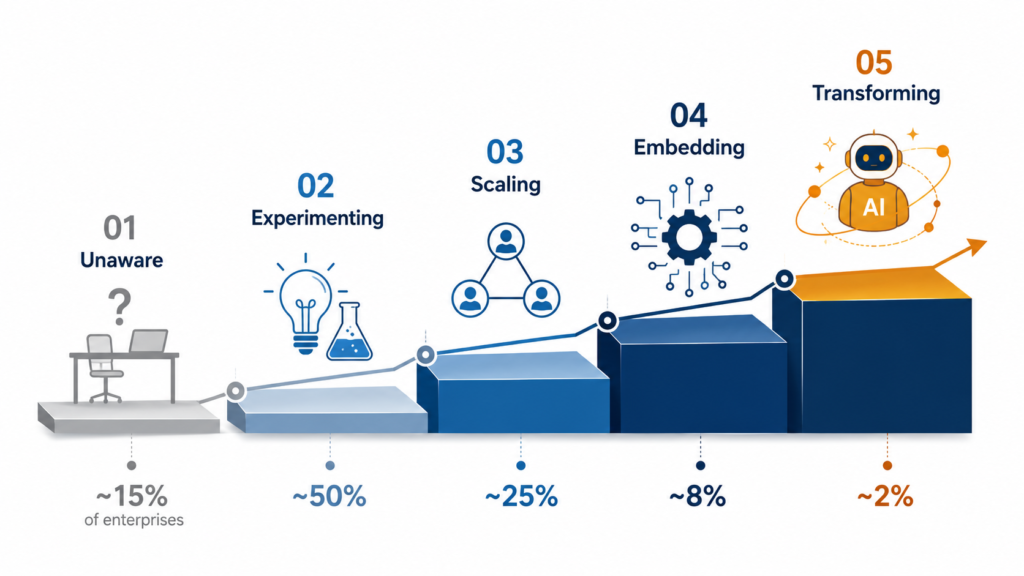
Understanding the stages of AI maturity is not an academic exercise. It is the difference between investing in the right next step and investing in the wrong one. Organizations that attempt to scale AI without embedding governance first consistently fail. Organizations that invest in workforce fluency before their data infrastructure is stable waste both time and goodwill. The levels exist to sequence the journey correctly.
Level 1 — Unaware: What an AI-Immature Organization Actually Looks Like
An Unaware organization has not yet made a deliberate, structured commitment to AI. Conversations about AI happen — in leadership meetings, in team channels, in vendor pitches — but they do not translate into coordinated action. There is no AI strategy. There is no data governance framework designed with AI in mind. There is no executive owner. There may be individual employees using AI tools personally, but the organization has no visibility into this and no position on it.
The defining characteristic of Level 1 is not ignorance. Most Level 1 organisations are aware that AI matters. The defining characteristic is inaction — the belief, often unspoken, that structured AI adoption can wait until the technology matures further, the budget opens up, or a competitor forces the issue. Every quarter spent at Level 1 is a quarter in which competitors are building data pipelines, governance frameworks, and workforce capability that will take years to replicate.
Typical Level 1 profile: Mid-size enterprise, traditional industry, IT-led technology function, no Chief AI Officer or equivalent, AI discussed at board level but not budgeted or owned.
Level 2 — Experimenting: Why Isolated AI Pilots Fail to Scale
An Experimenting organisation has moved from conversation to action — but the action is fragmented. Pilots are running. Individual teams have found AI tools that help them work faster and are using them enthusiastically. There may be a proof-of-concept underway in one or two business units.
The problem at Level 2 is not enthusiasm. It is isolation. Each pilot is its own island. There is no shared infrastructure, no cross-functional governance, no mechanism for capturing what works and replicating it, and critically — no measurement framework. This is where 80% of enterprise AI activity currently lives — organisations exploring and experimenting with AI tools, deploying point solutions, but not yet building the organisational capability to scale what works.
Level 2 is also where shadow AI proliferates fastest. Without a governance framework or a sanctioned platform, employees default to whatever tools solve their immediate problem. This creates a hidden layer of AI-dependent workflows that the organisation cannot see, cannot govern, and cannot support when something goes wrong.
Typical Level 2 profile: Progressive enterprise or scale-up, innovation team driving AI pilots, some executive interest but no executive ownership, data infrastructure not yet redesigned for AI workloads.
Level 3 — Scaling: How Organizations Successfully Move AI from Pilot to Production
Scaling is the first level at which AI maturity becomes structurally visible inside the organisation. At Level 3, AI has moved from isolated projects to coordinated programmes. There is an executive sponsor. A governance framework — however early — is in place. A unified data platform is either operational or in active development. Three to five AI use cases have produced documented, measurable value and are being used to build the internal business case for further investment.
The Level 3 organization has crossed what is arguably the hardest single threshold in the AI maturity journey: the transition from pilot to production. Only 5% of custom enterprise AI solutions ever make it to production. (Source: MIT GenAI Divide 2025). The organizations that do share a common characteristic — they stopped treating AI as an experiment and started treating it as an operational discipline. That shift in mindset is what Level 3 represents.
Typical Level 3 profile: Digitally progressive enterprise, dedicated AI programme team, CDO or equivalent in post, cloud data platform operational, early ROI documented on flagship use cases, upskilling programme launched.
Level 4 — Embedding: When AI Integration Becomes an Operational Standard
At Level 4, the nature of the conversation about AI inside the organisation changes fundamentally. AI is no longer the subject of a steering committee update or a pilot review. It is embedded in how core workflows operate, how decisions get made, and how performance is measured. AI-attributed value appears in financial reporting. The question is no longer whether AI works — it is where to deploy it next.
The workforce at a Level 4 organisation looks different from Level 3. AI fluency is not concentrated in a dedicated team — it is distributed across functions. Role-specific capability expectations exist. A champions network sustains momentum. Employees are not just using AI tools — they are building AI-enhanced workflows and identifying use cases independently.
Level 4 is also where culture shift becomes self-sustaining. AI-driven personalisation, proactive analytics, and zero-touch automation stop being transformation initiatives and become operating standards — the baseline expectation rather than the competitive differentiator. The governance posture at Level 4 is mature. An AI ethics board or equivalent exists with genuine authority. Regulatory compliance is mapped and maintained.
Typical Level 4 profile: Large enterprise, AI embedded in core operations across at least three business functions, CDO and CAIO in post, AI value reported at P&L level, regulatory compliance framework operational.
Level 5 — Transforming: What Agentic AI Enterprise Readiness Actually Looks Like
Level 5 is not simply a better version of Level 4. It is a qualitatively different organisational state. At Level 5, AI is a documented source of competitive advantage — not a capability the organisation has, but a capability that shapes what the organisation is and what it can do that others cannot.
The defining technical characteristic of Level 5 is agentic AI. Organisations at the frontier of AI maturity in 2026 are not just deploying AI tools that augment human work — they are deploying AI agents that complete multi-step tasks autonomously, with human oversight at the orchestration level rather than the task level. Customer onboarding, supply chain optimisation, financial reconciliation, content operations — at Level 5, these are not AI-assisted processes. They are AI-run processes with human governance.
The cultural characteristic of Level 5 is equally important. Employees at a Transforming organisation do not wait to be told where AI applies. They identify opportunities independently, propose new use cases through established channels, and hold each other accountable for AI-first thinking. The organisation has built a compounding return on its AI investment — each capability improvement generates data and insight that funds the next one.
Typical Level 5 profile: Digital-native enterprise or AI-first organisation, agentic AI systems operational across multiple functions, AI value compounding through continuous learning loops, AI reshaping business model and competitive positioning.
The AI Maturity Scorecard: Full 7×5 Matrix for Business Self-Assessment
The matrix below is the centrepiece of this framework. Each cell represents what your organisation looks like at the intersection of a specific dimension and a specific maturity level. Score each dimension independently. Resist the temptation to average across dimensions — the gaps between your highest and lowest scores are where your most important strategic insights live.
| Dimension | L1: Unaware | L2: Experimenting | L3: Scaling | L4: Embedding | L5: Transforming |
|---|---|---|---|---|---|
| Strategic Alignment | No AI in business strategy. No executive ownership. AI discussed but not budgeted. | AI referenced in strategy. Individual champions exist. No cross-functional ownership or defined KPIs. | AI roadmap exists with named executive sponsor. AI KPIs defined and reviewed quarterly. | AI KPIs embedded in business scorecards. AI investment reported as a strategic line item. Board-level accountability. | AI drives new business model creation. Competitive positioning explicitly shaped by AI capability. |
| Data Readiness | Siloed, ungoverned data. No data strategy designed for AI. Quality issues unacknowledged. | Data audit initiated. Quality issues identified but not resolved. Governance policy drafted, not enforced. | Unified data platform operational. Data governance actively enforced. Use-case data provisioned in weeks. | Real-time data pipelines feeding AI systems in production. Single source of truth operational across core use cases. | AI systems continuously learning from live operational data. Data and AI in a closed improvement loop. |
| Technology & Infrastructure | No AI tooling beyond default SaaS features. No AI-specific infrastructure. | Point solutions deployed by individual teams — Copilot, ChatGPT, isolated automations. No unified platform. | Cloud AI platform in place. MLOps pipeline forming. Production AI systems monitored for performance and drift. | Enterprise AI platform operational. Models monitored, versioned, retrained systematically. Integration architecture designed for AI workloads. | Agentic AI systems operating autonomously across multiple functions. Orchestration layer, override controls, and audit trails fully operational. |
| Governance & Risk | No AI policy. No risk framework. Shadow AI undetected and unmanaged. | Acceptable use policy drafted. Basic awareness of regulatory requirements. No enforcement mechanism. | Risk classification framework in place. AI use cases categorised by risk level before deployment. High-risk applications subject to additional review. | AI ethics board operational with genuine authority. Regulatory compliance mapped and maintained. Full visibility into AI in use across the organisation. | Anticipatory governance. EU AI Act audit-ready. Governance framework evolving ahead of regulation. |
| Value Realization | No ROI tracking. No success metrics defined. Value assessment entirely anecdotal. | Anecdotal efficiency gains noted. No formal measurement. ROI defined retrospectively if at all. | Three to five AI use cases with documented, quantified ROI. Success metrics defined before launch. Executive review of outcomes in place. | AI-attributed savings and revenue reported at P&L level. Formal AI ROI measurement process operational. Value reviewed with same rigour as capital investment. | AI value compounding through continuous learning loops. AI generates insights that identify and fund the next generation of AI investment. |
| Workforce Fluency & Culture | No AI training programme. Individual use invisible to the organisation. No position on workforce AI adoption. | Ad hoc training. Power users self-selecting. AI enthusiasm concentrated in small pockets. Shadow AI growing. | Structured AI upskilling programme operational. Role-specific training in place for priority functions. AI champions network forming. | AI fluency measured by role. Champions network active and sustained. AI capability expectations embedded in performance management. | AI-first culture. Employees independently identify use cases and co-design workflows with AI agents. AI proficiency a hiring and promotion criterion. |
| AI Security & Trust | No AI security posture. Outputs unaudited. No explainability. No process to challenge AI decisions. | Basic cybersecurity applied to AI tools. Explainability not considered. No adversarial testing. | Adversarial testing initiated for high-risk use cases. Explainability requirements defined for regulated applications. | AI reliability monitored and reported. Explainability built into deployment standards. Challenge and escalation process operational. | Full explainability across all production systems. Trust metrics tracked and reported at board level. Anticipatory security posture against emerging adversarial threats. |
How to Assess AI Maturity in Your Business: A Step-by-Step Scoring Guide
Assessing AI maturity honestly is harder than it looks — not because the framework is complex, but because the instinct in most organisations is to score against aspiration rather than reality. The three-step process below is designed to counteract that instinct.
Step 1: Who Should Complete Your AI Readiness Assessment
Do not score the CPP AI Maturity Matrix™ alone, and do not score it only with your AI or technology team. The most effective AI maturity assessments ask people across the entire organisation — or in selected groups of business leaders and key functions — rather than relying on a single perspective from IT or a central transformation team. Invite representatives from at least four functions: technology, operations, finance, and one or two business units that are active AI users. Their perspectives will diverge — and that divergence is data, not noise.
Plan for a two-hour working session. Brief participants in advance with the dimension definitions above. Ask them to form an initial view before the session so the discussion starts with positions, not blank sheets.
Step 2: How to Use the AI Maturity Questionnaire Dimension by Dimension
Work through each of the seven dimensions in sequence. For each one, read the level descriptions and the diagnostic questions aloud as a group. Arrive at a consensus score using the following rule: score to the lowest level at which all criteria are genuinely met — not the highest level you are partially approaching.
This rule matters. The most common scoring error in maturity assessments is crediting partial progress at a higher level rather than acknowledging incomplete foundations at a lower one. An organisation that has a data governance policy drafted but not enforced is at Level 2 on Data Readiness — not Level 3 — regardless of how much progress feels like it has been made.
Record your score for each dimension. Note the specific criteria that determined your level — these become the action items in Step 3.
Step 3: How to Interpret Your AI Maturity Assessment Score and Identify Your Binding Constraint
Once all seven dimensions are scored, resist the instinct to calculate an average. Your dimension profile — the seven individual scores laid side by side — is where the strategic insight lives.
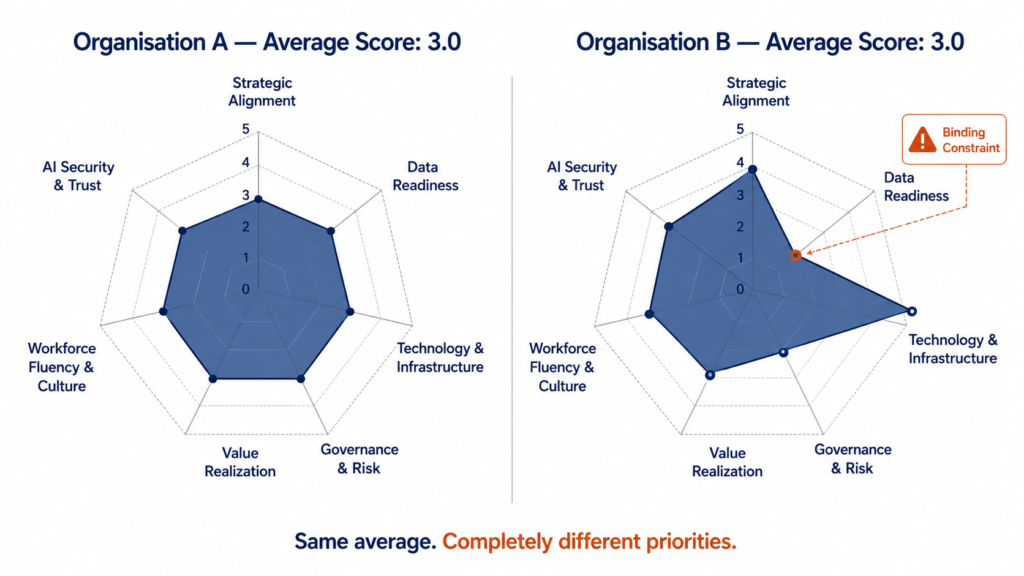
Look for two things specifically. First, identify your lowest-scoring dimension. This is almost always your binding constraint — the dimension whose weakness is limiting progress in every other area. Data Readiness at Level 1 will cap your Technology and Infrastructure progress regardless of how sophisticated your tooling is. Governance at Level 1 will eventually halt your Scaling efforts when something goes wrong publicly. Fix the floor before you raise the ceiling.
Second, identify your largest gap — the dimension where the distance between your current score and your target maturity level is greatest. This is your highest-return investment area. Closing a two-level gap in Value Realization will typically do more for your organisation’s AI programme than incremental improvement in a dimension already performing well.
AI Maturity Levels Explained: What Your Score Means and Your Next Steps by Level
Your dimension profile is not a report card. It is a strategic sequencing tool. The organizations that use maturity assessments most effectively respond with a sequenced investment thesis — fixing foundations before adding capability, closing binding constraints before pursuing ceiling improvements.
At Level 1: How to Build AI Readiness Before You Deploy Anything
The temptation at Level 1 is to leap — to launch a flagship AI initiative that demonstrates commitment and generates internal momentum. Resist it. Nearly 42% of companies abandoned their generative AI initiatives in 2025, up from 17% the year before — and among those that launched, almost half discarded their AI concepts before reaching production. (Source:S&P Global Market Intelligence 2025) Most of those failures were Level 1 organizations that skipped the foundation.
Your priority at Level 1 is not AI deployment. It is AI readiness. Commission a data audit. Appoint an executive AI owner. Draft an acceptable use policy. Define what success looks like for your first use case before you build it. These are unglamorous steps. They are also the ones that determine whether everything that follows them works.
At Level 2: How to Scale AI Beyond the Pilot Stage
Level 2 organizations have proved that AI can work. What they have not done is build the conditions under which it can scale. The single most valuable investment at Level 2 is governance — not because regulators demand it, but because without it, every successful pilot remains an island.
Establish a unified AI platform. Stand up a risk classification framework. Define your first set of cross-functional AI KPIs. And critically — conduct a shadow AI audit. 72% of AI investments are being undermined by tool sprawl and unmanaged shadow AI.(Source: ISG / Heinz Marketing synthesis citing ISG data) You cannot govern what you cannot see, and you cannot scale what you cannot govern.
At Level 3: How to Measure AI ROI and Close the Value Gap
Level 3 organizations have infrastructure, governance, and executive ownership. What they frequently lack is a rigorous value measurement discipline. The transition from Level 3 to Level 4 is not a technology problem — it is a measurement problem.
Build a formal AI ROI framework. Require success metrics to be defined before any new use case is approved. Create a reporting mechanism that surfaces AI-attributed value at the executive level on a quarterly cadence. The organisations that reach Level 4 are not the ones that deployed the most AI. They are the ones that measured it most honestly.
At Level 4: Building Agentic AI Readiness and Closing the Proficiency Gap
Level 4 organisations have built the infrastructure and governance to operate AI at scale. The ceiling they hit next is usually workforce depth — the gap between AI access and AI proficiency that limits the return on the technology investment already made. OpenAI’s 2025 State of Enterprise AI report found a 6x engagement gap between AI power users and typical employees — Meta reported a 30% average improvement in output from AI tools, but an 80% improvement among power users.(Source : OpenAI State of Enterprise AI 2025)
Close that gap deliberately. Measure proficiency by role, not by licence count. Build role-specific capability frameworks. And begin your agentic AI readiness assessment — because the organisations moving from Level 4 to Level 5 in 2026 are the ones that started building agentic infrastructure twelve months earlier.
At Level 5: Sustaining AI Transformation and Compounding Your Competitive Advantage
Level 5 is not a destination at which you arrive and rest. The compounding advantage of AI maturity means the gap between Level 5 organizations and those one level below is widening faster than those lower-level organizations can close it. Your priority at Level 5 is sustaining the improvement loop — continuous learning, continuous measurement, and continuous governance evolution that keeps your capability ahead of both the regulatory environment and the competitive field.
From AI Readiness to AI Maturity: The Organizations That Win the AI Decade
AI maturity is not a destination. It is a discipline — the ongoing practice of honest self-assessment, deliberate investment, and structured progression that separates organisations building compounding advantage from those funding compounding waste.
The enterprise AI market is projected to reach $347 billion in 2026 — yet 46% of companies report that not a single enterprise objective has seen a strong positive impact from their AI initiatives. The gap between those two numbers is not a technology problem. It is a maturity problem. And maturity problems have maturity solutions.
The CPP AI Maturity Matrix™ gives you the diagnostic precision to know exactly where your organisation sits across seven dimensions, what your binding constraints are, and what the sequenced path forward looks like. Use it honestly. Score to the lowest level at which all criteria are genuinely met. Read your dimension profile, not your average. And invest in the floor before you raise the ceiling.
The organisations that understand where they are in 2026 are the ones that will know where they are going in 2027 — and beyond.
More from CorporatePlaybookPro.com
→ AI Maturity Assessment Scoring Guide for Small Business
→ Agentic AI for Small Business: Use Cases & Roadmap
→ Top 10 AI Use Cases Transforming Small & Medium Business
→ Top 9 Affordable Agentic AI Platforms for Small Businesses
→ What is Agentic AI? Complete Guide with Real-World Examples
→ Types of AI Agents : Guide for Business Leaders
→ How to Use Claude AI for Business: The Complete 2026 Guide
→ Google AI For Business Leaders : Maturity Assessment Guide
Frequently Asked Questions : AI Maturity Assessment Frame Work
What is AI maturity in business and why does it matter now?
AI maturity in business refers to the degree to which an organisation has systematically embedded artificial intelligence across its strategy, operations, data infrastructure, governance, and culture — and the extent to which that embedding is producing measurable business value. It matters now specifically because the gap between AI investment and AI impact has never been wider. The average AI maturity score across enterprises dropped nine points in 2025 despite record investment (source: ServiceNow/Oxford Economics Enterprise AI Maturity Index 2025) — meaning most organisations are investing faster than they are maturing. Understanding where you actually stand is the precondition for closing that gap. Default
What is the difference between AI readiness and AI maturity?
AI readiness measures whether an organisation has the foundational conditions in place to begin deploying AI effectively — data infrastructure, governance policies, executive sponsorship, and workforce awareness. AI maturity measures how far along the journey an organisation actually is, and whether AI is producing real business impact. Readiness is a precondition. Maturity is the outcome. An organisation can be AI-ready and still be AI-immature if its deployments are producing no measurable value. The most important practical implication: organisations that skip the readiness assessment and attempt to scale AI directly almost always stall at Level 2.
How do you conduct an AI maturity assessment step by step?
Conducting an AI maturity assessment effectively requires four steps. First, select a cross-functional scoring group that includes technology, operations, finance, and at least two active AI-using business units — a single-team assessment produces optimistic scores. Second, score each dimension independently using defined level descriptors and diagnostic questions, applying the rule that you score to the lowest level at which all criteria are genuinely met. Third, produce a dimension profile — seven individual scores laid side by side — rather than calculating an average. Fourth, identify your binding constraint — the lowest-scoring dimension — and your largest gap — the dimension furthest from your target level. These two data points drive your AI investment sequencing. The full process takes approximately two hours in a facilitated working session.
What are the biggest blockers to AI maturity in enterprise organizations?
The most common blockers to AI maturity include siloed data, lack of skilled talent, unclear ROI, poor change management, and underdeveloped governance frameworks. In practice, the binding constraint varies by maturity level. For Level 1 and Level 2 organisations, the blocker is almost always data readiness — AI systems cannot produce reliable outputs from ungoverned, siloed data regardless of how sophisticated the models are. For Level 3 organisations, the blocker is typically measurement discipline — the absence of a formal ROI framework means successful pilots cannot build the internal business case for scaling. For Level 4 organisations, the blocker shifts to workforce depth — the gap between AI access and genuine AI proficiency limits the return on technology already deployed. Identifying which blocker applies to your organisation is the primary output of a dimension-level maturity assessment. ServiceNow
How often should an organization reassess its AI maturity?
AI maturity should be formally reassessed at minimum annually, and triggered immediately by four specific events: a significant technology infrastructure change such as a new cloud platform or AI tooling migration; a leadership transition in a technology, data, or AI role; a merger, acquisition, or major restructuring; or a material regulatory change such as EU AI Act implementation affecting your sector. (Editorial guidance, CPP AI Maturity Matrix) Beyond these triggers, organizations at Level 3 and above benefit from a lighter quarterly dimension check — not a full assessment, but a review of whether the binding constraint identified in the last assessment has been addressed and whether any new gaps have emerged. Maturity is not a static state. Fast-moving AI capability development means an organization that accurately scored Level 3 twelve months ago may have advanced — or regressed — significantly since.
Can a mid-size business reach AI maturity without a dedicated AI team?
Yes — but the path looks different from a large enterprise. Mid-size organisations can determine their AI maturity stage by reviewing how AI is currently used: if there is no intentional use, the organisation is at Level 1; if AI is used by individuals or single departments, it is at Level 2; if AI is integrated across multiple functions with executive ownership, it is at Level 3 or above. The absence of a dedicated AI team does not prevent maturity progression — but it does shift where executive ownership must sit. For mid-size organisations without a Chief AI Officer, the CEO or COO must own the AI strategy directly. The dimensions that require specialist depth — Technology and Infrastructure and AI Security and Trust — can be addressed through targeted vendor partnerships or fractional AI leadership. The dimensions requiring organisational will — Strategic Alignment, Value Realization, and Workforce Fluency — cannot be outsourced and are equally achievable for mid-size organisations that commit to them. Agility at Scale
What is the difference between an AI maturity model and an AI roadmap?
An AI maturity model is a diagnostic — it tells you where your organisation currently sits across a set of defined dimensions and levels. An AI roadmap is a plan — it defines where you are going, by when, and through which initiatives. The relationship between them is sequential: you cannot build a credible AI roadmap without first completing an honest maturity assessment, because the roadmap’s starting point must reflect your actual current state, not your aspirational one. Organisations that build roadmaps without a maturity assessment typically do one of two things — they plan against an inflated view of their current capability, leading to implementation failures, or they plan against a generic industry template that does not reflect their specific dimension profile. The CPP AI Maturity Matrix™ is the diagnostic that makes an accurate, sequenced AI roadmap possible.
How does agentic AI change what AI maturity means for businesses?
Agentic AI fundamentally raises the bar for what Level 5 AI maturity looks like — and creates a new dimension of assessment that most pre-2025 maturity models were not built to capture. Traditional AI maturity frameworks were designed for the era of AI assistants: tools that help humans work faster, produce content, or surface insights. The defining question of AI maturity in 2026 is no longer “are your people using AI tools?” It is “is AI doing independent work?” Maturity models that do not distinguish between AI as an assistant and AI as an autonomous agent are measuring organisations against yesterday’s standard. In practical terms, agentic AI readiness requires infrastructure capabilities — orchestration layers, override controls, audit trails — and governance capabilities — accountability frameworks for autonomous decisions — that sit above and beyond what Level 4 embedding requires. This is why the CPP AI Maturity Matrix™ places agentic AI explicitly at Level 5 of the Technology and Infrastructure dimension, and why AI Security and Trust exists as a standalone seventh dimension. Authentic
How long does it take to move from one AI maturity level to the next?
Progression timelines vary significantly by dimension and by the quality of investment in foundations. As a general benchmark: moving from Level 1 to Level 2 can happen in as little as three to six months if an executive owner is appointed, a data audit is commissioned, and a governance policy is drafted — these are decisions, not infrastructure projects. Moving from Level 2 to Level 3 typically takes nine to eighteen months and requires real infrastructure investment — a unified data platform, a cross-functional governance framework, and at least three use cases taken to production. The Level 3 to Level 4 transition is often faster than expected — six to twelve months — because the foundation is already in place and the work shifts to measurement discipline and workforce development. The Level 4 to Level 5 transition has no reliable timeline because it depends on agentic AI infrastructure readiness and cultural maturity that cannot be forced. Organisations that try to compress it typically compromise governance in ways that create significant downstream risk.
What is the most important dimension of AI maturity to fix first?
The answer depends entirely on your current dimension profile — which is why averaging your scores is a mistake. The governing rule is: fix the binding constraint first, not the most appealing opportunity. For most Level 1 and Level 2 organisations, Data Readiness is the binding constraint — every other dimension’s progress is capped by the quality and accessibility of your data. For Level 3 organisations, Value Realization is typically the highest-return fix — translating existing AI activity into documented, board-level business value unlocks the investment and executive commitment needed for Level 4. For Level 4 organisations, the binding constraint usually sits in either Workforce Fluency — where proficiency has not kept pace with deployment — or AI Security and Trust — where governance has not been extended to cover the technical integrity of AI systems themselves. Identify your lowest score first. That dimension is where to invest before anything else.