You’ve read the AI maturity frameworks. Gartner has one. Deloitte has one. Consulting firms sell six-figure engagements built entirely around them. And none of them were written with a five-person business in mind. If you’ve ever tried mapping your shop against a model built for a Fortune 500 innovation team, you already know the problem: half the questions don’t apply to you, and the ones that do assume a data science team, a governance committee, and a change-management budget you simply don’t have.
Here’s what actually matters for a small operation: knowing your own AI maturity level, understanding where the real risk sits, and knowing exactly what to do next — without hiring anyone to tell you. That’s a fair thing to want. Only 30% of marketing leaders at large, well-resourced companies report mature or fully developed AI readiness capabilities (Gartner). If teams with dedicated budgets and headcount are still stuck at “not ready,” a small business owner shouldn’t feel behind for lacking a formal AI strategy — what’s missing is a version of this ai maturity assessment for small business built for an operation your actual size. This guide gives you a free, ungated, 15-minute self-scoring assessment, explains exactly why the enterprise models don’t map onto a small operation, and tells you what to do with your score once you have it. Think of it as an ai readiness assessment for small business, sized correctly for the first time.
What Is an AI Maturity Assessment (and Why Small Business Needs a Different One)
An ai maturity assessment for small business is a structured way to measure how far an organization has moved from experimenting with AI to running it as a dependable part of daily operations. The standard models — Gartner’s five-level scale, Deloitte’s four-level scale, and the dozen consulting-firm variants built on top of them — score this across pillars like strategy, governance, data infrastructure, talent, and culture. They were built for organizations with departments to staff each pillar, not for a business where the owner is also the accountant, the marketer, and the entire IT department.
Just 1% of companies believe they’ve actually reached full AI maturity, according to McKinsey’s Superagency in the Workplace research — and that figure comes from companies with the budget and staff to try seriously. If a Gartner-style model rarely produces a clean result even for well-funded enterprises, forcing that same rubric onto a five-person shop doesn’t just waste an afternoon — it produces a misleading score. A small business scored against enterprise governance pillars will almost always come back “immature,” regardless of how well AI is actually working inside the business, because the model is measuring committees and roadmap documents that were never going to exist there.
This is precisely why any honest ai maturity assessment for small business starts from the position that enterprise ai maturity models don’t work for small business: they measure things a small operation structurally doesn’t have — a dedicated AI governance board, a data science function, a multi-year transformation roadmap with quarterly checkpoints — and they miss the one variable that actually determines whether AI sticks in a small shop: whether a single person can maintain it day to day without breaking something else in the business. The gartner ai maturity model for small business use, in its unmodified form, asks about “cross-functional AI centers of excellence” and multi-year platform investment plans. A one-person consultancy doesn’t have functions to cross, and shouldn’t try to invent one just to answer the question honestly.
None of this means small businesses are lagging the enterprises these models were built for — often the opposite is true. Shopify’s Sidekick AI assistant onboarded roughly 750,000 new merchants in a single quarter, generating close to 100 million interactions (MLQ.ai reporting on Shopify’s Q3 2025 results), most of them small, independent sellers using AI for inventory management and customer replies without any formal maturity model guiding them at all. That scale of small-business AI use — real, operational, unglamorous — is exactly what a maturity model for this audience should measure, rather than penalizing a business for lacking a governance charter it was never going to write.
If you want the broader organizational version of this framework — the one built for teams with departments and multiple decision-makers — the AI Maturity Assessment Framework for Business covers that ground in full. This guide strips the model down to the parts that actually apply at solopreneur and small-team scale, and replaces the parts that don’t with questions sized for a real one-to-ten-person operation.
Picture three common small-business owners running through the standard Gartner-style rubric: a solo bookkeeper, a two-person marketing agency, and a local retail shop with four employees. All three would be asked about their “AI center of excellence” and their “cross-functional governance board.” None of them have one, none of them need one at this size, and none of that absence tells you anything useful about whether their business is actually using AI well or badly. That’s the core failure of applying an unmodified ai maturity assessment for small business straight from an enterprise template — it scores structures, not outcomes. A workable small business version scores habits, judgment, and consistency instead, because those are the things a one-to-ten-person team actually controls day to day.
The 5 AI Maturity Levels Explained for a One-Person Business
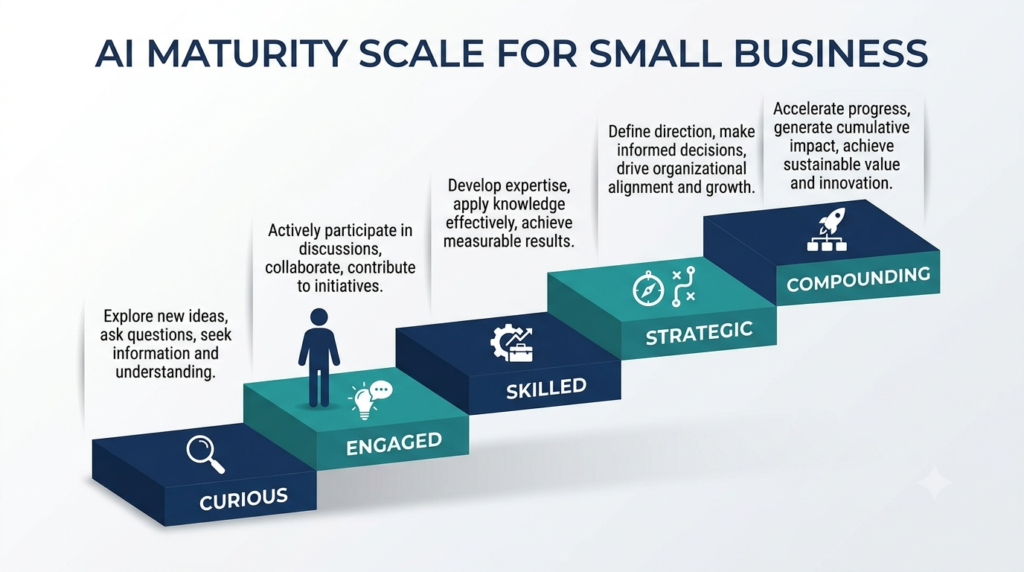
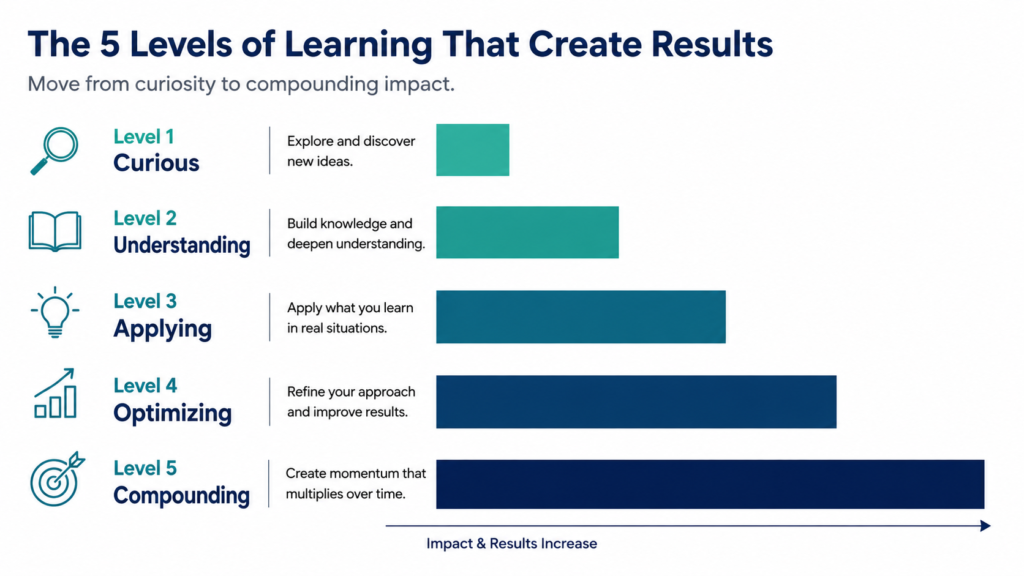
Every AI maturity model — Gartner’s, Deloitte’s, the imitators — collapses to the same underlying arc: awareness, experimentation, operational use, scaled use, and full integration. Here are the ai maturity levels explained for a one-person business, adapted so each level describes something a solo operator or small team would actually recognize in their own week:
Level 1 — Curious. You’ve used ChatGPT or a similar tool a handful of times, out of curiosity more than necessity. No workflow depends on it. If the tool disappeared tomorrow, nothing in the business would break.
Level 2 — Dabbling. AI helps with one or two recurring tasks — drafting emails, generating social captions, summarizing a long document — but it’s ad hoc. There’s no process; you just reach for it when you remember to.
Level 3 — Operational. At least one real workflow runs through AI on a regular basis: a customer-service reply draft, an invoice categorization step, a content calendar. You’d notice — and feel it — if it stopped working.
Level 4 — Integrated. Multiple workflows lean on AI, and you’ve started tracking, even informally, what it saves in time or money. You have a rough sense of return on the tools you pay for.
Level 5 — Compounding. AI touches most of your recurring operations, and you actively look for the next task worth handing off. It’s become part of how the business runs day to day, not a tool you occasionally remember to open.
These ai maturity stages for small business aren’t a ladder you’re expected to climb in order over years — most solo operators bounce between Level 2 and Level 3 depending on the month. 58% of small businesses now self-identify as using generative AI, up from 40% the year before (U.S. Chamber of Commerce) — which means most readers of this guide are sitting somewhere around Level 2 or 3, not Level 1. That’s the normal, unremarkable starting point for almost everyone doing this self-assessment, and it’s exactly why scoring yourself honestly matters more than assuming the worst or the best about where you stand on ai adoption.
Consider what movement between levels actually looks like in practice, rather than in the abstract. A freelance graphic designer at Level 2 might be using an AI tool to draft client proposal language, but redoing it from scratch half the time because the output doesn’t match her voice. Moving to Level 3 doesn’t mean buying a bigger tool — it means building a five-minute editing pass into her process so the workflow becomes dependable enough to actually rely on. A four-person bookkeeping practice at Level 3 might have one AI-assisted categorization workflow running smoothly, but no idea whether it’s actually saving time once error-correction is factored in; moving to Level 4 means simply tracking that number for two weeks. None of these transitions require new software, new headcount, or a consultant — they require the specific, narrow fix that this article’s scorecard is built to surface for each dimension separately.
AI Maturity Self-Assessment for Solopreneurs With No Team
Every enterprise maturity model has a “people and culture” or “talent” pillar — and every one of them assumes there’s a team to assess, train, and hold accountable. An ai maturity self-assessment for solopreneurs with no team needs a direct substitute: instead of asking “does your organization have AI-literate staff,” it should ask “do you personally understand what each AI tool you rely on is actually doing with your data and your decisions, right now, today.”
This distinction is at the heart of any real ai maturity assessment for small business, and it matters more than it first appears. Organizational readiness accounted for 48% of the difference between companies capturing real value from AI and those that weren’t — nearly twice the 25% explained by personal readiness alone (McKinsey). In a business of one, there is no separate “organization” to compensate for gaps in your personal habits — you are the organization. Your documentation, your willingness to double-check AI output before it reaches a customer, your consistency across weeks rather than just enthusiasm in the first one — that’s your entire organizational-readiness score, full stop. An ai readiness assessment for small business built for a true solopreneur has to measure habits, not headcount, because headcount is the one thing a true solo operator will never have to offer. Think of it as an ai readiness assessment for solopreneurs first, and an AI maturity model second.
AI Readiness Questions for Small Business Without an IT Department
The ai readiness questions for small business without an it department that actually predict success aren’t about servers or infrastructure — they’re about habits repeated every week. Ask yourself honestly: Do you know which AI tools have access to customer data, and which don’t? Do you check AI-generated output before it goes out the door, every single time, or only when you happen to remember? If a tool changed its pricing overnight or shut down entirely, would you know how to replace it within a day without losing a client deadline?
These three questions substitute for an entire enterprise “IT readiness” pillar, because in a small business the owner’s habits are the infrastructure — there’s no separate systems team keeping score behind the scenes. Building basic ai literacy around these three questions, and revisiting them every quarter, closes most of the gap that a formal IT department would otherwise cover in a larger company.
Add a fourth question if you use more than two or three tools regularly: do any of them talk to each other automatically — a form tool feeding a CRM, an email assistant pulling from a shared inbox — and would you notice if that connection silently broke? Small businesses without an IT department rarely find out a connection failed until a customer complains, which is a far more expensive way to learn than checking it once a month yourself.
The Simple AI Maturity Scorecard for Small Business Owners
A simple ai maturity scorecard for small business owners should take less time to complete than the meeting you’d need to sit through to have an enterprise framework explained to you. This ai maturity assessment for small business boils down to scoring yourself 1–5 on each of the five dimensions below, based on where you honestly are today — not where you’d like to be in six months.
| Dimension | 1 (Curious) | 3 (Operational) | 5 (Compounding) | Your Score |
|---|---|---|---|---|
| Workflow use | Occasional, no set process | One core workflow runs on AI | Most recurring tasks touch AI | ___ |
| Data handling | Unsure what data tools access | Know what’s shared, no written policy | Written data-handling rule per tool | ___ |
| Output review | Rarely check AI output | Check most of the time | Consistent review step built in | ___ |
| Cost/time tracking | No idea what it costs or saves | Rough sense of savings | Tracked time/cost ROI per tool | ___ |
| Vendor resilience | No backup if a tool disappears | Know alternatives exist | Documented fallback per tool | ___ |
Add your five scores together. A total of 5–11 puts you at Level 1 (Curious). 12–17 spans Level 2 to Level 3 (Dabbling to Operational). 18–22 is Level 4 (Integrated). 23–25 is Level 5 (Compounding). 68% of U.S. small businesses now use AI regularly, up from 48% in mid-2024 (Intuit QuickBooks) — so most readers of this ai readiness scorecard for small business will land in the 12–17 range: already using AI day to day, but without yet tracking cost, documenting data handling, or building in a consistent review step. That’s a completely normal place to land on this ai maturity assessment for small business, and it points straight at what to fix first — habits and tracking, not fancier tools.
Run the numbers on a real example. A one-person e-commerce seller scores herself: workflow use 3 (product descriptions run through AI regularly), data handling 2 (unsure exactly what her chatbot plugin stores), output review 4 (she checks everything before it posts), cost tracking 1 (never tracked it), vendor resilience 2 (no backup plan). Total: 12 — solidly Level 2–3. Her lowest score, cost tracking, becomes this month’s fix: log fifteen minutes a day for one week on the single tool she uses most, and she’ll have a real number instead of a guess. That’s the entire value of this ai maturity assessment for small business — not a rank, but a next action.
How to Score Your Business AI Maturity in 15 Minutes
- List every AI tool you use regularly — five minutes, no judgment attached.
- Score each of the five scorecard dimensions above honestly, 1 through 5.
- Add the total and find your level band from the ranges above.
- Circle your single lowest-scoring dimension on this ai maturity assessment for small business — that’s your priority, not your favorite tool to upgrade next.
- Write one sentence describing exactly what “one level up” would look like for that specific dimension.
That five-step sequence is the entire process for how to score your business ai maturity in 15 minutes. No workshop, no consultant call, no expensive spreadsheet template to buy first. A good ai readiness checklist for small business does exactly one job: point you toward what to fix next, not rank you against a competitor you’ll never actually compete with on this metric.
Data Privacy Checklist for Small Business Using AI Tools
This is the section every enterprise model buries three layers deep under “governance” — and the one small businesses can least afford to skip, because there’s no compliance team catching mistakes after the fact. A data privacy checklist for small business using ai tools starts with three questions per tool, asked one at a time: What customer or business data does this tool actually see? Where is that data stored, and for how long after you stop using it? Can you delete it on request if a customer asks you to?
Small businesses have adopted AI noticeably faster than they’ve written rules for using it, according to recent reporting (Forbes) — meaning most small business owners today are running tools with no documented ai data privacy for small business policy at all, not because they don’t care, but because nobody built them an easy way to write one. You don’t need a legal team to close this gap. A one-page document listing each tool, exactly what it can access, and one plain-language rule for that tool — “never paste customer financial data into a general-purpose chatbot” is a common one — closes most of the risk in a single afternoon.
Read the terms of service for whatever tool touches customer data before deciding it’s safe to keep using it long-term. Most owners never do this, and it’s the single fastest way to catch the riskiest tool in your stack — the one quietly training on your inputs, or retaining data longer than you’d expect, or sharing it with a broader platform ecosystem you never agreed to in plain terms.
Two categories of AI tool deserve extra scrutiny on this front for any small business: free-tier general chatbots, which are often free precisely because your inputs help train the underlying model, and browser extensions that request broad page-access permissions to “help” with forms or emails. Neither is automatically unsafe, but neither should be handling a customer’s name, address, or payment details until you’ve actually checked the setting that turns off data retention or model training, if one exists. This habit — checking one setting, once, per tool — is the cheapest insurance a small operation can buy.
What to Do After a Low AI Maturity Score
A low score on this ai maturity assessment for small business is not a verdict on your business — it’s a to-do list, and a shorter one than it looks. Only 25% of AI initiatives have delivered the ROI companies expected, and just 16% have scaled beyond a pilot, even at large, well-funded enterprises with dedicated project teams (IBM). That statistic should be reassuring rather than discouraging: companies with entire departments dedicated to this still get it wrong most of the time, usually by trying to fix everything simultaneously instead of one thing at a time.
Good guidance on what to do after a low ai maturity score small business owners can actually follow means doing the opposite of what enterprises attempt — pick your single lowest-scoring dimension from the scorecard above and fix only that, for 30 days straight, before touching anything else. If your lowest score was data handling, write the one-page privacy policy described above this week. If it was output review, add a two-minute manual check before anything AI-generated reaches a customer’s inbox. If it was cost tracking, log time saved for one week on your single most-used tool, and nothing more ambitious than that.
Small businesses that treat a low score as one narrow, specific fix — rather than a reason to overhaul the entire operation at once — close the gap fastest, because the fix fits inside a week they actually have available, not a quarter they don’t.
Resist the urge to fix two dimensions at once, even when both feel urgent. A small business that tries to write a data policy, add a review step, and start cost tracking in the same week almost never finishes any of the three well — each fix competes for the same handful of hours a solo owner or small team actually has spare. This ai implementation roadmap for small business works because it’s sequential, not because any single step is hard. Finish one 30-day fix, confirm it’s actually sticking as a habit, then move to the next-lowest score.
How Small Businesses Can Build an AI Roadmap Without Consultants
Only 26% of enterprises have successfully operationalized AI at scale, per a 2026 Forrester-commissioned study (Forrester/FPT) — despite most of those enterprises having consultants, dedicated budgets, and full project teams behind the effort. That statistic is the strongest argument yet for why learning how small businesses can build an ai roadmap without consultants isn’t a compromise forced by a tight budget — it may genuinely work better, because a five-person business can move in weeks, not committee review cycles.
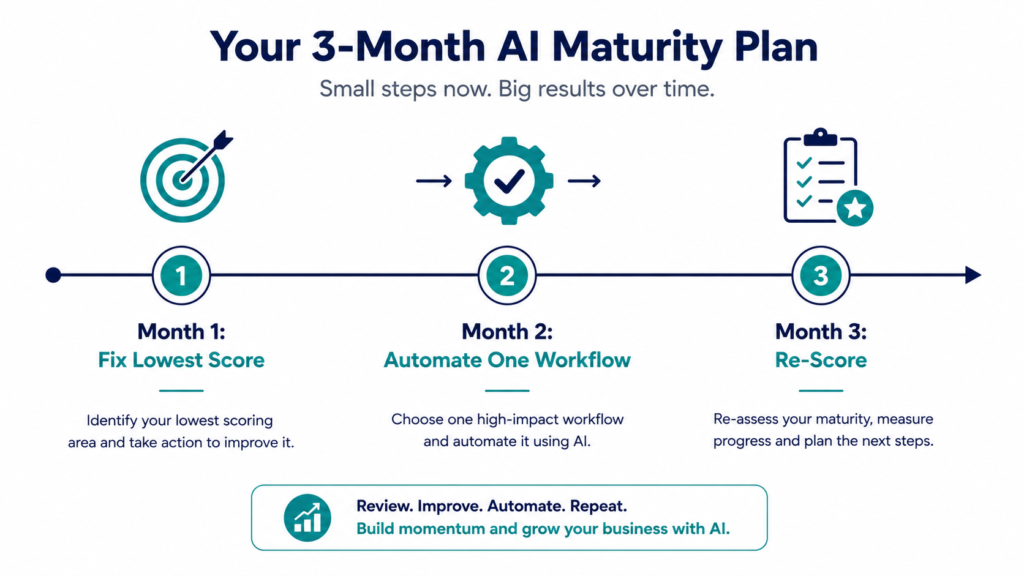
A workable roadmap that follows directly from this ai maturity assessment for small business looks like this: in month one, fix your single lowest scorecard dimension and nothing else. In month two, pick exactly one new workflow to automate — something repetitive and low-risk, not the customer-facing task you’re most nervous about handing off. In month three, re-take this scorecard and compare your new score against today’s baseline. That’s the entire roadmap; anything more elaborate starts to resemble the enterprise process you were trying to avoid in the first place.
Simple ai implementation for small business works precisely because it refuses to borrow enterprise pacing. A ten-person accounting firm doesn’t need a steering committee to decide whether to automate expense categorization — the owner tries it for two weeks, checks the error rate, and either keeps it or drops it. That decision speed is a genuine structural advantage over a 10,000-person company running the same evaluation through six layers of sign-off, and it’s worth using deliberately rather than apologizing for not having “proper” process around it.
If you’re ready to explore specific use cases for that next workflow, our guide to Gen AI Uses for Small Business and our roundup of the top AI use cases for small and medium business are both good starting points sized for exactly this stage. And if your business eventually outgrows single-tool use and is ready for AI that can act on its own within set guardrails, Agentic AI for Small Business covers what that next stage of small business ai strategy actually looks like in practice.
A note on timing: don’t wait for a “good” quarter to start this roadmap without consultants. The businesses that make the most progress on ai tools for small business owners treat month one as whatever month it is right now — not the slower season, not after the busy holiday period, not once revenue is more predictable. The fix for your lowest-scoring dimension takes the same 30 days regardless of when you start it, and every month spent waiting for ideal conditions is a month spent at the same score you have today.
Before moving to the conclusion, it helps to restate what this ai maturity assessment for small business is actually measuring and why each piece matters at this scale. Every enterprise ai maturity assessment tries to answer “how sophisticated is this organization’s AI program.” This ai maturity assessment for small business asks a narrower, more useful question instead: “is this specific business’s AI use dependable, safe, and worth the time it costs to maintain.” That reframing is the entire reason a generic ai maturity assessment for small business — copied wholesale from a Gartner deck — produces a misleading score, while a version built around five plain-language dimensions produces a genuinely useful one.
If you skimmed straight to this point, here is the compressed version of this ai maturity assessment for small business: five dimensions, scored 1 to 5, added into a single total, mapped to a level band, and pointed at exactly one fix. Repeat the same ai maturity assessment for small business every quarter, and you’ll have a real trend line within a year — something almost no small business currently tracks, and something no enterprise framework was ever going to hand you in a form you’d actually use.
Conclusion: Where Your Business Stands — and the Next Step
It’s worth stating plainly why this approach exists as its own guide rather than a shorter version of the Hub framework: a small business that runs an unmodified enterprise ai maturity assessment for small business use case will typically score itself as “immature” across every pillar, every time, regardless of how effectively it’s actually using AI day to day. That’s not a useful signal — it’s a mismatch between the measuring tool and the thing being measured. A five-person landscaping company running a genuinely dependable AI-assisted scheduling workflow is, in every practical sense, more AI-mature than a 2,000-person enterprise that has a governance committee but no working AI workflow at all. The enterprise model would score the second company higher anyway, because it rewards structure over outcome.
This ai maturity assessment for small business inverts that priority on purpose. It doesn’t ask whether you have a committee; it asks whether the thing you built actually works, whether you understand what it touches, and whether you’d notice if it broke. Those three questions make for a more honest ai maturity assessment for small business than a six-pillar enterprise rubric will ever produce for a business your size, because they measure the business you actually run rather than the business a consulting firm imagines when it builds a framework for a client roster of billion-dollar companies. Score honestly, fix one thing, and move on — that’s the whole method, and it scales from a single freelancer up through a twenty-person team without needing a different model at any point along the way.
An ai readiness assessment for small business doesn’t need six pillars, a governance committee, or a consultant’s slide deck to be genuinely useful — it needs to tell you, honestly, where you stand today and exactly what to fix first. Score yourself against the five dimensions in this guide, fix your single lowest-scoring one this month, and re-score in 90 days to see the movement. That’s a faster, cheaper, and arguably more honest ai maturity assessment for small business than most enterprises manage to run with their entire budget behind it.
Bookmark this scorecard and treat it as a recurring habit rather than a one-time exercise. Businesses change month to month — a new hire, a new tool, a new client with stricter data requirements — and a maturity score taken once loses its usefulness fast. Re-running this ai maturity assessment for small business every quarter takes the same fifteen minutes it took the first time, and it turns a single snapshot into an actual trend line you can watch move in the right direction.
For the broader organizational version of this framework — built for teams with more than one decision-maker — the AI Maturity Assessment Framework for Business is the next place to look once your business outgrows a one-person scorecard. Until then, this simple, self-scored version is the more honest fit — and the one you’ll actually finish.
More from CorporatePlaybookPro.com
→ The AI Maturity Assessment Framework Every Business Leader Needs
→ Google AI Tools for Business Leaders: The Maturity Guide
→ Digital Maturity Assessment: Benchmark Your Organization’s Transformation Readiness (2025 Guide)
→ How to Use Claude AI for Business: The Complete 2026 Guide
→ Claude vs ChatGPT for Small Business: Which AI Actually Fits Your Workflow? (2026)
→ Types of AI Agents: A Simple Guide for Business Leaders
→ What Is Digital Transformation? The Complete Guide for Business Leaders
→ Business Strategy Frameworks: The Complete Guide for Business Leaders
Frequently Asked Questions
How is AI readiness different from AI maturity?
AI readiness describes whether you could start using AI effectively right now — your data, tools, and habits. AI maturity describes how far you’ve actually progressed once you started. A small business can be AI-ready (clean habits, clear tool list) but still low on the ai maturity model for small business scale if it hasn’t put much into practice yet. Readiness is the starting line; maturity is how far down the track you’ve run.
Can a small business really assess its own AI maturity without hiring a consultant?
Yes — the five-dimension scorecard in this guide was built specifically so a solo owner or small team can complete it unaided in about 15 minutes. Consultants add value for complex, multi-department rollouts; a one-to-ten-person business rarely needs that layer to get an honest, useful score. Self-assessment works precisely because the questions are about your own habits, which nobody knows better than you do.
What tools do I need to run this AI maturity assessment myself?
None beyond a notepad or a blank document. This ai readiness checklist for small business is designed to be paper-and-pen simple: list your tools, score five dimensions 1–5, add the total. No software, template purchase, or account signup is required to get a usable result.
How often should a small business reassess its AI maturity?
Every quarter is the practical rhythm for most small businesses — often enough to catch a new tool or habit change, rare enough that it doesn’t become busywork. Reassess sooner if you add a new AI tool that touches customer data, since that changes your data-handling score immediately.
Do free AI readiness assessments actually work for solopreneurs?
They work well as long as the assessment is built for a true one-person operation rather than adapted from an enterprise template with a hidden “team capability” assumption. A free, honest scorecard focused on habits — not headcount — gives a solopreneur a genuinely accurate score, no paid tool required.
How long does an AI maturity self-assessment take for a small business?
Around 15 minutes for the five-dimension scorecard in this guide: five minutes to list your tools, five minutes to score each dimension, five minutes to total your score and pick your priority fix. That’s the entire time investment — no scheduling a workshop or blocking off an afternoon.
Should I hire an AI consultant or self-assess first?
Self-assess first, always. A consultant engagement is expensive and most useful when you already know your weak spot and need help executing a fix — not when you’re still figuring out where you stand. Score yourself, fix your lowest dimension for 30 days, and only bring in outside help if a specific technical gap (not a general “AI strategy” gap) remains after that.
How do I know if my small business AI maturity score is accurate without an outside audit?
Accuracy here comes from honesty, not verification — score each dimension against what you actually do in a typical week, not what you plan to do. If you’re unsure between two scores for a dimension, pick the lower one; small businesses consistently over-estimate output review and data handling until they check their own habits closely for a week.
What should a solo consultant do differently than a small business with employees when scoring AI maturity?
A solo consultant should skip any dimension that assumes delegation — there’s no one else to check your output but you, so “output review” becomes a personal discipline rather than a team process. Everything else on the scorecard applies the same way regardless of headcount; the difference is entirely in the “vendor resilience” and “workflow use” dimensions, which matter more when one person is the sole point of failure.
Can I use this AI maturity scorecard if my business only uses free AI tools?
Yes — the scorecard scores your habits and workflows, not what you paid for a tool. Free-tier tools actually raise the stakes on the data-handling dimension specifically, since many free AI products fund themselves by using your inputs for model training, so check that setting first regardless of your score elsewhere.
How many AI tools does a small business need before an AI maturity assessment is worth doing?
One is enough. If a single AI tool touches customer data, a recurring workflow, or a decision you rely on, this assessment is worth the 15 minutes — the risk and habit questions apply the same whether you use one tool or ten. Waiting until you have “enough” tools to justify assessing them just means running on unchecked habits longer.
What is a good AI maturity model for small business use, compared to Gartner or Deloitte’s?
A good small-business model drops the pillars that require departments — governance committees, dedicated data teams — and replaces them with habit-based dimensions: workflow use, data handling, output review, cost tracking, and vendor resilience. It should take minutes, not days, and should be usable without any outside facilitation.
What counts as a good AI readiness score for a small business?
On the five-dimension, 25-point scorecard in this guide, 18 or above (Level 4–5) reflects a business actively tracking and benefiting from AI use. A score of 12–17 is the most common range and simply means there’s one clear habit to build next — not that the business is behind.
What are the small business AI adoption levels most owners fall into today?
Most small business owners today sit at Level 2 or 3 — using AI regularly for one or two tasks but without formal tracking or documentation. Very few small businesses have reached Level 5, where AI is compounding across most operations, which is normal this early in small-business AI adoption broadly.