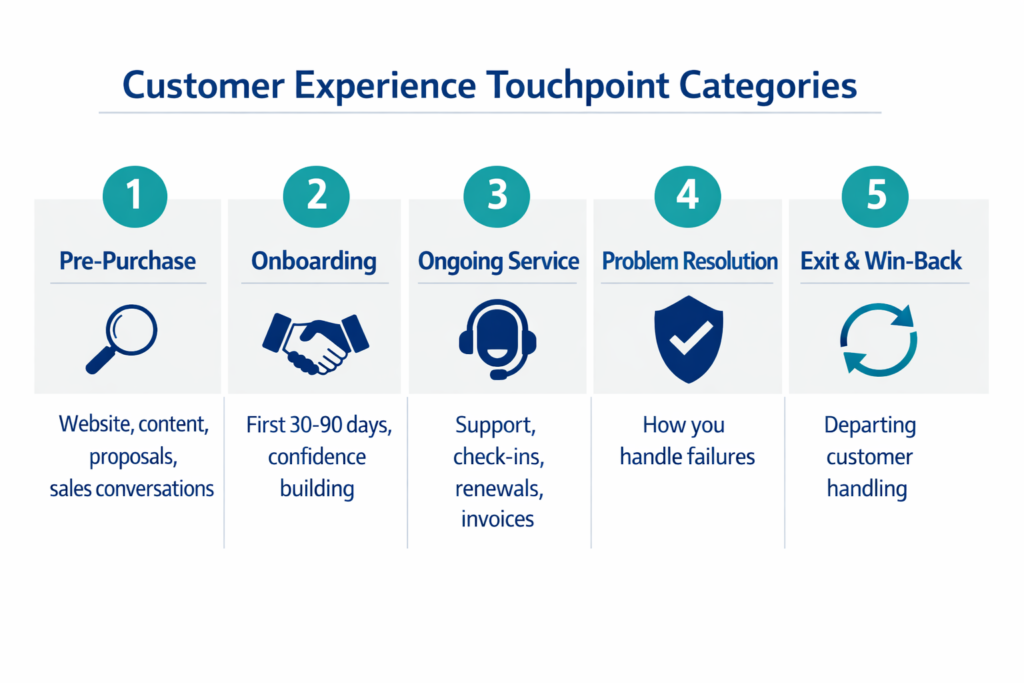
B2B customer experience strategy is the deliberate, organisation-wide approach to designing, measuring, and continuously improving every interaction between your business and your clients — from the first API handshake to the annual renewal conversation. Unlike CX frameworks written for dedicated CX teams, a B2B customer experience strategy for CTOs anchors in the technology layer you already own: integration architecture, customer portals, data pipelines, and the systems that determine how your clients actually experience your product at scale.
Your clients file the same support ticket three times. Your monitoring tools report green while a client’s team works around a broken integration. Your onboarding takes 60 days because nobody mapped who owns which handoff. None of that is a customer service problem. It’s a systems and ownership problem — and the buck stops with you.
Most B2B CX guides assume you have a dedicated CX team. You probably don’t. Fewer than 40% of B2B organisations have even one part-time person formally owning customer experience (McKinsey). The rest run CX through product, engineering, and operations. Which means the CTO is the de facto CX owner whether the org chart says so or not.
The numbers make the case for taking this seriously: 86% of B2B buyers will pay a premium for a superior customer experience (PwC). CX-leading companies grow revenue 2–3× faster than laggards (Forrester). And 70% of the B2B buying journey now happens digitally before a buyer ever speaks to a sales rep (Gartner) — which means the systems you’ve built are running your first impression.
This playbook gives you a concrete B2B customer experience strategy built around the technology decisions you actually control. No CX team required. No theory. Just a framework that works from the systems level up.
Why CTOs Now Own Digital Customer Experience in B2B Companies
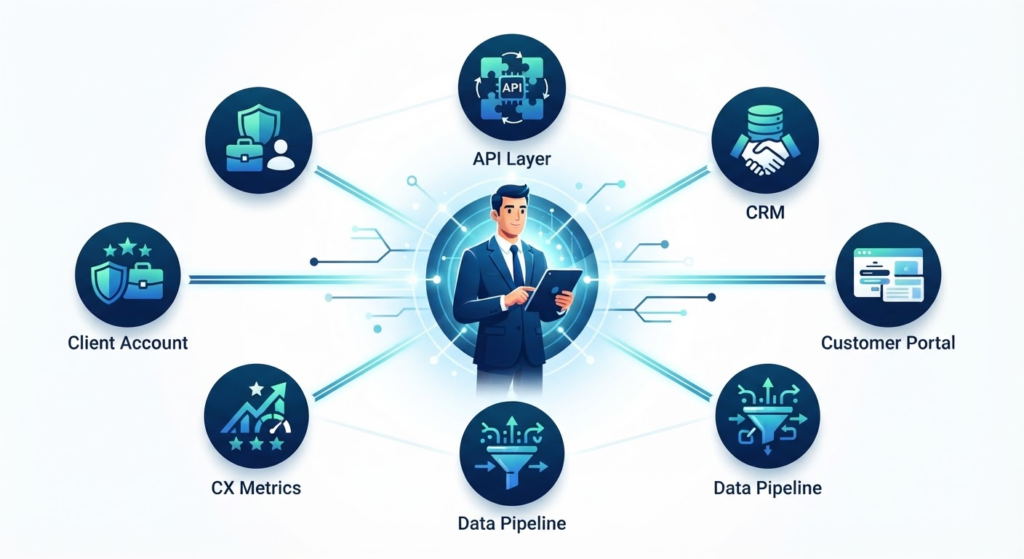
How CTOs can own digital customer experience without a CX team is the question most B2B technology leaders are quietly trying to answer. The reason it’s now your problem: digital transformation has moved the primary B2B client touchpoints from sales reps and account managers onto technology infrastructure. Your API, your client-facing portal, your integration stack — these are the experience now.
Ten years ago, a B2B client’s primary experience was the relationship with their account executive. Today, it’s whether your self-service portal loads in under two seconds, whether your API documentation is accurate, whether their ERP system integrates with yours without a custom connector. B2B buyers now interact across an average of 10 different channels before making a purchase decision (McKinsey) — and most of those channels are technology-owned.
The practical implication: every CX failure that surfaces in a client complaint usually traces back to a technology decision. A broken webhook. A CRM that doesn’t carry context between teams. A customer portal that requires users to re-authenticate every 15 minutes. These aren’t minor UX friction points — they compound into churn signals. 54% of B2B buyers say they would switch suppliers for a better digital purchasing experience (Adobe).
The digital CX ownership gap is real and quantifiable. Most organisations have product owning the roadmap, customer success owning renewals, and support owning tickets — but nobody owns the connective tissue between them. That connective tissue is technology. And the CTO is the only executive with line-of-sight across all of it.
This doesn’t mean becoming a CX manager. It means recognising that the architectural decisions you make — which data systems talk to each other, how client accounts are structured in your CRM, whether your portal is built on a shared or account-isolated data model — are CX decisions, not just engineering decisions.
→ For the full strategic CX framework that CTOs and business leaders can layer this under, see the Customer Experience (CX): The Complete Playbook for Business Leaders and Consultants
The B2B Customer Experience Technology Stack CTOs Actually Need
The B2B customer experience technology stack for mid-market companies doesn’t need to be enterprise-scale to be effective. What it does need is intentional integration — because the most common CX failure isn’t using the wrong tools, it’s using the right tools in isolation. 28% of B2B organisations cite siloed, fragmented customer data as their primary CX barrier (European B2B CX Benchmark Report, 2025–26). The average mid-market company uses over 15 different systems to manage customer interactions — and most of them don’t talk to each other.
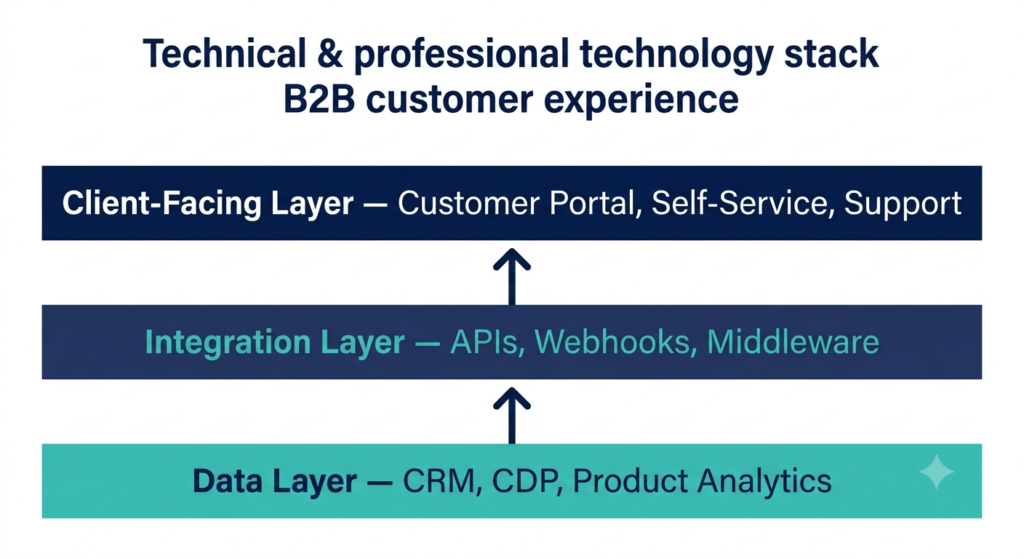
Here’s the CX technology stack B2B leaders should build around three functional layers:
CRM and Customer Data Platform as the CX Backbone for Technology Leaders
B2B CRM and customer data platform as CX backbone for technology leaders is the layer most CTOs already have — but rarely optimise for CX output. Your CRM is only useful for CX if it carries full account context: integration health, support history, renewal dates, stakeholder map, and product usage data — all in one record that every team can access.
The architecture principle: the CRM is not a sales tool. It’s the shared source of truth for the entire account relationship. Customer data centralisation means that when a client calls support, the agent sees the same account view as the renewal manager. When your CTO reviews churn risk, it maps to the same dataset as client-facing QBRs.
For mid-market B2B companies, Salesforce, HubSpot CRM, or a purpose-built B2B CRM paired with a lightweight CDP (Segment, Rudderstack) covers most use cases. The key configuration decisions that fall to the CTO: account hierarchy structure, custom object design for integration health tracking, and which product usage events get surfaced to the account record automatically.
Customer Portal Architecture for B2B Self-Service Without a Large Dev Team
Customer portal architecture for B2B self-service without a large dev team is achievable — and worth prioritising. 100% of B2B customers now expect self-service options for at least some parts of the buying process (Gartner). A client portal that lets customers track orders, manage account settings, access documentation, and submit support tickets without emailing a human is the single highest-ROI CX investment a mid-market CTO can make.
The architectural choice: build on a portal framework (Salesforce Experience Cloud, Freshdesk Customer Portal, Gainsight PX, or a headless approach using your existing API layer) rather than building from scratch. The portal should authenticate via SSO linked to your CRM account record, surface integration health metrics the client cares about, and allow self-serve configuration of the features they’ve purchased.
Self-service CX reduces ticket volume, accelerates onboarding, and gives clients a sense of control — which is a retention lever in its own right.
B2B Customer Experience Metrics CTOs Should Track Beyond NPS
B2B customer experience metrics CTOs should track beyond NPS is one of the most practical gaps in existing CX guidance. NPS, CSAT, and CES are important — but they’re outcome metrics. By the time a client scores you a 6 on NPS, the damage is done. CTOs need leading indicators that surface experience degradation before it hits a survey. B2B CX metrics for technology leaders split into two tiers: experience signals and system health signals.
Experience signals (standard CX metrics with B2B nuance):
- NPS (Net Promoter Score): Measure at relationship level (annual) and transactional level (post-onboarding, post-incident). The meaningful number is your trend, not the absolute score.
- CES (Customer Effort Score): Track after key self-service interactions. CES is the metric most correlated with churn in B2B, more so than CSAT.
- Time to Resolution (TTR): Measure TTR for onboarding milestones, integration go-lives, and account configuration requests — not just support tickets.
- Ticket deflection rate: What percentage of support queries are resolved via self-service or documentation without a human? Target: 40–60% for a well-built portal.
System health signals (the metrics only CTOs can see — and that directly predict experience quality):
- API success rate per client: A client-level view of API call success vs. failure rate. Degradation here means they’re experiencing failures before they report them.
- Integration latency by account: Per-account latency tracked over time. Latency spikes often precede support tickets by 48–72 hours.
- Portal session depth: Are clients logging in and completing tasks, or dropping off at the first screen? Shallow sessions signal UX friction.
- Data sync failure rate: Error rate over time on any client-facing data integration is a direct proxy for experience quality.
Companies with the best customer experience have a 60% lower customer churn rate than those with the worst (Harvard Business School). The difference isn’t the NPS process — it’s that they catch degradation signals before they become cancellation conversations.
Build a CX dashboard that combines both tiers. Route experience signal alerts to Customer Success. Route system health alerts to Engineering. Hold a joint weekly review of both. That joint review is where churn gets prevented.
How to Break Data Silos and Deliver Consistent B2B Digital CX Without a Large Team
How to break data silos for better B2B customer experience as a technology leader is fundamentally a data architecture problem dressed in a CX costume. The most common B2B CX failure pattern: support doesn’t know what product sold, product doesn’t know what support is firefighting, and sales closes a renewal on an account that engineering knows is at risk. The fix is not a new tool. It’s a data flow design decision. Customer data integration B2B starts with mapping which teams own which data — and then mandating that data moves between those systems automatically, not via email threads.
B2B Customer Journey Mapping for Technology Leaders Managing Digital Touchpoints
B2B customer journey mapping for technology leaders managing digital touchpoints differs from the journey maps CX consultants draw. You’re not mapping how a buyer feels — you’re mapping which system owns each interaction. A technology-led journey map for a mid-market B2B company typically looks like this:
- Discovery: Website CMS, marketing automation, lead capture → lead enters CRM
- Sales: CRM, proposal tooling, contract management → account created in product database
- Onboarding: Onboarding portal, provisioning system, integration setup → account goes live; integration events flow to CRM
- Adoption: Product analytics (Mixpanel, Amplitude, Heap) → usage events routed to CRM and Customer Success tool
- Support: Helpdesk (Zendesk, Freshdesk) → ticket data linked to CRM account record; resolution times tracked per account
- Renewal: CRM renewal date trigger → Customer Success review cadence initiated; integration health report auto-generated
Map the system that owns each stage. Then ask: what data needs to flow from this stage to the next, and is it flowing automatically today? Every manual handoff in that map is a data silo — and a CX risk.
API Integration Strategy for Seamless B2B Customer Experience
The architectural pattern that eliminates most data silos without a large engineering team: event-driven integration using a lightweight middleware layer. Platforms like Zapier, Make (Integromat), or a lightweight Kafka deployment for higher volume can route data events between systems without custom code for every integration. The principle: when an event happens in System A (a new support ticket, a product usage milestone, an integration failure), it triggers an update in System B (the CRM account record) without human involvement.
API-driven CX means that a client’s account record is always current, always complete, and always visible to whoever needs it. The CTO’s role here is architectural: design the event taxonomy (what gets triggered when), choose the middleware stack, and enforce the standard that no team creates a manual process where an automated one is feasible.
Salesforce, in deploying CX tools at scale across their enterprise customer base, found that the primary barrier to consistent CX was not tool choice but data flow design — specifically, the absence of real-time account data in frontline systems. The same principle applies at mid-market scale.
How to Align Product and Customer Experience in B2B Companies Without Dedicated CX Resources
How to align product and customer experience in B2B companies without dedicated CX resources is a governance challenge more than a technology challenge. The core problem: Product prioritises features based on roadmap goals and internal hypotheses. Support firefights tickets. Customer Success manages renewals. Nobody has a shared view of which product gaps are driving CX failures — because that data lives in three different systems.
The fix requires two structural decisions:
1. Create a monthly CX signal review. Once a month, product, support, and customer success sit in the same room with the following data: top 5 support ticket themes, CES scores by product area, NPS verbatims that mention product issues, and integration failure events by feature. This is not a blame session — it’s a shared dataset. Product uses it to reprioritise. Support uses it to build better documentation. Customer success uses it to get ahead of renewal conversations.
2. Build CX criteria into your definition of done. Before any feature ships, it answers three questions: (a) What support tickets does this feature eliminate? (b) What does the client see in their portal when this changes? (c) What integration events does this trigger — and are they documented? This adds 20 minutes to sprint planning and prevents entire categories of CX failures at source.
Companies that regularly act on customer feedback see a 15% increase in customer retention (Forrester). The mechanism isn’t the survey — it’s the product feedback loop that the survey feeds. Product and customer experience alignment in B2B requires that feedback loop to run from clients through support through product on a cadence — not just at annual planning.
How to Justify the CX Investment to Your Board Without a CX Budget
How to justify customer experience investment to the board without a CX budget is the conversation every CTO dreads — because “improve customer experience” doesn’t have a natural line item. The board thinks in revenue retention, churn rate, and engineering headcount. Translate accordingly.
The CX ROI business case for a B2B technology leader rests on three numbers:
1. Churn cost avoided. Calculate your average contract value, then your current annual churn rate. A 5% reduction in churn on a $10M ARR base is $500K in retained revenue. If fixing your customer portal reduces churn by 2 percentage points, that’s $200K — which is more than most portal rebuild projects cost.
2. Support cost reduction. Track your cost per support ticket (engineering time + support staff + escalation cost). A self-service portal that deflects 30% of tickets at $80 average ticket cost, at 5,000 tickets per year, saves $120,000 annually — before counting the engineering hours freed from firefighting.
3. Expansion revenue enabled. B2B clients who score high on CES are measurably more likely to expand their contract. A 5% increase in customer retention can boost profits by 25–95% (Bain & Company / Harvard Business Review). Present expansion rate by CES cohort if you have the data — that’s the board’s language.
Frame the CX investment as infrastructure, not overhead. The customer portal is infrastructure. The API event log that prevents churn surprises is infrastructure. Infrastructure has a clear ROI model that engineering-minded boards understand.
The 90-Day B2B Customer Experience Implementation Plan for CTOs
A 90-day B2B customer experience implementation plan for business executives has to start with the systems you already own — not a transformation programme that runs for 18 months. Here’s the sequence that works for a mid-market B2B company where the CTO is running CX without a dedicated team.
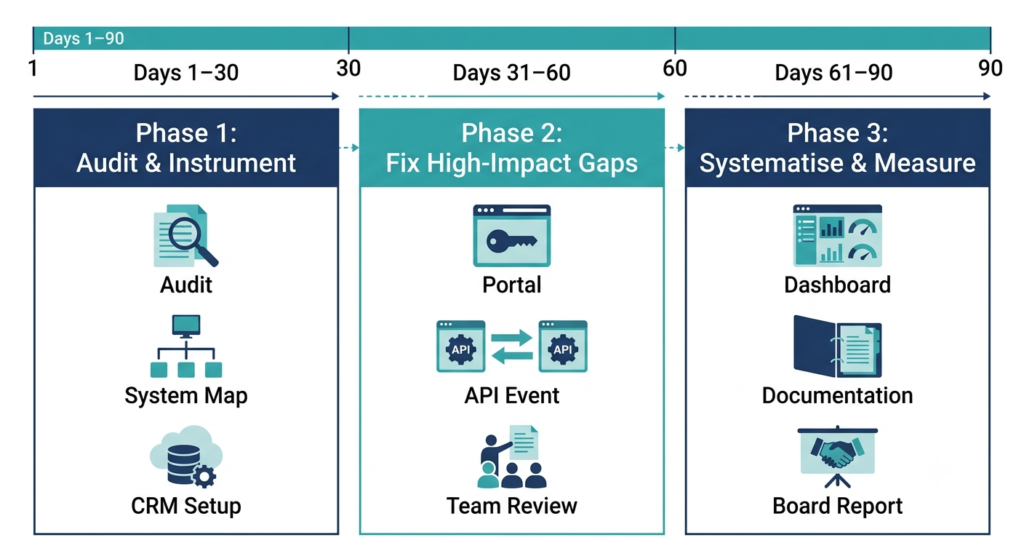
Days 1–30: Audit and Instrument
- Map your current client-facing systems and document which team owns each one.
- Identify the top 5 support ticket categories from the past 90 days — these are your highest-priority CX failures.
- Check whether your CRM account records contain integration health, support history, and product usage data in the same view. If not, this is your first integration project.
- Pull API success rates and integration latency by client. Flag any account where either metric has degraded in the past 30 days — these accounts are at churn risk regardless of what their NPS says.
- Survey a sample of clients on CES for one specific interaction. Baseline the score.
Days 31–60: Fix the Highest-Impact Gaps
- Build or improve the one client-facing touchpoint generating the most support tickets — usually a portal or documentation gap.
- Implement one API event route: when a support ticket is created, the CRM account record is updated with ticket category and severity automatically. Eliminates the single most common data silo in B2B CX.
- Run the first weekly cross-functional CX signal review with product, support, and customer success — share ticket themes, CES scores, and churn-risk accounts flagged by system health metrics.
- Brief your board on the three-number CX investment framework (churn cost avoided, support cost reduction, expansion revenue enabled).
Days 61–90: Systematise and Measure
- Build the CX dashboard combining experience signals and system health signals. Route alerts to the right teams automatically.
- Document your CX integration architecture — the event taxonomy, the middleware layer, the account record design — so it survives team changes.
- Re-run your baseline CES survey. Compare. Report the delta to your board as proof of concept.
- Identify the next highest-impact gap from your ticket analysis and build it into Q2 roadmap with explicit CX success criteria.
The pattern: audit first, fix the highest-cost failure, then systematise before expanding scope. A customer experience implementation plan at this pace — 90 days — is achievable without a dedicated CX team and without a major budget. CX maturity builds iteratively. Adobe’s B2B State of Digital Customer Experience report found that mid-market B2B companies that prioritised self-service portal investment in a 90-day sprint saw an average 23% reduction in onboarding-related support tickets within the first quarter — primarily engineering time, not a new CX budget line.
Start Where You Have the Most Control
The strongest B2B customer experience strategy for CTOs isn’t a CX transformation programme. It’s a series of technology decisions made with the client’s experience explicitly in mind — the CRM architecture, the portal design, the API event model, the dashboard that surfaces churn signals before they become cancellation calls.
You already own the systems that define most of your clients’ experience. The question is whether those systems are designed to serve the client or just to serve internal teams. That’s the decision this playbook is pushing you to make.
Start with the audit. Map your client-facing systems. Pull the API health data by account. Find the top three support ticket drivers and ask which one you can eliminate with a portal improvement in the next 30 days. A solid B2B customer experience strategy doesn’t require a dedicated CX team — it requires the CTO to treat client-facing technology as an intentional product, not just infrastructure.
The companies winning B2B CX right now aren’t the ones with the biggest CX teams. They’re the ones where the CTO and the product function have made client experience a first-class engineering concern. That’s the gap this playbook was written to close.
Frequently Asked Questions
What is a B2B customer experience strategy and why do CTOs need to own it?
A B2B customer experience strategy is an organisation-wide plan to design and improve every interaction between your business and its clients — from onboarding through renewal. CTOs need to own it because the majority of B2B client touchpoints are now digital: API integrations, customer portals, support systems, and data pipelines. These are technology assets, not marketing assets. The CTO is the only executive with operational control across all of them.
How can a CTO build a B2B CX strategy without a dedicated CX team?
Start by mapping which systems own each client-facing interaction, then identify the top three ticket-driving failures and fix them as engineering problems. A monthly cross-functional CX signal review (product, support, customer success, engineering) replaces the need for a dedicated CX function at mid-market scale. Build CX criteria into your definition of done for every product release, and instrument your CRM to surface integration health and support data on the same account record.
What B2B customer experience metrics should CTOs track beyond NPS?
CTOs should track two tiers: experience signals (CES after key self-service interactions, ticket deflection rate, time to resolution by milestone) and system health signals (API success rate per client, integration latency by account, portal session depth, data sync failure rate). System health metrics are leading indicators — they predict CX degradation 48–72 hours before it surfaces in a support ticket or NPS score.
How do data silos cause B2B customer experience failures and how do you fix them?
Data silos create CX failures because each team works from a partial view of the client account. The fix is architectural: implement an event-driven integration layer (Zapier, Make, or lightweight middleware) that routes key account events between systems automatically, and redesign your CRM account record to contain integration health, support history, and product usage in a single view.
What is the best B2B customer experience technology stack for a mid-market company?
A practical mid-market B2B CX tech stack has three layers: a CRM (Salesforce or HubSpot) paired with a lightweight CDP (Segment or Rudderstack) as the data backbone; a middleware integration layer (Make, Zapier, or a lightweight Kafka deployment) to route events between systems; and a client portal built on an existing framework (Salesforce Experience Cloud, Freshdesk Customer Portal, or headless API-based) rather than from scratch. The goal is integration between these layers, not tool sophistication within each.
How do you build a B2B customer portal for self-service without a large development team?
Use a portal framework rather than building from scratch. Salesforce Experience Cloud, Freshdesk Customer Portal, or Gainsight PX can be deployed with a small engineering team in 4–8 weeks. Key requirements: SSO authentication linked to your CRM account record, self-serve access to client-specific data (integration status, usage reports, order history), and a support interface that pre-populates account context. Prioritise features that eliminate your highest-volume support ticket categories first.
How do you justify a B2B customer experience investment to the board without a CX budget?
Translate CX into three financial metrics the board already tracks: churn cost avoided, support cost reduction, and expansion revenue enabled by high-CES account cohorts. Frame the investment as infrastructure — the portal rebuild, the CRM integration project — not as a customer experience programme. Infrastructure investment models resonate with engineering-minded boards.
What does a 90-day CX implementation plan look like for a B2B company without a CX team?
Days 1–30: audit client-facing systems, pull API health data by account, identify top 5 support ticket drivers, baseline CES on one key interaction. Days 31–60: fix the highest-ticket-volume failure, implement one CRM integration event, run the first weekly cross-functional CX signal review. Days 61–90: build the combined CX dashboard, document the integration architecture, re-run the CES baseline, and present a delta report to your board as proof of concept for expanded investment.
How does B2B customer experience strategy differ from B2C CX strategy?
B2B customer experience strategy involves multiple stakeholders within each account, longer buying and onboarding cycles, complex integrations with the client’s existing tech stack, and relationship KPIs (NRR, expansion rate) spanning years rather than transactions. In B2B, losing one account can represent 10–20% of ARR — which makes CX a financial risk management function, not just a satisfaction programme.
How should AI be used in a B2B customer experience strategy by technology leaders?
AI has three high-value CX applications: conversational self-service (reduces support volume without expanding headcount), churn signal detection (ML models trained on support patterns and integration failure rates predict churn 30–60 days ahead of the renewal conversation), and support triage (AI routing cuts time-to-resolution without hiring). Start with self-service — it delivers the fastest measurable ROI.
How do you measure B2B customer experience ROI?
Measure B2B CX ROI across three vectors: retention impact (churn rate before vs. after improvements × average contract value), support cost reduction (cost per ticket × deflection rate improvement), and expansion revenue (expansion rate comparison between high-CES and low-CES account cohorts). Set baselines before any CX initiative begins, run for at least one full quarter, and report the delta to your board.