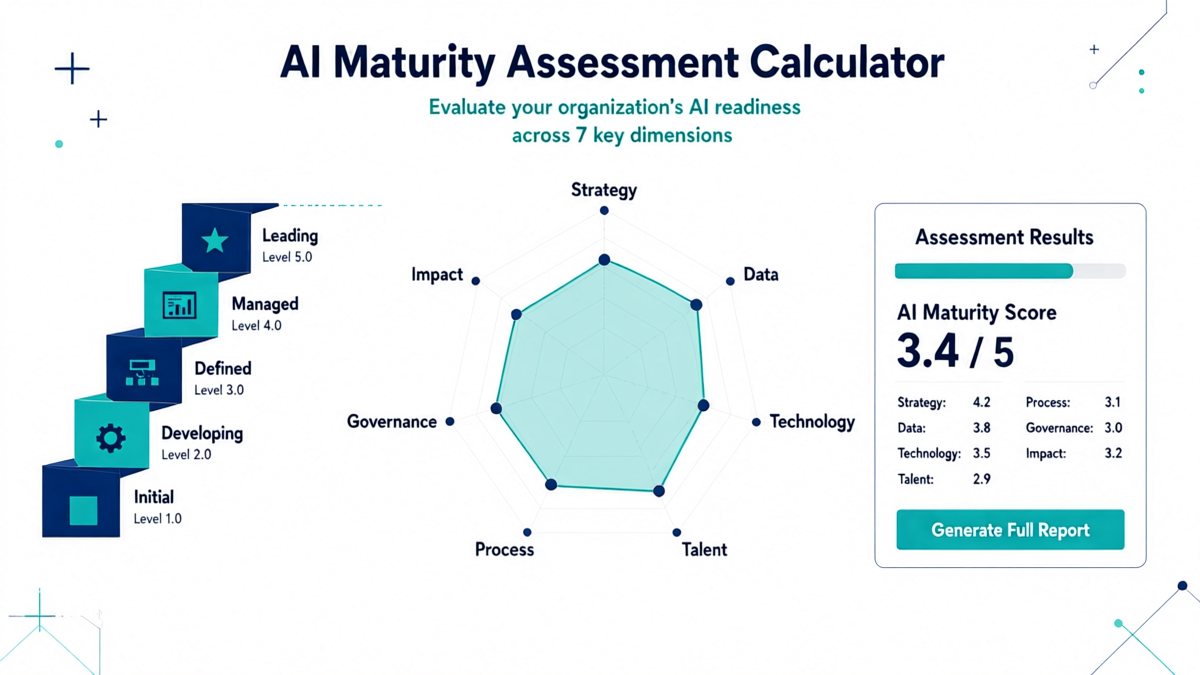
An AI maturity assessment calculator is an online scoring tool that measures how mature your organization’s AI capability is across strategy, data, technology, governance, value, workforce and security, then turns your answers into a maturity level, a gap analysis and a prioritized action roadmap.
Most AI programs stall because nobody agreed on where the organization actually stands. This free AI maturity assessment calculator gives you that baseline. Answer 35 practical questions in about 10 to 15 minutes, adjust the dimension weights to match your priorities, and see your score, your weakest dimensions and the next moves to make. It uses the seven dimensions and five levels of the CPP AI Maturity Matrix™.
AI Maturity Assessment Calculator
Benchmark your organization across the 7 dimensions of the CPP AI Maturity Matrix™. Get a personalized roadmap to accelerate your AI journey.
Start Your Free Assessment
Takes 10–15 minutes. Results appear instantly, and you can email yourself a copy.
🔒 Your information is never shared or sold. Used only to personalize and deliver your results.
Customize Dimension Weights
Reflect your organization’s strategic priorities. Weights must total 100%.
Dimension
Rate your organization 1–5 on each question.
Your AI Maturity Profile
Weighted assessment across the 7 dimensions of the CPP AI Maturity Matrix™.
Gap Analysis
Your top strengths and highest-priority improvement areas.
🗺 Priority Action Roadmap
Top actions to advance your AI maturity, ranked by impact potential.
Deepen Your AI Maturity Knowledge
Read the full CPP AI Maturity Matrix™ and level-by-level guidance on Corporate Playbook Pro.
What the AI Maturity Assessment Calculator Scores
The calculator scores seven dimensions with five questions each, 35 questions in total. Every question is a statement about observable practice that you rate from 1 to 5. The dimensions and their default weights come from the CPP AI Maturity Matrix™, and you can change the weights before you start as long as they total 100%.
| Dimension | Default weight | What it checks |
|---|---|---|
| Strategic Alignment | 15% | Whether AI is tied to business goals, owned by executives and resourced |
| Data Readiness | 20% | Whether your data is accessible, trusted and good enough for AI |
| Technology & Infrastructure | 15% | Whether your platforms and tooling can run AI reliably at scale |
| Governance & Risk | 10% | Whether policies, risk controls and accountability are in place |
| Value Realization | 15% | Whether AI results are measured against business outcomes |
| Workforce Fluency & Culture | 15% | Whether people have the skills and the habits to use AI well |
| AI Security & Trust | 10% | Whether AI systems are secure, explainable and trusted |
Data Readiness carries the highest default weight because weak data limits every other dimension. A regulated company might raise Governance & Risk, while an early-stage company might raise Value Realization. For the reasoning behind each dimension, read the full AI maturity model and assessment framework.
The Five AI Maturity Levels and Score Bands
Each dimension score is the average of its five answers. Your overall score is the weighted average of the seven dimension scores, and it maps to one of five levels:
- Unaware (1.0 to 1.8): AI is discussed but not deployed in any structured way.
- Experimenting (1.9 to 2.6): pilots are running but isolated, ungoverned and unmeasured.
- Scaling (2.7 to 3.4): AI is moving from projects to programs, with executive ownership and early documented ROI.
- Embedding (3.5 to 4.2): AI is built into core workflows and financial reporting, with systematic monitoring.
- Transforming (4.3 to 5.0): AI is a documented competitive differentiator.
How to Use Your AI Maturity Score
A score only helps if it changes a decision. Use your results in this order:
- Start with your lowest two or three dimensions, not the overall level. The overall score hides imbalance, and the weakest dimension usually limits everything else.
- Pick one action per weak dimension for the next 90 days. The priority action roadmap in your results suggests practical starting points.
- Have several leaders score separately, then compare. Differences in how people score the same dimension are a finding in themselves.
- Retake the calculator after each major initiative to confirm that your weakest dimensions are improving.
If your score shows pilots that never reach production, the next step is our guide to moving an AI pilot to production. If your lowest dimension is Governance & Risk and you are deploying AI agents, read agentic AI governance and risk.
Which Version Should You Use?
For a larger organization, run the calculator by business unit rather than once for the whole company, because averages hide the pockets that are far ahead or far behind. If you run a small business or work alone, the seven-dimension calculator may be more than you need. Start with the shorter AI maturity assessment for small business scorecard instead. If you are not sure whether your gap is in AI or in your wider digital foundation, see AI maturity vs digital maturity.
Frequently Asked Questions About the AI Maturity Calculator
Is the AI maturity assessment calculator free?
Yes. Enter your name, company and work email, plus your role, industry and company size, to start. Your results appear instantly, and you can print them or email yourself a copy.
How long does the AI maturity assessment take?
About 10 to 15 minutes. There are 35 questions across 7 dimensions, each answered on a 1 to 5 scale.
Can I change the dimension weights?
Yes. Adjust the weights on the second step, before you answer the questions. They must total 100% before you can continue.
How is my AI maturity level calculated?
Each dimension score is the average of its five answers. The overall score is the weighted average of all seven dimension scores, and it maps to one of five levels, from Unaware (1.0 to 1.8) to Transforming (4.3 to 5.0).
Is a self-assessment accurate?
It reflects how well your team knows its own practices, so it is only as honest as the people scoring. To get a more reliable result, have several leaders complete it separately, score against what you can point to as evidence, and compare the differences.
How often should I retake the calculator?
Retake it after each major AI initiative, and at least once or twice a year. Save your first result as a baseline so you can see which dimensions have moved.