Digital transformation consulting firms help businesses change how they work, not just which software they use. They look at your strategy, your processes, and your people, then plan and guide the changes that put technology to real use. A regular IT consultant keeps your systems running. A transformation firm helps you rethink what the business does with them.
You know you need help with digital transformation. Now you’re staring at hundreds of digital transformation consulting firms that all sound the same. Every site promises strategy, speed, and “end-to-end” support. So you compare logos, guess at prices, and wonder whether a giant with half a million employees will even return a call from a company your size.
Here’s what most lists skip: the best firm isn’t the biggest one. It’s the one that fits your size and your readiness. Many digital transformation consulting companies are great at something, just not at what you need. That matters, because only 16% of digital transformations improve performance and keep it up, according to a 2018 survey (McKinsey), and the wrong partner is a quick way into the other 84%.
This guide starts with the firms worth knowing, grouped by type. Then it shows you how to check your readiness, match a firm to your size and industry, ask sharper questions, spot red flags, and understand what digital transformation consulting really costs.
Top 9 Digital Transformation Consulting Firms, According to Forbes’ 2026 Ranking
If you want a short list backed by a real ranking, start here. Each year Forbes and Statista survey consulting clients and consulting executives, then rank America’s best management consulting firms. The 2026 list came from a survey run between October 2025 and February 2026. It included more than 1,250 clients who had hired a firm, and it covered 183 firms across 33 categories, including AI, IT strategy, and operations (Forbes). These are the nine top scorers.
| Rank | Firm | Forbes 2026 stars | Known for in digital work | Best fit |
|---|---|---|---|---|
| 1 | Bain & Company | 32 -(Tie) | Strategy tied to measurable results | Large enterprises |
| 2 | BCG | 32 -(Tie) | Digital strategy and a fast-growing AI practice | Large enterprises |
| 3 | Deloitte | 32 -(Tie) | Strategy through delivery, with its own AI platform (Ascend) | Large, multi-part programs |
| 4 | McKinsey & Company | 32 -(Tie) | Board-level strategy and published research on transformation | Large enterprises |
| 5 | PwC | 32 -(Tie) | Strategy, risk, and technology under one roof | Large enterprises |
| 6 | Accenture | 31 | Building and running technology at global scale | Large global programs |
| 7 | EY | 29 | Strategy and AI advice from a Big Four firm | Large enterprises |
| 8 | IBM Consulting | 26 | Technology and AI delivery (its Consulting Advantage platform) | Companies with complex IT |
| 9 | Alvarez & Marsal | 25 | Performance improvement and turnaround work | Companies fixing operations or finances |
Stars show how often clients and peers recommend a firm. Five stars means “very frequently recommended,” and a firm can earn stars in many categories. Accenture’s 31 stars included 24 five-star ratings (Forbes).
Here is a short profile of each firm, with what makes it different. Every fact comes from the firm itself or from Forbes.
Bain & Company: Results First
Bain was founded in 1973 and now works from 67 cities in 40 countries. Its pitch is simple: “We measure our success by our clients’ success.” It also blends AI strategy with the engineering and change leadership needed to make the work stick (Bain).
BCG: AI Built Into Every Offer
BCG reported $14.4 billion in 2025 revenue, its 22nd straight year of growth. What sets it apart is AI: services focused on AI and tech now make up over 40% of revenue, and BCG X builds custom AI tools for clients (BCG).
Deloitte: One Platform for Delivery
Deloitte stands out for how it delivers. Its Ascend platform puts the firm’s tested delivery methods, AI agents, and a client portal in one place. Deloitte says it is investing more than $1 billion in agentic and generative AI (Deloitte).
McKinsey & Company: Strategy Plus an AI Engine
McKinsey’s edge is pairing strategy with QuantumBlack, its AI and engineering arm, which grew from 45 people when it joined the firm in 2015 (McKinsey). McKinsey also studies transformation itself, including a survey of 1,793 people behind the 16% success figure above (McKinsey).
PwC: Advisory Backed by a Broad Network
PwC reported $56.9 billion in revenue and 364,000 people across 136 countries. Advisory is its biggest service line at $24.4 billion, and the firm says it invested $3.1 billion in capabilities such as AI and technology (PwC).
Accenture: Technology at Global Scale
Accenture reported $69.7 billion in fiscal 2025 revenue and about 779,000 people in more than 120 countries. It pairs cloud, data, and AI skills with industry knowledge and global delivery teams, and it booked $5.9 billion in new generative AI work that year (Accenture).
EY: AI-Led Consulting Growth
EY’s consulting arm earned $16.4 billion in fiscal 2025, up 5.2%. EY says its AI-related revenue rose 30% and that more than 15,000 of its professionals worked on AI-led client projects (EY).
IBM Consulting: Its Own Tech Stack
IBM Consulting delivers work through Consulting Advantage, a platform powered by IBM’s watsonx AI. IBM says it uses the same approach with clients that it uses internally. The platform is also FedRAMP authorized, a US government security standard (IBM).
Alvarez & Marsal: Hands-On Operators
Alvarez & Marsal was founded in 1983 by Tony Alvarez II and Bryan Marsal. It now has over 10,000 people in 80-plus offices. Its difference is rolling up its sleeves: A&M’s consultants often serve as advisers or interim leaders inside the client’s business (A&M).
Read this ranking with care. It scores management consulting as a whole, not digital transformation alone. The top five firms tied at 32 stars, so the order inside that group means nothing, and we listed them alphabetically. Most of these firms are also built for large clients. A top-9 list tells you who clients recommend. It doesn’t tell you who fits a 60-person company or a 600-person one. That is why the rest of this guide matches firm type to your size and maturity score.
Top Digital Transformation Consulting Firms in the USA, Grouped by Type
The top digital transformation consulting firms in the USA fall into four types: strategy houses, global integrators, engineering-led firms, and mid-market partners. That matters because digital transformation consulting companies differ a lot in size, price, and style. A firm that’s perfect for a bank can be a poor fit for a 40-person distributor, so a plain “top 10” list can mislead you.
A quick note on how we built this list. Nobody paid to be on it, and we haven’t ranked anyone ourselves. We used official annual results, independent analyst reports, and each firm’s own client pages. If we couldn’t confirm a fact, we left it out. We’re not on the list either. This is a buyer’s guide, not an ad.
| Type | Example firms | Best for | Typical client | Watch out for |
|---|---|---|---|---|
| Strategy houses | McKinsey & Company, BCG, Bain & Company | Board-level strategy and big bets | Large enterprises | Premium fees, less hands-on building |
| Global integrators and Big Four | Accenture, Deloitte, IBM Consulting, Capgemini, PwC, EY, KPMG | Strategy through build and run, at scale | Large enterprises | Layered teams, quality can vary by office |
| Engineering-led firms | Thoughtworks, EPAM | Building software and platforms | Large and upper mid-sized companies | Weaker if you still need to decide what to build |
| Mid-market partners | West Monroe, Perficient, Resultant | Practical projects sized for mid-sized budgets | Mid-sized companies, some smaller ones | Smaller bench, narrower focus |
Strategy houses. McKinsey, BCG, and Bain help leadership teams decide where to place their bets. BCG, for example, reported $14.4 billion in revenue and 33,500 employees in 2025 (BCG). Expect sharp thinking and big invoices. You hire one when the board needs a clear direction, not when you need someone to configure software.
Global integrators and the Big Four. Accenture reported $69.7 billion in revenue and about 779,000 employees for fiscal 2025 (Accenture), and Deloitte reported $70.5 billion and more than 470,000 people (Deloitte). IBM Consulting, Capgemini, PwC, EY, and KPMG sit in the same group. These firms can plan, build, and run change across many countries. That scale helps a global retailer. For a 150-person company, it can mean junior staff, long timelines, and project minimums that are too big to be useful.
Engineering-led firms. Thoughtworks and EPAM are known for building software. EPAM reported $5.46 billion in 2025 revenue and about 62,850 staff (EPAM), while Thoughtworks has more than 10,500 employees as of 2024 (Thoughtworks). They’re a good pick when your transformation is mostly about building or rebuilding digital products.
Mid-market partners. West Monroe is known for technology, change, and deal-related transformation work, and IDC named it a Major Player in its 2026 MarketScape for people, organization, and change management consulting. Perficient builds on platforms like Salesforce, Adobe, and Microsoft, and was named a Major Player in three IDC MarketScape reports on customer experience. Resultant has a dedicated page for small and mid-sized businesses, and its Clutch profile shows a mix of small, mid-sized, and large clients (self-reported). One honest note: “Major Player” is IDC’s designation just below Leader, not its top rating.
No list can tell you which firm is best. Only your size, your goals, and your readiness can. The rest of this guide shows you how to use all three.
Here’s how to use this list. Start with the type, not the name. Find the row that matches your size, then read up on two or three of those digital transformation consulting firms in detail. Skip the types that don’t fit, even when the logo is famous.
Boutique vs Big Four Digital Transformation Consulting: What Really Changes
Boutique vs Big Four digital transformation consulting comes down to who does the work and how fast decisions move. At a boutique, senior people usually stay on your project. At a Big Four firm, senior people often win the deal and a larger team delivers it. Boutique consulting firms also tend to cost less in total, even when day rates look alike, because their teams are smaller.
| Question | Boutique | Big Four |
|---|---|---|
| Who does the work? | Senior people, hands-on | Mixed teams, juniors often do the daily work |
| Speed of decisions | Fast, few layers | Slower, more approvals |
| Global reach and compliance depth | Limited | Strong |
| Name your board recognizes | Rarely | Yes |
Choose a boutique when you want speed and senior attention. Choose a Big Four firm when you need scale, many countries, or a heavy compliance load.
What Does a Digital Transformation Consulting Firm Do?
A digital transformation consulting firm helps you decide what to change, in what order, and then helps you make the change stick. So what does a digital transformation consulting firm do day to day? Digital transformation consulting services usually cover four jobs, and good firms do all four, not just the fun one.
- Diagnose. They review your systems, processes, and people, often with a maturity assessment.
- Plan. They build a strategy and a roadmap with owners, dates, and budgets.
- Build and connect. They help choose, set up, and link the tools, data, and automation.
- Make it stick. They train staff, manage resistance, and track results.
What they don’t do matters just as much. A consulting firm won’t own your results, change your culture for you, or fix a missing sponsor. It brings skills and structure. You bring decisions and daily ownership. Digital transformation consulting firms that promise otherwise are selling comfort, not change.
Digital transformation itself means rethinking how your business creates value with digital tools, data, and new ways of working. It’s a change in how you operate, not a software purchase. If you want the full picture, start with our guide on what digital transformation is and how it works. If the missing piece is a plan, our walkthrough on how to create a digital transformation roadmap shows what a good one contains.
Even with expert help, only 48% of digital initiatives meet or exceed their business targets (Gartner). Most misses don’t come from bad software. They come from people who never adopt the new way of working, which is why the “make it stick” job matters most. Our guide to digital transformation culture and change management explains why.
Check Your Digital Maturity Assessment Score Before Hiring a Consultant
A digital maturity assessment before hiring a consultant shows you where you stand today, so you only pay for help you actually need. Without that baseline, a firm can sell you a roadmap for problems you don’t have. Think of it as telling the mechanic what’s wrong with the car before you ask for a quote.
Our free Ai Digital Maturity Calculator scores your business across eight areas: strategy and leadership; customer experience; operations and process; technology and data; people, culture and change; governance, risk and security; innovation and business model; and value and performance. It takes 15 to 20 minutes and gives you a score from 1 to 5. Not sure what the model measures? Our guide to digital maturity explains each area.
| Traditional Score 1.0-1.8 | Exploring Score 1.9-2.6 | Transforming Score 2.7-3.4 | Optimizing Score 3.5-4.2 | Leading Score 4.3-5.0 | |
|---|---|---|---|---|---|
| Strategy & Leadership | No clear digital goals; seen as an IT matter | Goals on paper, but no owner or budget | Funded roadmap with an executive sponsor | Digital outcomes sit in executive scorecards | Strategy reset yearly against market shifts |
| Customer Experience | Manual, paper or phone-based service | A few digital tools; channels disconnected | Channels share one customer record | Data guides journeys; feedback acted on monthly | Needs anticipated before customers ask |
| Operations & Process | Paper, email and spreadsheet handoffs | Some processes automated in isolation | Core systems connected; data entered once | Live dashboards track process performance | Automation reaches partners and exceptions |
| Technology & Data | Aging systems; data scattered | Cloud pilots; fragile point-to-point links | APIs and automated deployment in place | Modern cloud stack; analytics in daily decisions | Composable platforms; AI in live decisions |
| People, Culture & Change | Low digital skills; change handled ad hoc | Basic training; adoption left to chance | Role-based upskilling; adoption targets set | Change managed on every project | Digital skills drive hiring and promotion |
| Governance, Risk & Security | Basic controls; no named risk owner | Policies written; gaps remain | Recognized security framework adopted | Vendor and cloud risks assessed routinely | Continuous monitoring; ahead of regulation |
| Innovation & Business Model | Ideas are informal; no test budget | Isolated pilots with no path to scale | Stage gates decide scale, pivot or stop | Partners add capability; steady experiments | New digital revenue streams every year |
| Value & Performance | Results are not measured | Some metrics, but owners unclear | Benefit reviews at 3 and 12 months | Results tracked against financial targets | Digital value reported at P&L level |
Source: our digital maturity assessment calculator. Scores run from 1 to 5. Find your lowest-scoring area, then read across to see what each level looks like in practice.
The score matters because readiness changes your odds. BCG found that companies that addressed six key success factors lifted their odds of a successful transformation from 30% to 80% (BCG). Here’s how to read your overall score and what kind of help usually fits. Treat it as a guide, not a verdict.
| Your score | Level | What it usually means | Help that usually fits |
|---|---|---|---|
| 1.0 to 1.8 | Traditional | Work is mostly manual. Digital is seen as IT’s job. | Don’t buy a big program yet. Run a short readiness check, name an owner, pick two or three quick wins. A fractional advisor or small boutique fits. |
| 1.9 to 2.6 | Exploring | Pilots exist, but they’re scattered. | A roadmap partner that connects the pieces and sets priorities. Boutique or mid-market firm. |
| 2.7 to 3.4 | Transforming | A funded roadmap and early wins. | An implementation partner plus change support. Mid-market or engineering-led firm. |
| 3.5 to 4.2 | Optimizing | Digital is part of daily work. | Targeted specialists for gaps in data, AI, or security. A strategy house only for board-level bets. |
| 4.3 to 5.0 | Leading | Digital is a competitive edge. | Rarely a general firm. Narrow experts or short advisory sessions. |

Two quick examples show how this works. Picture a 30-person distributor that scores 2.2, with its lowest mark in people, culture and change. It doesn’t need a global giant. It needs a small boutique or a fractional advisor for a short roadmap, plus a plan to train staff. Now picture a 600-person manufacturer at 3.1 with a 1.8 in technology and data. That company fits an engineering-led or mid-market partner better, because the gap is in the systems. (Both are made-up examples to show the logic.) Matching help to the gap is how smart buyers sort digital transformation consulting firms before a single sales call.
Look at your lowest-scoring area too, not only the total. A business with a 3.0 average but a 1.5 in people, culture and change needs a different partner than one that’s weak in technology and data. Take your score, find your row, and bring the result to your first call. A good firm will welcome it.
Before that first call, spend ten minutes on three things. Write down the one business result you want. Name the person who will own it on your side. Set a rough budget range. With those three answers and your score, you’ll sound like a buyer who knows what they want, and the good firms will treat you that way.
Digital Transformation Consulting Firms for Small Business
Digital transformation consulting firms for small business are rare, because most well-known firms build their teams and minimum project sizes for large clients. If you have fewer than 50 employees, a global name is almost never the right fit. The good news is that small teams have an edge: McKinsey found that organizations with fewer than 100 employees were 2.7 times more likely to report a successful transformation than those with more than 50,000 (McKinsey).
Digital transformation consultants who work with small businesses usually come in four forms:
- A fractional CIO or CTO. A part-time leader who gives you strategy and a roadmap without a full-time salary.
- A local IT provider with planning services. Good when your biggest problems are tools, security, and support.
- A platform partner. Microsoft, Salesforce, Shopify, and similar vendors list certified implementers sized for small accounts.
- A small boutique firm. Best for a fixed-scope assessment and written roadmap.
Start small. A two-to-six-week assessment with a written roadmap and a few quick wins beats a year-long contract. Our practical, phased guide to digital transformation for small business shows what to do before and after you hire anyone, and the 90-day digital transformation sprint is a good way to bank early wins.
Be honest about budget up front. Many digital transformation consulting firms have project minimums, so ask in your first email. A short note like “we’re a small team with a modest budget, can you still help?” saves everyone a lot of time.
Digital Transformation Consulting for Startups
Digital transformation consulting for startups looks different, because a startup has no old systems to untangle. The job is choosing tools that won’t need replacing when you hit 50 people. Startup digital transformation help is usually a few advisory hours, not a big project. Don’t hire a firm for something one good operations hire or a fractional CTO can handle.
Digital Transformation Consulting Firms for Mid-Sized Companies
Digital transformation consulting firms for mid-sized companies are the easiest group to find and the hardest to compare. Mid-size digital transformation consulting usually means a firm with a few hundred to a couple of thousand people that can run a six-to-twelve-month program. You have real systems, real customers, and a leadership team that can’t stop the business to fix it. Good mid-market partners are used to legacy systems and tight timelines, and they know how to change the engine without stopping the car.
Industry matters more as you grow. McKinsey found success rates of only 4% to 11% in traditional industries such as oil and gas, automotive, infrastructure, and pharma (McKinsey). If you work in an older industry, pick a partner who has done this exact kind of project before. Ask for a named team, a fixed-fee first phase, and a client reference in your industry.
Mid-sized buyers also face a trap: pilot after pilot that never becomes part of daily work. Ask every one of the digital transformation consulting firms on your shortlist how a pilot turns into a rollout, and who on your side runs it after the project ends.
Digital Transformation Consulting for Healthcare Organizations
Digital transformation consulting for healthcare organizations has to start with patient data and compliance. A firm that doesn’t talk about privacy rules and system access in the first meeting is the wrong one. Healthcare digital transformation consulting works best when it begins with one workflow, like scheduling or billing, and proves value before touching clinical systems. Ask how they avoid locking you into one vendor.
Digital Transformation Consulting for Manufacturing Companies
Digital transformation consulting for manufacturing companies is mostly about getting data out of machines and plants and into decisions. Think supply chain visibility, maintenance alerts, and connecting old equipment to modern systems. Manufacturing digital transformation consulting works best as a pilot on one production line first. Engineering-led firms often fit here, since the work involves building and connecting systems.
Digital Transformation Consulting for Financial Services
Digital transformation consulting for financial services is shaped by regulation, security, and old core systems. You need a partner who can show audit trails, security practices, and past work with regulators. Financial services digital transformation consulting is where large integrators often shine, though smaller fintech teams may get faster results from a boutique that knows their rules.
How to Choose a Digital Transformation Consulting Firm
Here’s how to choose a digital transformation consulting firm: match four things, your size, your maturity score, your industry, and the kind of help you need. Then test the firm with references and a small first project. If you want to choose a digital transformation partner with less risk, fit beats fame every time.
- Score your digital maturity first.
- Write your goal in one sentence.
- Match the firm type to your size.
- Check industry experience and references.
- Ask for a fixed-fee first phase.
- Meet the people who will do the work.
- Compare two or three proposals side by side.
Start with a paid pilot. A fixed-fee first phase of four to eight weeks lets you see how the team works, how they talk to your staff, and whether the first deliverable is useful. If it goes well, extend the work. Digital transformation consulting firms that refuse a small first phase are asking you to trust them before they’ve earned it.
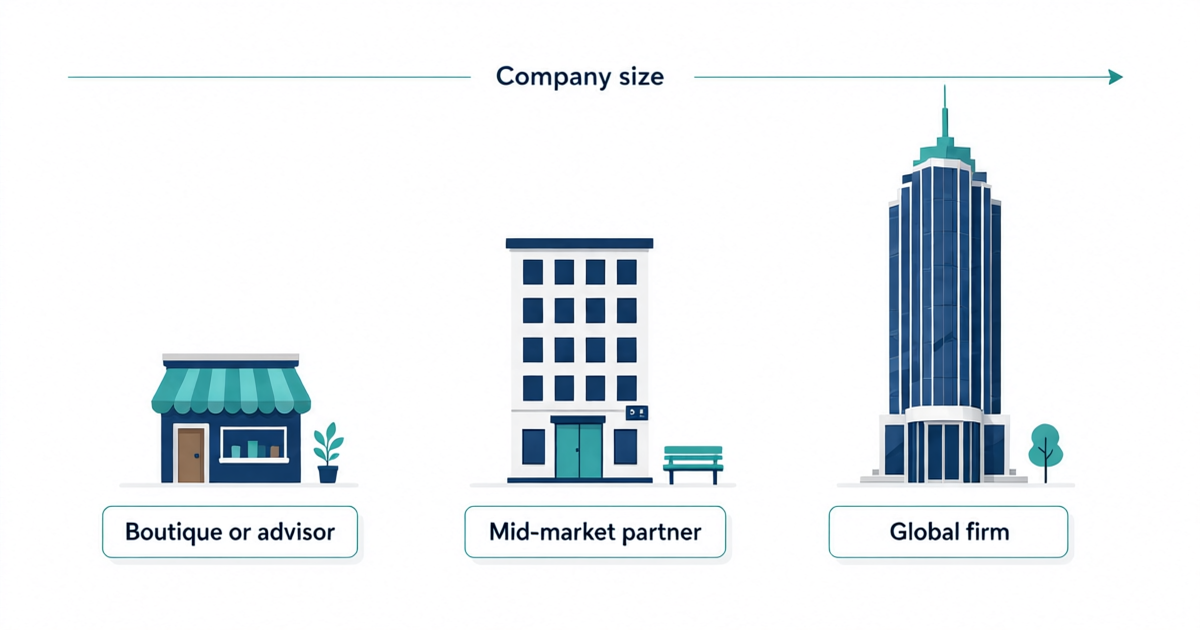
Here’s a simple way to match size to firm type, using the same size bands as our calculator:
| Company size | Firm types that usually fit |
|---|---|
| 1 to 50 employees | Fractional advisor, local IT provider, small boutique |
| 51 to 200 employees | Boutique or mid-market partner |
| 201 to 1,000 employees | Mid-market partner; engineering-led firm for builds |
| 1,001 to 5,000 employees | Mid-market partner, integrator for big programs, strategy house for board-level choices |
| 5,000+ employees | Integrators, strategy houses, engineering-led firms |

Write your evaluation criteria before you read any proposal, then score each one the same way. That keeps the loudest of the digital transformation consulting firms from winning by default.
Not sure which method your consultant should use? Our guide to digital transformation frameworks compared shows which model fits which business, so you can judge their approach instead of just trusting it. Also ask how they’ll handle the people side. Prosci found that 88% of projects with excellent change management met or exceeded their objectives, compared with 13% of projects with poor change management (Prosci). A firm with no clear answer on training and adoption is a firm that will hand you software and walk away.
Questions to Ask a Digital Transformation Consulting Firm Before Hiring
The best questions to ask a digital transformation consulting firm before hiring are about people, proof, and exit terms, not about technology. Ask each firm to explain its methodology in plain words. These questions to ask consultants work because a good answer is specific. A weak answer is vague, long, or full of buzzwords.
| Question | What a good answer sounds like |
|---|---|
| Who exactly will work on my project, and for how long? | Names and roles. Senior people stay involved every week. |
| Can I speak to a client like us? | Similar size or industry, and an easy yes. |
| What will you deliver in the first 30 to 60 days? | Specific documents and decisions, not “discovery”. |
| How will we measure success? | A few clear numbers tied to your goals. |
| How do you handle training and adoption? | A plan for people and change that continues after go-live. |
| What do you need from my team? | An honest time estimate and a named executive sponsor. |
| What happens if we want to stop? | Milestone gates and a clear exit clause. |
| Do you earn money from any tools you recommend? | A direct answer. Vendor-neutral, or fully disclosed. |
| Who owns the documents and work when we finish? | You do. |
When you call a reference, ask about the work, not the sales pitch. Did the team that was promised show up? Did the project finish on time and on budget? What did the firm do when something went wrong? Would they hire them again? Reference calls are the cheapest way to separate strong digital transformation consulting firms from polished ones.
Pay attention to who owns results on your side, too. Gartner found that a “digital vanguard” of CIOs and business executives who share responsibility for delivery saw 71% of their digital initiatives meet or exceed their targets, versus 48% on average (Gartner). If no one on your team owns the outcome, no firm can fix that for you. Agree on a few numbers up front, and use our guide on how to measure digital transformation ROI to pick them.
Red Flags When Hiring a Digital Transformation Consultant
The biggest red flags when hiring a digital transformation consultant are vague deliverables, a team switch after you sign, and promises that sound too good. Knowing how to vet a consulting firm early saves you months of regret. Watch for these:
- Vague deliverables. If you can’t say what you’ll hold in your hands at week four, walk away.
- The bait-and-switch team. Senior people pitch, then juniors you never met do the work.
- Guaranteed ROI. About 70% of transformations fall short of their targets (BCG), so no honest firm can promise results.
- One-size-fits-all plans. If the proposal never mentions your business by name, it’s a template.
- No plan for people. Training and adoption are an afterthought.
- Pushing one vendor’s tools. Ask whether they get paid for what they recommend.
- Support that ends at launch. Real change needs help after go-live.
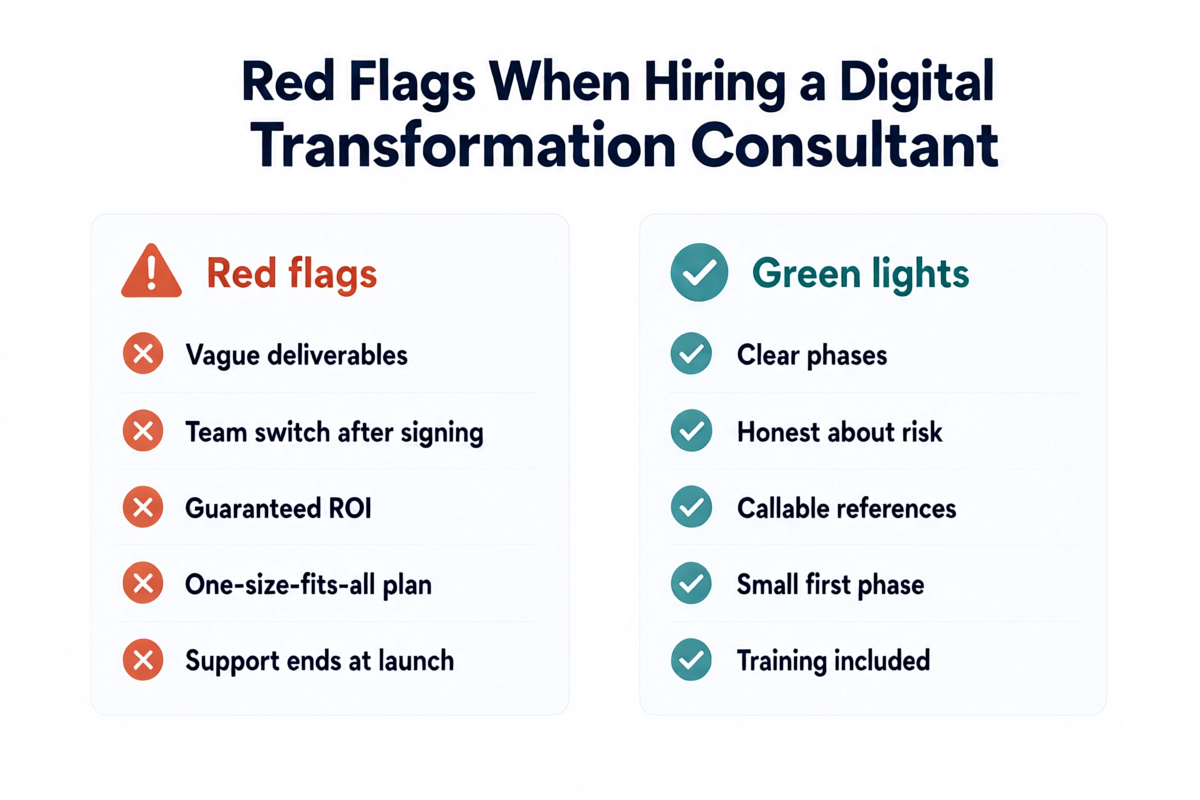
Green lights are the opposite: clear phases, honest talk about risk, references you can call, and a first phase that’s small enough to walk away from.
How Much Do Digital Transformation Consulting Firms Charge?
So how much do digital transformation consulting firms charge? Anywhere from a few thousand dollars for a small assessment to many millions for a global program. Price depends mostly on the firm’s type and your scope, so digital transformation consulting cost can’t be quoted without a clear scope. Treat the ranges below as rough estimates from public rate guides and our own research. They’re not quotes.
| Firm type | Rough hourly range | Rough project size |
|---|---|---|
| Strategy houses | $400 to $900 or more | $500,000 and up for strategy phases |
| Global integrators and Big Four | $150 to $350 | Six to nine figures for full programs |
| Engineering-led firms | $90 to $200 | $100,000 to several million for builds |
| Mid-market and boutique firms | $150 to $400 | $25,000 to $500,000 |
| Independent or fractional advisors | Varies; often a monthly retainer | $5,000 to $25,000 for an assessment |
For one real example, Resultant lists $150 to $199 per hour and project minimums from $5,000 on its Clutch profile (self-reported, checked October 2026). Rates are only part of the story. A pricey firm with a small senior team can cost less in total than a cheap one with a huge junior team. Also ask what is not in the price. Travel, software licenses, and support after launch can add up, so get everything in writing. A clear rate card and a project fee breakdown by phase are easy to ask for, and hard to argue with.
Fixed Fee vs Time and Materials Consulting Contract
A fixed fee vs time and materials consulting contract is really a choice about who carries the risk. With a fixed fee, you know the total up front and the firm carries the risk, but the scope must be crystal clear. With time and materials, you pay for hours used, which is flexible but can balloon. A smart middle path: fixed fee for the first phase, then time and materials with a cap. Whatever you pick, tie payments to milestones, put the work in a written statement of work, and keep an exit clause. These consulting fee structures protect you if things go sideways.
How Long Does a Digital Transformation Consulting Engagement Take?
How long does a digital transformation consulting engagement take? Usually about six to twelve weeks for a strategy and roadmap phase, and six to twenty-four months for the build and rollout that follows. Small businesses can finish an assessment in a few weeks. Large programs run for years. These are rough estimates, since scope and readiness change everything. If you’re asking how long does digital transformation take overall, the honest answer is that it never fully ends, so plan in phases. Our roadmap guide shows how to break it up.
Digital Transformation Consulting Firms vs an In-House Team
Digital transformation consulting firms vs in-house team isn’t an either-or choice. Most companies do best with a hybrid model: outside experts for the plan and hard skills, your own people for daily ownership. The build vs buy digital transformation question comes down to skills, speed, and how long you’ll need the help.
- Hire a firm when you lack a skill, need speed, or want an outside view you can trust.
- Build in-house when the work is ongoing, you have capable people, and you don’t want to depend on someone else.
- Go hybrid when you want the firm to teach your team so they can run it after the consultants leave.
Whichever route you take, plan for people. Prosci found that projects with excellent change management were nearly five times more likely to stay on or ahead of schedule (Prosci). Ask any firm you hire to include knowledge transfer in the contract.
Choosing the Right Digital Transformation Consulting Partner: Your Next Step
The right digital transformation consulting partner fits your size, your maturity score, and your industry, and it proves itself in a small first phase before you commit to more. A good digital transformation partner also teaches your team as it goes. Digital transformation consulting works best when you know what you need before you shop. There are plenty of digital transformation consulting firms out there, so the real work is matching, not searching.
- Take the digital maturity assessment calculator and find your row in the score table above.
- Shortlist two or three firms of the type that fits your size and score.
- Ask the questions above, then start with a fixed-fee first phase.
Want help with your own digital transformation? If you’d like to talk it through, send us a short note below and we’ll get back to you.
More from CorporatePlaybookPro.com
→ What Is Digital Transformation? The Complete Guide for Business Leaders
→ Digital Transformation Frameworks Compared: Which Model Fits Your Business
→ Digital Transformation Culture and Change Management (2026 Guide)
→ How to Create a Successful Digital Transformation Roadmap: A Leader’s Guide
→ Digital Maturity Assessment: Benchmark Your Organization’s Transformation Readiness (2025 Guide)
→ Top 7 Digital Transformation Trends to Watch in 2025: The Complete Guide
→ The 90-Day Digital Transformation Sprint: Quick Wins That Build Long-Term Success
→ Why Customer Centricity Should Drive Digital Transformation
Frequently Asked Questions
Are digital transformation consulting firms worth the money?
They can be, when you hire for a clear gap and measure the result. A firm is worth it if it brings a skill, speed, or outside view you lack and you can name what you’re paying for. It’s rarely worth it if you hire before you know the problem. Score your maturity first, then buy only the help your score points to.
What is the difference between digital transformation and IT consulting?
IT consulting focuses on technology: systems, security, and support. Digital transformation consulting looks at the whole business, including strategy, processes, customers, and people, and uses technology to support the change. Many projects need both, but a tool-only fix won’t change how the business works.
Which consulting firm is best for digital transformation?
No single firm is best for everyone. Strategy houses suit board-level decisions, integrators suit large global programs, engineering-led firms suit software builds, and mid-market or boutique firms suit smaller budgets. The best choice is the type that matches your size, your maturity score, and your industry.
What qualifications should a digital transformation consultant have?
Look for proven results more than certificates. Good signs include past projects at companies your size, references you can call, and experience in both technology and change management. Certifications in project management, cloud platforms, or change management can help, but they don’t replace a track record.
Can a 20-person company hire a digital transformation consulting firm on a small budget?
Yes, if you keep the scope small. Ask for a fixed-fee assessment of two to six weeks, or work with a fractional advisor or local IT partner instead of a large firm. Share your budget in the first email so the firm can tell you quickly whether it can help.
What should a statement of work include when hiring a digital transformation consulting firm?
It should list the deliverables for each phase, the dates, the people assigned, and the price. Add how you’ll approve each milestone, what your team must provide, who owns the finished work, and how either side can exit. If any of these points is vague, fix it before you sign.
How do I compare proposals from digital transformation consulting firms side by side?
Score every proposal against the same criteria you wrote before reading them, such as fit with your size, named team, first-60-day deliverables, references, and total cost. Compare total cost, not hourly rate. Drop any proposal that can’t name who will do the work.
What should I do if my digital transformation consultant keeps missing milestones?
Raise it in writing and ask for a recovery plan with dates. Check the contract for your rights at each milestone gate. If the problem is the team, ask for the people you were promised, and if it keeps happening, use your exit clause and keep all the work done so far.
Can I do digital transformation without a consulting firm if I have no IT team?
Often yes, at small scale. Start with your maturity score, pick a few quick wins like cloud tools and simple automation, and use a fractional advisor or platform partner for the hard parts. Bring in a firm only when the gap is bigger than your team can close.
What is a digital maturity assessment?
A digital maturity assessment is a scorecard of how well your business uses digital tools, data, and ways of working today. It rates areas such as strategy, customers, operations, technology, and people, then points to your biggest gaps. Our free digital maturity assessment calculator gives you a score from 1 to 5 in about 15 to 20 minutes.
How are digital transformation consulting companies different from software vendors?
A consulting company sells advice and project help, and it should stay neutral about tools. A software vendor sells its own product and has a reason to recommend it. Ask any firm whether it earns money from the tools it suggests.
What is the difference between a digital transformation agency and a consulting firm?
An agency usually focuses on building and running digital work such as websites, apps, and marketing technology. A consulting firm focuses more on strategy, process, and change across the whole business. Some firms do both, so check what they actually deliver.