Customer experience (CX) is the total perception your customer forms about your business across every interaction — from the first time they hear your name through every onboarding session, support conversation, invoice, renewal discussion, and final decision to stay, expand, or leave. It is not a department, a software platform, or a satisfaction score. Customer experience is the cumulative result of every touchpoint your business creates: how your website loads, how your onboarding feels, how your team responds to problems, how your invoices are worded, and how your renewal conversations go. Every one of these moments contributes to a single, ongoing impression — and that impression determines whether your customer stays, grows, or quietly starts evaluating your competitors.
You own customer experience in your company. That might not be your job title — it never is — but if you’re a CTO, a strategy consultant, a founder, or a business executive, CX outcomes land on you. You’re the one fielding the call when a key account threatens to leave. You’re the one deciding whether to invest in a new CRM or a new support process. And when your renewal rate drops, the board asks you what’s happening.
The problem is that most CX guidance assumes you have a CX director, a research budget, and dedicated headcount. Qualtrics, Salesforce, and Oracle publish excellent content — about systems you’d need a team of ten to implement. What they don’t publish is a playbook for business leaders who are running this alone, or close to it.
Poor customer experiences cost businesses $3.7 trillion globally each year (PwC). Companies that invest strategically in customer experience increase revenue by 5–10% while reducing operating costs by 15–25% within two to three years (McKinsey). 52% of consumers have stopped buying from a brand after a single bad experience (PwC 2025). Those numbers don’t require a CX department to move — they respond to a clear framework applied consistently.
This customer experience playbook is built specifically for business leaders and consultants who own CX outcomes without the organizational infrastructure most CX guides assume. It covers every core component — from building your customer experience strategy to choosing the right metric first to automating the parts that don’t require human judgment — using the team and tools you already have.
How Customer Experience Differs from Customer Service — and Why It Matters for Business Leaders
The difference between customer experience and customer service for business leaders is not semantic. It determines what you invest in, who owns it, and what you measure.
Customer service is reactive: a customer has a problem, your team responds. You can improve it by cutting response times, training support staff, and building better knowledge bases. It lives in one department and has one clear success metric — resolution time.
Customer experience is the total perception your customer forms across every interaction with your business — before they buy, through onboarding, across every invoice, support ticket, and renewal conversation. Bain & Company research shows that CX leaders grow revenue 4–8% faster than their competitors, but only when CX is treated as an organization-wide operating model — not a customer service improvement project confined to one function.
For business leaders without a CX team, this distinction has an immediate practical implication: you’re not fixing customer service. You’re redesigning how your entire business shows up to customers. The technology purchases, the onboarding flow, the invoice layout, how your team communicates delays — all of it is customer experience. None of it sits in a single department.
Amazon built its early competitive advantage not by having the best customer service team, but by designing every operational system — returns, shipping visibility, pricing clarity — around customer experience trade-offs. Jeff Bezos kept an empty chair at executive meetings to represent the customer. Every operational decision was run through the question: “What does this do to the customer’s experience?” You don’t need an empty chair. You need a framework that does the same job — which is what this CX playbook delivers.
→ Full guide: B2B Customer Experience Strategy: A Playbook for CTOs and Business Executives
What Shapes Customer Experience — 5 Touchpoint Categories Business Leaders Must Own
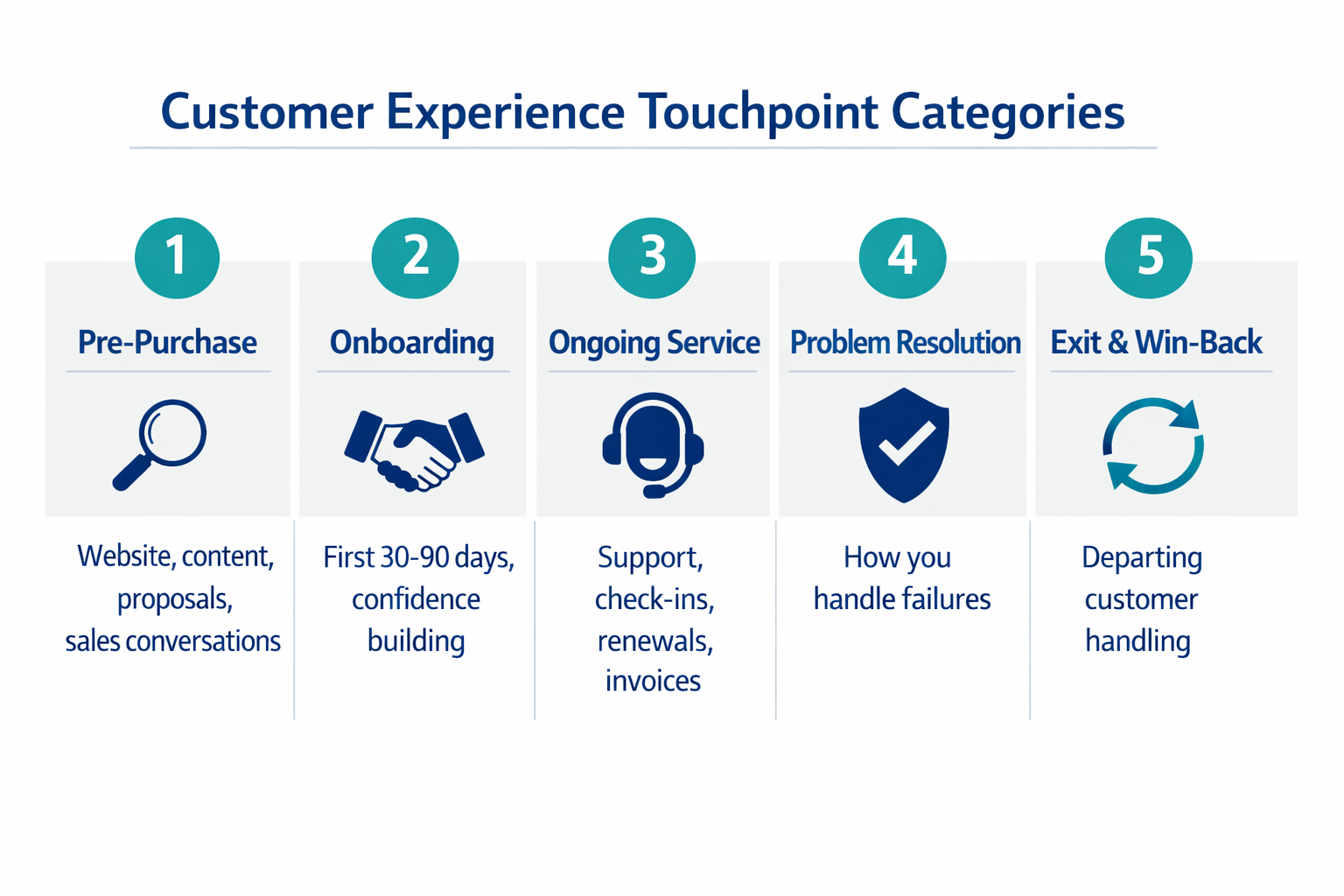
Understanding what shapes customer experience and which touchpoint categories business leaders must own is the foundation of any CX operating model. There are five categories — each one either building or eroding the customer’s cumulative perception of your business.
1. Pre-purchase touchpoints. Everything before money changes hands: your website, content, sales conversations, and proposals. Customers form their first impression here, and that impression sets the expectation baseline for everything that follows. A beautifully designed sales process that overpromises creates a CX debt that onboarding will spend months trying to repay.
2. Onboarding touchpoints. The first 30–90 days after purchase are when customers build confidence or develop doubt. Bain & Company research shows that customers who have a poor onboarding experience are 60% more likely to churn within the first year, regardless of how strong the product is. Onboarding is consistently the highest-leverage CX investment for B2B service businesses — and the most neglected once the sales team has moved on.
3. Ongoing service touchpoints. Every support interaction, check-in call, renewal conversation, and invoice. These touchpoints maintain — or slowly erode — the trust built in the onboarding phase. Invisible problems here produce visible churn six to twelve months later.
4. Problem resolution touchpoints. How you handle things when they go wrong is the strongest predictor of customer loyalty in B2B. HBR research shows that customers who had a problem resolved to their satisfaction are more loyal than customers who never had a problem at all. The response to failure is a more powerful CX signal than the experience of success.
5. Exit and win-back touchpoints. How you handle a departing customer — and whether you have a structured win-back process — determines whether a departure becomes permanent or an opportunity to reset the relationship on better terms.
The practical implication for customer experience touchpoints management: map your current touchpoints against these five categories. Every gap is a CX risk; every gap you close is retained revenue that required no additional acquisition spend.
How to Build a Customer Experience Strategy Without a Dedicated CX Team
Building a customer experience strategy without a dedicated CX team doesn’t mean doing less. It means being more deliberate about the four elements that make the difference between a working CX program and a pile of survey responses nobody reads.
Step 1: Define your CX vision as a measurable commitment, not an aspiration. “We want customers to feel valued” is not a CX vision. “Customers can resolve any issue without repeating themselves to a second person” is. Your CX vision is a behavioral standard your organization can actually test against — one sentence, specific, falsifiable. If you can’t tell on any given day whether you met it, it’s not a vision; it’s a tagline.
Step 2: Map what you currently know before you buy anything. Your support ticket history, churn data, contract renewal notes, and sales team’s objection log are your customer intelligence system. Before you invest in a feedback tool, extract the pattern from data you already have. Most organizations find their top three CX pain points in this existing data — no survey required. This is the first step in any effective customer experience strategy.
Step 3: Assign ownership — even partial ownership. CX cannot be everyone’s job with no one accountable. In a company without a CX team, ownership means: one person reviews customer feedback monthly, one cross-functional meeting per month where CX data is presented alongside commercial metrics, and one person who owns the action list. That structure costs nothing and prevents the most common CX failure mode — data collected, insights unread.
Step 4: Build the feedback loop before the strategy gets complicated. Deploy a survey at one key touchpoint — post-onboarding, post-support interaction, or a quarterly relationship check. Two to three questions maximum. Set a low-score alert. Act on the first three low scores you receive. The discipline of acting on feedback is more valuable at this stage than the sophistication of the feedback system.
Step 5: Connect CX metrics to commercial outcomes from day one. Forrester research shows customer-obsessed organizations achieve 41% faster revenue growth and 49% better profit gains than peers who don’t systematically prioritize CX. When you present CX data to leadership, the first number on the page should be churn rate or renewal revenue impact — not satisfaction scores in isolation. That framing is what secures the budget for the next initiative and keeps the program alive past the first quarter.
These five steps won’t give you a CX team. They give you a customer experience strategy that a CX team would recognize — running on the resources you already have.
→ Full guide: Customer Experience Strategy for Small Business Owners and Solopreneurs (2026 Playbook) (coming soon)
Customer Journey Mapping for B2B Teams Without a UX Researcher
Customer journey mapping for B2B teams without a UX researcher has a reputation for being a research project — twelve weeks, post-it note workshops, a design firm on retainer. For business leaders who need actionable output this quarter, that version of journey mapping is irrelevant.
Step 1: List every touchpoint in sequence. From the first time a prospect hears about you through first contact, proposal, onboarding, first month of use, first support request, and first renewal. Write them in a row. You now have the bones of a B2B customer journey map.
Step 2: Rate each touchpoint on two dimensions. Customer effort — how hard is it for the customer to navigate this stage? And your confidence — how well does your business perform here? Score both 1–5. Low confidence scores are where your CX is leaking revenue quietly.
Step 3: Validate with three customers. A 20-minute conversation with three existing customers about where they felt friction will confirm or challenge your scores. Three conversations is enough to identify the pattern. More is useful; fewer is fine for a first pass.
Step 4: Build one improvement sprint per quarter. Pick the highest-priority friction point and fix it. Document what changed and what metric moved afterward. This quarterly cycle is your ongoing journey management program — no workshops required.
B2B journeys involve more decision-makers than B2C, which means friction at any one touchpoint creates political cost inside the client organization, not just operational delay on your side. Journey mapping gives you visibility into where that political cost is accumulating — before it surfaces as a lost renewal.
→ Full guide: Customer Journey Mapping for Small Business and B2B Teams: A Step-by-Step Framework (coming soon)
Voice of the Customer — How to Run a Lean VoC Program Without a Research Team or Budget
Running a voice of the customer program without a research team or dedicated budget is entirely feasible when you strip the process to its minimum viable components. Voice of the Customer (VoC) is the systematic process of capturing what customers think, feel, and expect — then converting that input into operational improvements. The enterprise version requires research platforms, dedicated analysts, and multi-month project cycles. The lean version requires three things: a consistent method for collecting input at key moments, a process for reviewing it regularly, and a clear path from insight to action.
Channel 1 — Structured surveys. NPS quarterly + CSAT post-interaction (covered in the metrics section of this CX playbook). These are your quantitative signal: numbers you can track over time, present in leadership meetings, and connect directly to commercial outcomes.
Channel 2 — Unstructured conversation. One 20-minute customer call per month. Not a sales call or a support call — a deliberately open conversation: “What’s working? What’s frustrating? What would make you recommend us more readily?” Twelve of these conversations per year generates more actionable insight than most formal VoC programs. The insight arrives in the customer’s own language, unfiltered by survey design.
Channel 3 — Passive listening. Support tickets, renewal objections, and sales call notes already contain your customers’ exact words about what’s failing. Gartner research shows that 80% of the customer insight businesses need to improve CX already exists inside their own internal systems — it’s simply not being read systematically. Build a monthly habit of reading ten support tickets and five sales objection notes. Patterns emerge faster than you expect.
The output of a lean voice of customer program isn’t a report. It’s a prioritized list of three improvements for next quarter. That’s the only deliverable that produces results — everything else is documentation without accountability.
→ Full guide: Voice of the Customer (VoC) Programs: A Lean Playbook for Solopreneurs and Small Teams (coming soon)
NPS, CSAT and CES: Which Customer Experience Metric to Track First
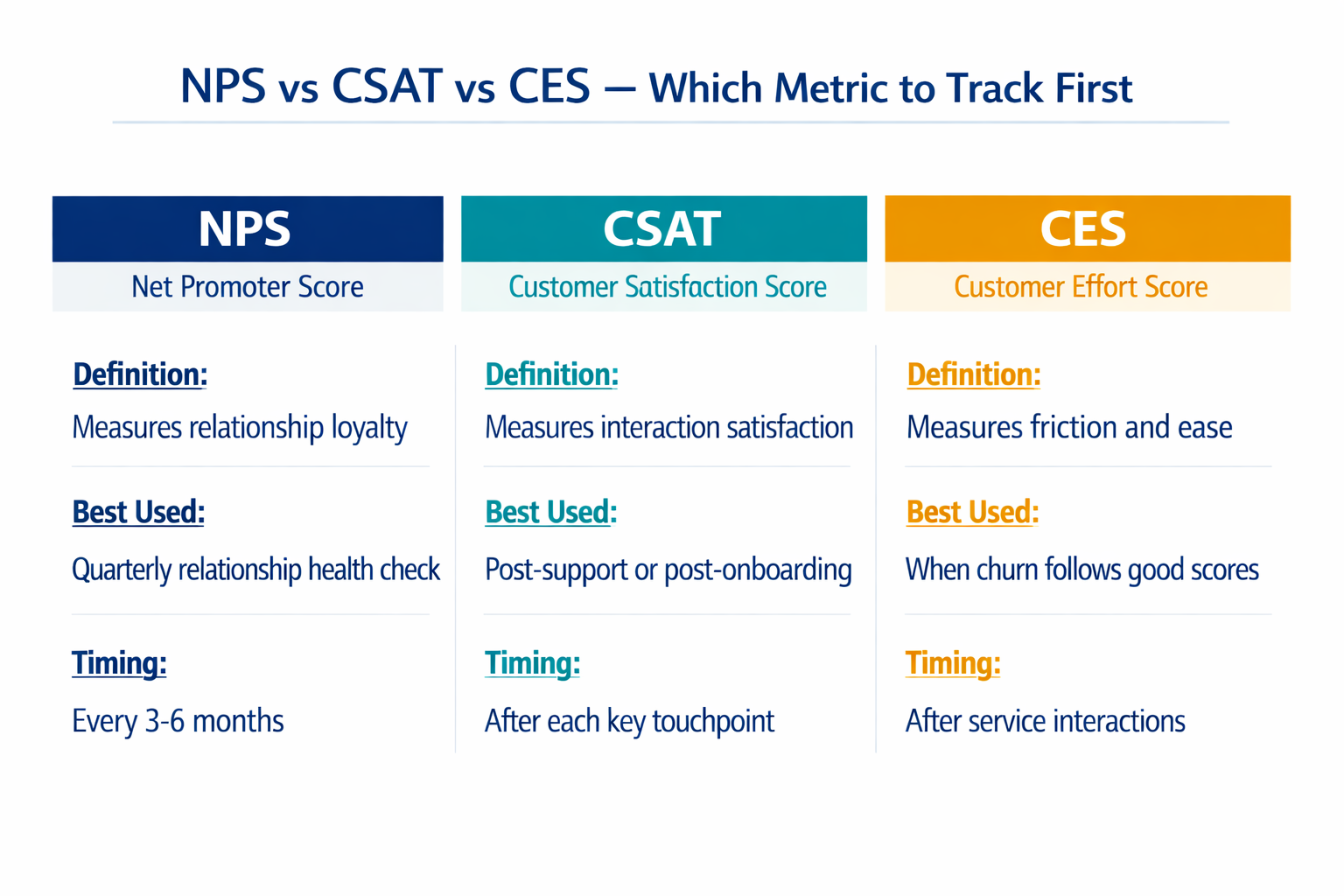
Choosing which customer experience metric to track first — NPS, CSAT, or CES — is not a question of which metric is best. It’s a question of which one answers the problem you most urgently need answered.
NPS (Net Promoter Score) measures relationship loyalty: how likely is your customer to recommend you? Collected quarterly or biannually, it signals whether your overall CX trajectory is moving in the right direction and is the most commonly used leading indicator before a renewal conversation.
CSAT (Customer Satisfaction Score) measures satisfaction with a specific interaction. Collected post-interaction, it tells you which touchpoints are performing and which are dragging, making it diagnostic rather than strategic.
CES (Customer Effort Score) measures friction: how easy was it for the customer to get what they needed? Gartner research shows that reducing customer effort is the most reliable predictor of customer loyalty in B2B service relationships — ahead of satisfaction and delight. Best used when you suspect customers are leaving not because they dislike you but because working with you takes too much effort.
The NPS vs CSAT vs CES comparison resolves simply for most B2B businesses starting from zero: begin with NPS quarterly + CSAT at your two highest-friction touchpoints. This gives you directional health (NPS) and diagnostic signal (CSAT) without building a survey infrastructure your team can’t sustain.
When to Use NPS Over CSAT for B2B Service Companies
Choosing NPS over CSAT for B2B service companies comes down to timing and question type. Use NPS when you need a strategic health signal across the full customer relationship — especially before a renewal cycle, a pricing conversation, or a contract expansion discussion. NPS for B2B service gives you the number that tells you whether the relationship is structurally at risk. CSAT tells you which specific interaction created or resolved that risk. The two metrics work together; start with NPS to understand the health of the relationship, then use CSAT to diagnose where the problem originated.
Customer Effort Score for B2B Service Businesses — When It Earns Its Place
Customer effort score earns its place in B2B service businesses once you’ve established relationship health (NPS) and touchpoint quality (CSAT) and you start noticing customers leaving despite good satisfaction scores. When customers tell you support interactions were pleasant but they still churned, CES is the missing diagnostic. CES measurement in B2B surfaces the friction that doesn’t show up in satisfaction surveys — the three-step verification process, the PDF that has to be signed and emailed back, the onboarding checklist that takes four hours to complete. High effort doesn’t produce complaints. It produces quiet churn.
→ Full guide: NPS vs CSAT vs CES: Which Customer Experience Metric Should You Track First? (coming soon)
How to Calculate Customer Experience ROI Without a Finance Team
Calculating customer experience ROI without a finance team requires three numbers you already have access to: your annual churn rate, your average contract or transaction value, and your support ticket volume.
Revenue impact: If 10% of your customers churn annually and your average contract value is $20,000, you’re losing $200,000/year in revenue to churn alone — before accounting for the cost of replacing those customers through acquisition. A 2-percentage-point churn reduction from better CX is worth $40,000 in retained revenue. That’s your CX ROI baseline.
Cost avoidance: Support tickets in B2B cost an average of $20–$40 each to resolve when you factor in staff time and overhead. If you handle 200 tickets monthly and CX improvements reduce that volume by 20%, you’re saving $12,000–$19,200 annually from reduced support load alone.
Expansion revenue: NPS promoters are statistically 2.5x more likely to purchase additional products or services. If you have 40 NPS promoters at an average expansion deal of $8,000, you’re holding a $16,000–$40,000 expansion pipeline that closes faster when the CX relationship is strong.
Watermark Consulting’s CX ROI Study found that CX leaders outperform CX laggards by a cumulative 45 percentage points in total stock returns over an 11-year period. That’s the long-term case. For a leadership meeting next week, present the short-term case: your current churn rate, your average contract value, and a 2-point churn reduction target tied to one specific CX initiative. That’s the customer experience ROI calculation that gets the next budget approved.
→ Full guide: Customer Experience KPIs: The Metrics Dashboard Every Business Leader Should Track (coming soon)
How to Get Executive Buy-In for Customer Experience Initiatives
Getting executive buy-in for customer experience initiatives fails most often not because the data is wrong but because the case is made in the wrong language. Executives respond to revenue risk, competitive position, and board-visible metrics. CX data needs to speak all three simultaneously.
Revenue risk framing: Don’t present NPS scores. Present what a 5-point NPS decline correlates to in your historical churn rate. If leadership sees CX data as a leading indicator of revenue risk — a canary in the P&L coal mine — it gets boardroom attention. If it looks like a satisfaction survey, it gets delegated to the marketing team and forgotten by Q2.
Competitive position framing: McKinsey research shows that companies investing strategically in CX increase revenue by 5–10% while cutting operating costs by 15–25% within two to three years. If your direct competitors are executing a CX business case and you’re not, the disadvantage is invisible in this quarter’s numbers and painfully visible in next year’s renewal rates. Put that timeline in front of leadership explicitly.
Proof-by-pilot framing: Don’t ask for a CX budget. Ask for permission to run one 90-day initiative with one measurable metric and a defined success threshold. Deliver a result. Use that result to fund the second initiative. The most durable CX programs inside lean organizations began as a single proof-of-concept that leadership couldn’t argue with because it was too specific and too small to reject. See Why Customer Centricity Should Drive Digital Transformation for the strategic framing that makes this case to digital-native leadership.
Customer Experience Maturity — How to Assess Where Your Business Stands Today
Assessing your customer experience maturity without a CX consultant starts with five honest questions — each diagnostic rather than aspirational. The customer experience maturity model used by consultancies costs tens of thousands of dollars to administer. This version costs nothing.
Score 1 point for each “yes”:
1. Do you have a defined CX vision? Not a values statement — a specific, testable behavioral commitment. “Customers can resolve any issue without repeating themselves to a second team member” is a CX vision. “We want customers to feel valued” is a mission statement. If you have a testable commitment, score 1.
2. Do you collect customer feedback at least once per quarter? Structured, consistent, and comparable quarter-over-quarter — not anecdotally from a sales call. Score 1 if yes.
3. Does someone review that feedback and produce a written summary? Feedback that no one reads has no business value. Score 1 if a named person produces a written output from your feedback data regularly.
4. Has the business made a measurable change in response to customer feedback in the last six months? Collecting feedback without acting on it is often worse than not collecting it — customers who submitted input and saw nothing change become more disengaged, not less. Score 1 if you can name a specific change and its outcome.
5. Do you present CX metrics alongside revenue metrics in leadership meetings? This question reveals whether CX is a program or a project. Programs have ongoing boardroom visibility. Projects get buried. Score 1 if CX data appears in your standard leadership reporting.
Scoring: 0–1 = Pre-CX (reactive, no structured visibility). 2–3 = Emerging CX (foundations in place; discipline is the gap). 4–5 = Managed CX (systematically measured and acted on — ahead of most companies your size).
McKinsey research shows that companies operating at the ‘Managed CX’ stage outperform ‘Pre-CX’ companies by 10–15 percentage points in customer retention — a gap that widens every year those habits compound.
Customer Retention vs Customer Experience — What Business Leaders Get Wrong
Customer retention vs customer experience is a distinction that business leaders get wrong regularly — not because they’re unaware of the difference, but because they try to manage one without building the other.
Customer retention is an outcome: a customer chose to stay. Customer experience is the mechanism: every interaction and impression that made staying feel like the obvious choice. The mistake is investing in retention tactics — discounts, loyalty schemes, win-back offers — while leaving the underlying experience unchanged. A customer who stays because you offered a 20% discount has not become loyal. They’ve become temporarily cheaper to retain. The moment a competitor offers 25%, they leave.
The correct framing: CX investment prevents the retention problem from arising. Retention tactics manage the retention problem after it has already occurred. Fixing the experience is structurally cheaper than running ongoing retention programs — and the results compound rather than reset every quarter.
Bain & Company research shows that increasing customer retention by just 5% increases profits by 25–95%. The mechanism behind those numbers is not loyalty programs — it’s reducing the friction, frustration, and unmet expectations that cause customers to begin evaluating alternatives. The discount doesn’t address what drove them to look; the fixed experience removes the reason to look.
For business leaders evaluating budget allocation, the practical test is straightforward: if you’re currently spending more on retention tactics than on CX improvement, you’re managing the symptom while the underlying condition continues. The connection between customer retention and experience is not conceptual — it’s the reason your renewal rate moves or doesn’t move regardless of how competitive your pricing is.
→ Full guide: Customer Retention vs Customer Experience: What Business Leaders Get Wrong (coming soon — Supporting Article)
AI Tools for Customer Experience Automation When You Don’t Have a CX Team
Using AI tools for customer experience automation without a CX team has become the most practical path for lean organizations in 2026. AI has eliminated the cost of entry for capabilities that previously required dedicated headcount — specifically: survey distribution, feedback analysis, first-contact resolution, and customer insight synthesis.
Automated feedback distribution and analysis: Tools like Delighted, Typeform AI, and CustomerGauge automatically send NPS/CSAT surveys at the right moment, aggregate responses, and surface themes from open-text feedback without a survey analyst. Over 60% of small businesses adopted AI-powered customer engagement tools by early 2026, with the majority reporting measurable improvement in customer satisfaction scores within six months.
AI-powered first-contact resolution: A well-configured AI chatbot resolves 40–60% of support queries before they reach a human. Zendesk data shows that AI-assisted customer service teams resolve issues 35% faster at 30% lower cost than fully human teams. For a business handling 100 support interactions monthly, that’s meaningful capacity freed for complex escalations. See how agentic AI reshapes customer service automation for a deeper technical breakdown.
Feedback synthesis: AI tools like Claude or ChatGPT can synthesize customer interview notes, support ticket patterns, and review data into a structured insight report in under 30 minutes — a task that previously required a CX analyst and three days. This is the AI customer experience tool use case with the lowest barrier to entry and the most immediate time savings for a business leader doing this alone.
How to Use AI to Collect Customer Feedback Without a Survey Team
Collecting customer feedback with AI without a survey team requires three things: a survey platform with automation, a CRM or email trigger, and a low-score alert. Connect Delighted, Typeform, or Google Forms to your CRM. Set a trigger: every customer who completes onboarding receives a CSAT survey on day 30. Set an alert for any score below 3/5. One person reviews alerts weekly. That’s a functional AI feedback collection loop — no survey team, no manual distribution, no analyst required.
Best Affordable CX Automation Tools for Solopreneurs and Small Teams in 2026
For budget-constrained implementations: Delighted (free tier: 50 surveys/month), Tidio or Crisp (free AI chatbot tier), Claude or ChatGPT for feedback synthesis, HubSpot CRM (free tier) for contact management and email automation. Total cost: $0–$50/month for a functional CX tool stack for small business. Start with free tiers; upgrade only once you’ve proven the metric moves.
→ Full guide: AI in Customer Experience: A Practical Adoption Guide for Business Leaders (coming soon)
How to Deliver Omnichannel Customer Experience With a Lean B2B Team
Delivering omnichannel customer experience with a lean B2B team doesn’t require a unified data platform, a dedicated channel manager, or enterprise CRM licensing. It requires consistency — which is achievable with three practical rules and tools most businesses already have access to.
What omnichannel means in a B2B context: Your customer gets the same quality of experience whether they contact you by email, phone, support ticket, or LinkedIn message. Your team has context from previous interactions so the customer never has to repeat themselves. Transitions between stages — sales to onboarding, onboarding to support — don’t create friction because of an information gap.
That definition is achievable for a team of three. The enterprise version of omnichannel customer experience strategy — real-time data unification across twelve channels with AI routing — is not what your customers are asking for. Zendesk’s 2025 CX Trends report found that the single biggest omnichannel complaint in B2B is customers having to repeat their situation to a second or third contact — not the absence of a real-time data platform. Your customers want context continuity. That’s an information discipline problem, not a technology problem.
Rule 1 — One customer record. Every team member who touches a customer uses the same CRM. HubSpot’s free tier handles this for teams of up to ten. Every interaction is logged. No exceptions — a CRM that some people use is a CRM that produces incomplete records and broken context handoffs.
Rule 2 — Written transition summaries. Every time a customer moves between stages, a brief written summary transfers with them: who they are, what they bought, what they expect, what to watch out for. Five sentences. Takes three minutes to write. Prevents the single most common B2B CX failure.
Rule 3 — Channel response standards. Define your response commitment per channel and hold it publicly. Customers don’t need you on every channel — they need you to be reliable on the channels where they reach you. Predictability is a form of customer experience that costs nothing to deliver once the habit is established.
How to Build a Customer-Centric Culture in a Small Company Without a Change Program
Building a customer-centric culture in a small company without a formal change management program works because culture in small organizations is closer to behavior than belief — it’s the decisions your team makes when nobody is watching. Creating the right conditions for those decisions doesn’t require an HR program. It requires three consistent habits.
Customer story sharing: In every weekly team meeting, spend five minutes on one customer interaction — positive or negative. Share the exact words the customer used. This practice keeps the customer present in decisions that appear administrative but are actually CX decisions — how a delay is communicated, how an invoice is worded, how a complaint is escalated. Customer-centric culture is built in these moments, not in values workshops.
CX scorecard visibility: Post your NPS or CSAT score somewhere every team member sees it — a Slack channel, a shared dashboard, a number on the weekly report. When the team sees the score move, they make the connection between their daily actions and customer outcomes. Zappos, which built a $1 billion business on customer experience culture, famously paid new employees $2,000 to quit if they decided the culture wasn’t right for them — a structural signal that customer commitment was non-negotiable. You don’t need $2,000. You need a visible number that everyone can affect.
The decision rule: Give your team one question to route difficult customer situations through: “Would this make the customer more likely to recommend us?” That question is a culture implementation tool disguised as a decision framework. It redirects judgment toward the customer without requiring a policy manual. The Ritz-Carlton empowers every employee to spend up to $2,000 resolving a customer issue without manager approval — the principle behind that rule is what matters, not the amount. See how customer centricity drives transformation for the organizational-change framing. The customer experience culture dividend compounds over time; the entry cost is three meetings and one visible dashboard.
Customer Experience Governance Model for Companies Without a CX Director
A customer experience governance model for companies without a CX director solves one structural problem: preventing CX data from being collected and then quietly ignored. Governance is not bureaucracy — it is the structural answer to the question: who reviews the data, who makes the decision, and who is accountable for the outcome? Without that answer in writing, CX metrics become quarterly slide decorations.
Role 1 — The CX Owner. One named person who owns the CX metrics, reviews feedback data monthly, and produces a one-page summary of findings and recommended actions. This does not have to be their primary role. In a ten-person company it is typically the operations lead, the COO, or the founder. In a fifty-person company, it might be a senior account manager with a 20% mandate. What matters is that one person is named, given authority to initiate changes, and held to a monthly deliverable.
Role 2 — The Monthly Review Cadence. A 30-minute meeting, monthly, where the CX Owner presents three things: the current NPS or CSAT score, the top three themes from customer feedback that month, and the one improvement made last month and its measured effect. This meeting prevents CX from becoming a quarterly slide deck that gets acknowledged but never acted upon.
Role 3 — The Escalation Path. When a customer issue reveals a systemic problem rather than a one-off complaint, there is a clear path from the CX Owner to the person with the budget and authority to fix it. Without this path, systemic issues get documented indefinitely. With it, they get resolved within a defined timeframe — which is what customers experience as responsiveness.
Forrester research shows that organizations with a defined CX governance structure are 2.5x more likely to act on customer feedback within 30 days than those without one. The customer experience governance framework itself is the intervention — it creates the accountability cadence that makes feedback valuable and keeps the program alive past the first enthusiastic quarter. This structure takes a half-day to define and costs nothing to operate. What it produces — consistent accountability for CX outcomes — is what separates organizations that improve CX year-over-year from those that simply measure it.
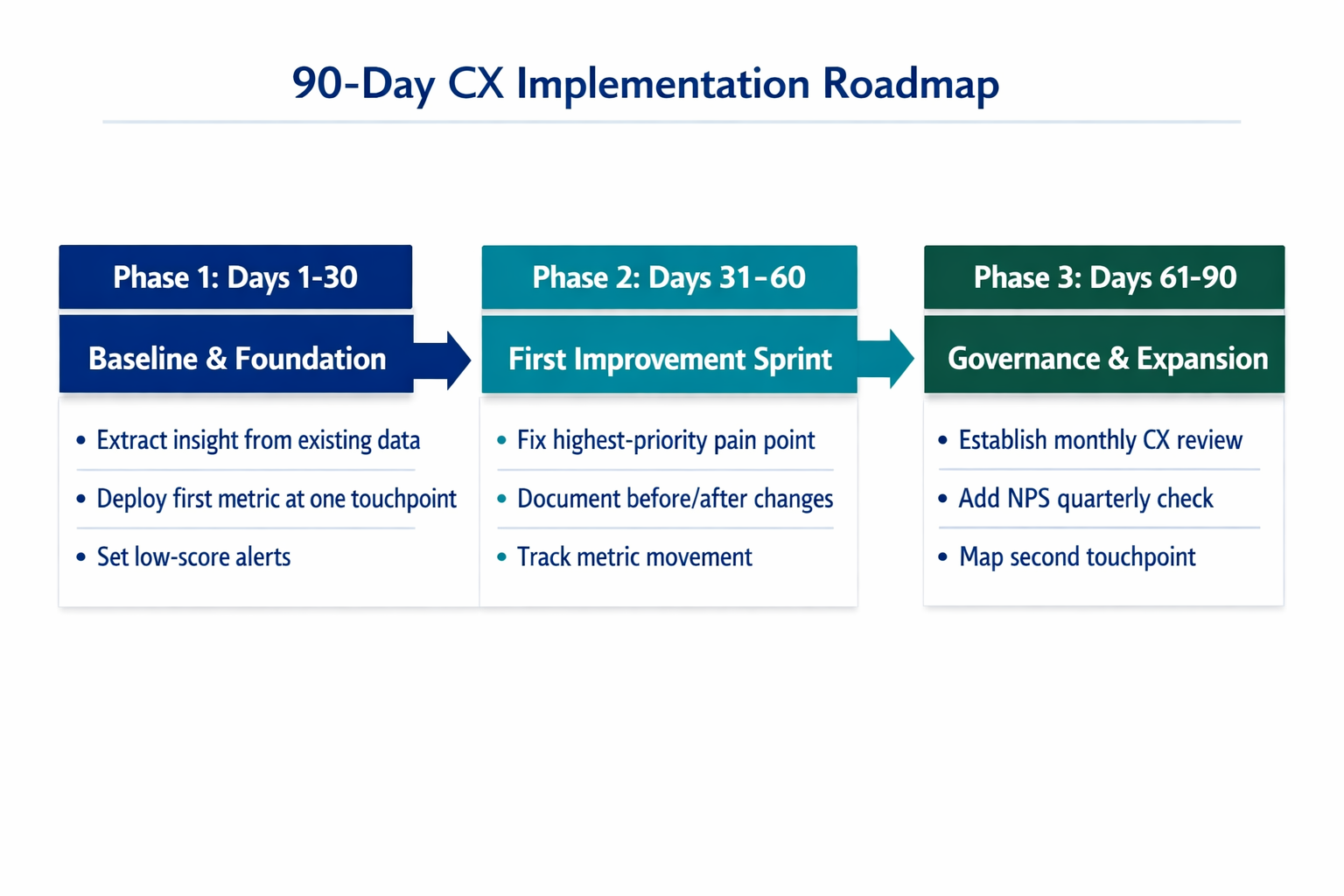
Your 90-Day Customer Experience Playbook: A Phased Implementation Guide for Business Leaders
A 90-day customer experience implementation guide for business leaders is enough to build a working CX operating model from scratch — baseline metric, first improvement sprint, governance cadence, and a documented outcome to take to leadership. Here’s the phased structure.
Days 1–30: Baseline and Foundation. Weeks 1–2: Extract your current CX signal from data you already own. Pull the last 12 months of churn, your support ticket volume by category, your renewal win/loss notes, and any existing customer feedback. Identify your top three customer pain points from this data alone — before running a single new survey. Weeks 3–4: Deploy one baseline metric at one touchpoint. If you’ve never formally measured CX before, start with a post-onboarding CSAT. Two questions maximum: one rating, one open-text “why.” Set a low-score alert for anything below 3 out of 5. Review alerts weekly.
Days 31–60: First Improvement Sprint. Take the highest-priority pain point from your baseline phase. Design one fix. It doesn’t have to be a technology investment — it can be a process change, a communication improvement, or a responsibility reassignment. Implement it. Document what changed and when. In the following four weeks, monitor whether CSAT at that touchpoint shifts. This creates the before/after evidence that CX investment produces results.
Days 61–90: Governance and Expansion. Establish your monthly CX review cadence: who attends, what metrics are presented, what decisions get made, and what escalation path exists for recurring issues. Add NPS as a quarterly relationship check. Begin mapping your second priority touchpoint using the journey mapping approach from earlier in this CX playbook.
At day 90 you will have: a baseline metric with historical data, one completed improvement sprint with a documented outcome, and a governance cadence that keeps the program alive past the first enthusiastic quarter. That is a customer experience implementation roadmap — small, measurable, and defensible to any board or leadership team.
→ Full guide: Customer Experience for B2B SaaS Founders: Winning the First 90 Days (coming soon)
Conclusion
Customer experience is often positioned as a transformation — something that requires a CX director, a multi-year roadmap, and a technology budget most business leaders don’t have. The evidence says otherwise. The most measurable CX improvements in lean organizations come from three things: a clear framework, the right metric at the right touchpoint, and a monthly cadence that takes the data seriously enough to act on it.
This customer experience playbook for business leaders was built for the people who own CX outcomes without the organizational infrastructure most customer experience strategy guides assume. Use the 90-day structure as your entry point. Pick one metric. Fix one friction point. Document one outcome. Show that number to leadership.
Forrester data shows customer-obsessed organizations achieve 51% better customer retention than those that don’t systematically prioritize CX. That advantage compounds over every business cycle where you’ve held it. It starts with a single survey at a single touchpoint and someone willing to read the responses and act on them. That person is you.
More from CorporatePlaybookPro.com
→ Customer Experience Strategy for Solopreneurs (2026 Guide)
→ Customer Journey Mapping for Small Business (2026 Guide)
→ B2B Customer Experience Strategy: A Playbook for CTOs and Business Executives
→ AI Customer Experience Adoption: A Guide for Leaders
→ Agentic AI for Customer Service: Keep the Human Touch
→ Voice-First Customer Experience: Why Conversational AI is the Future of Customer Service
→ Why Customer Centricity Should Drive Digital Transformation
→ How to Use Claude AI for Business: The Complete 2026 Guide
Frequently Asked Questions
What is the difference between customer experience and customer service?
Customer service is a reactive function — your team responding to problems that have already occurred. Customer experience is the total perception your customer forms across every touchpoint with your business, from first awareness through renewal and advocacy. Customer service is one component of that experience. Leaders who improve only customer service while leaving onboarding friction, invoice clarity, or delayed communication unaddressed will see satisfaction scores improve without seeing churn decline.
How long does it take to build a customer experience strategy?
A working customer experience strategy can be operational within 90 days — a defined CX vision, one metric at one touchpoint, one completed improvement sprint, and a monthly governance cadence. It won’t be comprehensive at day 90, but it will be functional and measurable. CX strategy is not a project with a finish line. It’s an operating model that matures continuously. The only correct start date is as soon as possible.
Do you need a dedicated CX team to improve customer experience?
No. Most effective CX programs begin without dedicated headcount — one person who owns the metrics, one cross-functional monthly review, and a clear leadership mandate. A dedicated CX team accelerates a mature program; it is not a prerequisite for starting one. The prerequisite is accountability: someone who reviews the data and owns the action list.
How do you get employees to care about customer experience without a formal training program?
Share one customer story — positive or negative — in every team meeting. Post your NPS or CSAT score somewhere the whole team sees it weekly. Give your team one decision rule: “Would this make the customer more likely to recommend us?” These three habits cost nothing and create a stronger culture signal than most formal training programs.
What is the ROI of investing in customer experience for a small business?
The most direct ROI signal is churn reduction. If your annual churn is 10% and your average contract value is $20,000, a 2-percentage-point churn reduction retains $40,000 in revenue — before accounting for acquisition cost savings. Bain & Company research shows that increasing customer retention by just 5% increases profits by 25–95%. For small businesses, CX ROI appears in renewal rates, support cost reduction, and referral volume — not abstract satisfaction scores.
What are the most common customer experience mistakes business leaders make?
The three most damaging mistakes are: treating CX as a departmental function — assigning it to marketing or support while leaving onboarding, billing, and renewal processes unchanged; collecting feedback without closing the loop — customers who see no change after submitting input become more disengaged than those never asked; and confusing satisfaction with loyalty — a customer can score 4/5 on CSAT and still churn because the aggregate friction across every touchpoint makes the relationship feel costly to maintain. The correction for all three is the same: assign ownership, establish a monthly action cadence, and track churn — not satisfaction scores alone — as the primary indicator that your CX investment is working.
How do you improve customer experience without adding headcount?
The highest-leverage CX improvements require no additional staff. First, reduce friction in your onboarding sequence — a single process change that eliminates one unnecessary step prevents the churn that onboarding friction creates six months later. Second, add a written transition summary every time a customer moves between teams — this costs three minutes per handoff and eliminates the most common B2B CX complaint: having to repeat themselves. Third, set a low-score alert on your existing feedback tool so the right person is notified within 24 hours when something goes wrong, before it escalates to a churn event. These three changes improve CX materially without adding a single role. Headcount accelerates an already-working CX program; it does not substitute for one.
What is the difference between customer experience and customer success?
Customer experience is the total perception your customer forms across every interaction — how onboarding feels, how billing works, how support responds, how problems are handled. It is owned across the whole business. Customer success is a post-sale function specifically focused on helping customers achieve the outcomes they purchased your product or service to reach, measured by adoption rates, time-to-value, and renewal likelihood. Customer success is one component of customer experience, not a synonym for it. A company can have an excellent customer success team and poor overall CX if the sales process overpromises, onboarding is confusing, and billing creates unnecessary friction before the customer success manager is even introduced.
How do you measure whether your customer experience is actually improving?
Track three numbers quarter-over-quarter: your NPS trend (directional loyalty signal), your churn rate (the outcome CX ultimately determines), and your CSAT at your two highest-friction touchpoints (diagnostic signal for where improvement is landing). A rising NPS without a falling churn rate means the CX improvement is not yet reaching the customers most at risk. A falling churn rate without a rising NPS means you are fixing acute problems but not building sustained loyalty. When both move in the right direction simultaneously, your CX investment is working systemically — not just containing individual fires. Add support ticket volume as a fourth indicator once your feedback loop is established; declining ticket volume at a stable satisfaction score is the clearest sign that upstream CX fixes are working.
What free or low-cost customer experience tools work best for small businesses and solopreneurs?
A functional CX tool stack costs under $50/month at entry level: Delighted (free tier: 50 NPS/CSAT surveys per month, automated distribution, low-score alerts), HubSpot CRM (free tier: contact management, email sequences, pipeline visibility, and interaction history so every team member has customer context), Tidio or Crisp (free AI chatbot tier for first-contact resolution on common queries), and Claude or ChatGPT for synthesizing customer feedback patterns and support ticket themes into a monthly insight summary. These tools cover the four core CX functions — measurement, contact history, first-contact resolution, and insight synthesis — without enterprise licensing. Upgrade individual tools only when a specific metric shows the free tier is the operational constraint, not before.
Why is B2B customer experience harder to manage than B2C, and what should business leaders do differently?
B2B CX involves multiple stakeholders per account — the economic buyer, the day-to-day user, the IT gatekeeper, and the executive sponsor — each with different definitions of success and different thresholds for dissatisfaction. A B2C customer who is unhappy stops buying. A B2B customer who is unhappy may stay for the remainder of a contract while quietly building the internal case to switch at renewal. This means B2B churn is frequently invisible until the renewal conversation, by which point remediation is expensive and often unsuccessful. The implication for business leaders: B2B CX programs must prioritize proactive signals — NPS trends between annual reviews, support escalation patterns, product or service adoption rates — rather than waiting for customers to self-report dissatisfaction. By the time a B2B customer raises a formal complaint, the decision to leave is usually already made internally.