You’ve invested in better onboarding, trained your support team, and pushed your NPS surveys — and your scores look healthy. Yet last quarter, repeat revenue dropped and three key accounts didn’t renew. If that scenario sounds familiar, you’re not alone, and the cause is rarely what leaders think it is.
The mistake isn’t a bad customer experience. The mistake is assuming that customer retention and customer experience are the same problem with the same fix. They’re not. One describes how your customers feel at every touchpoint; the other describes whether they stay and keep buying. The relationship between customer experience and retention is real — but it’s not automatic, and conflating the two leads to decisions that improve your scores without improving your numbers.
Acquiring a new customer costs 5–25 times more than keeping an existing one (Harvard Business Review). That gap is exactly why getting the distinction right matters: you can’t afford to spend on the wrong lever while your retention numbers quietly erode.
This article defines both concepts separately, maps the different metrics each one requires, clarifies who should own what, and gives you five concrete retention levers you can pull today — even without a dedicated CX team.
Two Different Problems That Leaders Keep Treating as One
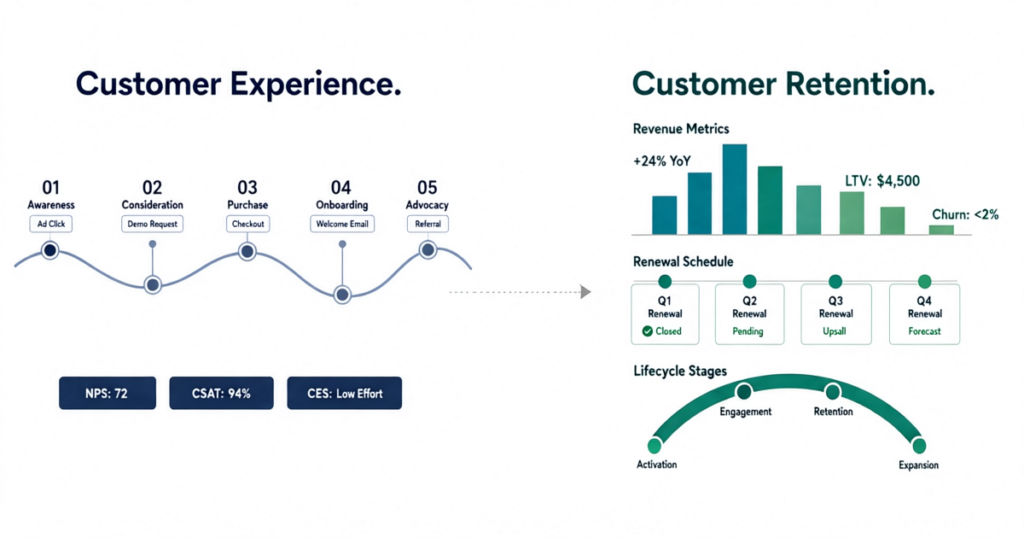
The difference between customer retention and customer experience is a conceptual one, not just a vocabulary preference. Understanding this distinction changes how you allocate resources, assign accountability, and measure success.
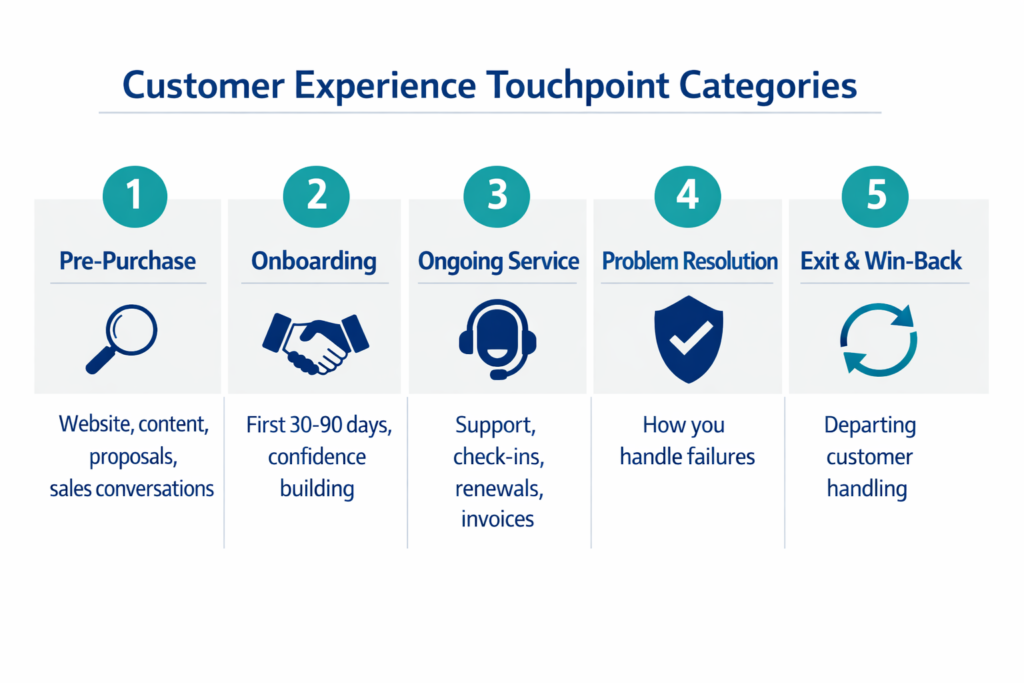
Customer experience refers to the cumulative perception a customer forms across every interaction with your business — from the first ad they see to the way your invoice is formatted. It’s qualitative. It lives in how they feel at each touchpoint along the customer journey.
Customer retention is a behavioural outcome. It answers one question: did the customer come back? It’s measured by whether someone renews, repurchases, or stays active within a defined period. Retention is quantitative. You either kept the customer or you didn’t.
The reason leaders conflate them is understandable. Good experience usually supports retention. But “usually” isn’t “always,” and the exceptions are where money gets lost. A customer can have a positive experience with your product yet switch to a competitor because of price, friction in your renewal process, or simply a better offer elsewhere. Their satisfaction was real. Your retention was zero.
65% of a company’s revenue typically comes from existing customers (Gartner). The cost of treating CX and retention as interchangeable is that you can invest heavily in improving scores while the revenue number tells a completely different story.
Related reading: [Customer Experience (CX): The Complete Playbook — link once Hub is live]
What Customer Loyalty Actually Means — and Why It’s Not the Same as Retention
Customer loyalty vs customer retention is a distinction business leaders often skip over, but it matters practically. The difference: retention is behavioural (did they come back?), while loyalty is attitudinal (do they prefer you and are they willing to advocate for you?).
A customer can be retained without being loyal — a B2B buyer who stays on your contract because switching costs are too high isn’t loyal, they’re captive. Conversely, an NPS “promoter” who actively recommends you to peers may still churn if a competitor offers a significantly better deal. Brand advocacy and repeat business are outcomes you want together, but they measure different things, and programmes that target one don’t automatically deliver the other.
Why You Can Score High on Customer Experience and Still Lose Customers
Good customer experience does not guarantee customer retention — and business leaders who haven’t internalised this are making expensive allocation decisions. The connection between customer experience strategy and retention is indirect, not deterministic: experience creates the conditions for retention, but several other factors determine whether a customer actually stays.
This is what we call the CX trap. You measure the experience. The experience looks good. Meanwhile, your churn rate climbs because the experience wasn’t the real driver of people leaving. Fixing scores when the problem is elsewhere is the equivalent of repainting a house with a structural crack.
The Three Reasons Customers Leave Despite Positive Experience Scores
Customers churn despite positive experience scores for three primary reasons, and none of them is a CX failure:
- Price and competitive disruption. A customer who genuinely loved your product will still leave if a competitor offers 30% less for equivalent value. Satisfaction doesn’t neutralise price sensitivity, especially under budget pressure.
- Operational friction outside the experience layer. Your product experience may be excellent, but your invoice process is confusing, your contract renewal requires three approval signatures, or your account manager turnover is high. These are retention problems, not CX problems — but they’re often invisible to CX surveys.
- Change in the customer’s own situation. Acquisition, headcount reduction, internal restructuring, or a change in strategy can remove a customer from your pipeline regardless of how well you served them. Experience scores can’t capture this signal.
The practical implication: run churn post-mortems. Ask departing customers directly — not a survey, an actual conversation. You’ll find that most churn falls into one of these three buckets, not “the experience was poor.”
What NPS Actually Measures — and the Retention Gap It Leaves
NPS measures advocacy intent, not customer retention — and that distinction is one the industry has been slow to communicate clearly. Understanding the NPS and customer retention relationship means accepting that a promoter (NPS 9 or 10) is someone willing to recommend you, not necessarily someone who will renew.
Research consistently shows a weak or inconsistent correlation between NPS scores and actual repeat-purchase behaviour, particularly in price-sensitive or commoditised markets. A telecom customer may rate a brand highly after a good service call and still switch providers at contract end for a better tariff. A hotel guest may recommend the property to friends while having no intention of returning — price, location, or a changed travel pattern makes the return unlikely regardless of how much they enjoyed their stay.
NPS answers: “Would you recommend us?” Retention answers: “Are you staying?” These are two different questions. A business that tracks only NPS and CSAT is measuring experience intent while remaining blind to retention risk. Add churn rate and cohort retention to your dashboard and you’ll start seeing the gap.
The Metrics Your Business Needs for Each — A Side-by-Side Breakdown
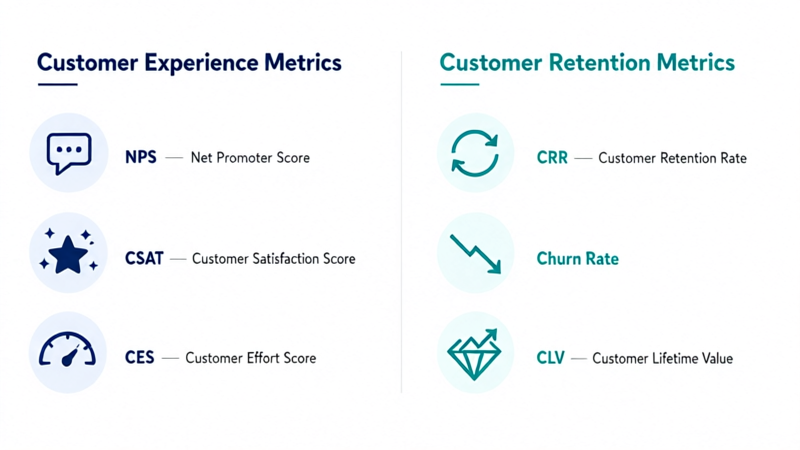
Customer experience metrics and customer retention metrics measure completely different things — and your dashboard needs both. Getting your customer retention KPIs right means separating the two domains rather than assuming one metric covers both.
Here’s how the two sets map out:
| Metric | Domain | What It Measures | What It Misses |
|---|---|---|---|
| Net Promoter Score (NPS) | Customer Experience | Likelihood to recommend | Actual repurchase behaviour; churn risk |
| Customer Satisfaction Score (CSAT) | Customer Experience | Satisfaction with a specific interaction | Overall retention trajectory; long-term loyalty |
| Customer Effort Score (CES) | Customer Experience | Ease of getting support or completing a task | Price sensitivity; competitive context |
| Customer Retention Rate (CRR) | Retention | Percentage of customers retained in a period | Why customers stayed or left |
| Churn Rate | Retention | Percentage of customers lost in a period | Experience quality at individual touchpoints |
| Customer Lifetime Value (CLV) | Retention | Total revenue expected from a customer relationship | Short-term interaction quality |
The key principle: CX metrics tell you how the relationship feels. Retention metrics tell you whether the relationship continues. You need the CX metrics to diagnose problems. You need the retention metrics to know you have a problem in the first place.
How to Calculate Your Customer Retention Rate (and What Benchmark to Aim For)
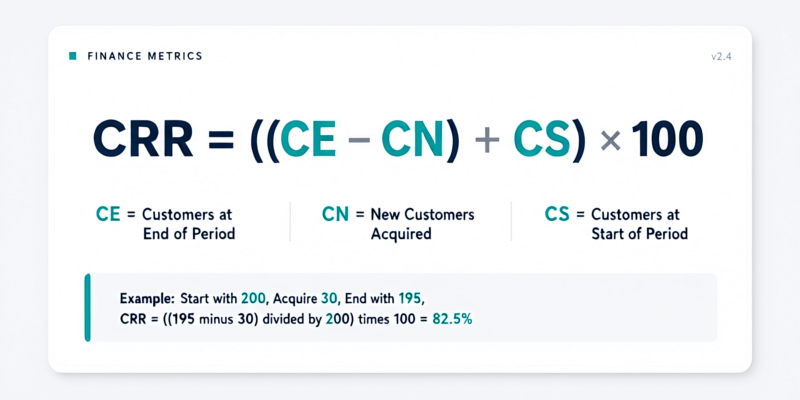
Measuring customer retention rate starts with a simple formula. Take the number of customers at the end of a period, subtract new customers acquired during that period, divide by the number of customers at the start, and multiply by 100.
CRR = ((End Customers − New Customers Acquired) ÷ Start Customers) × 100
For a B2B professional services business, a retention rate above 85% is a strong benchmark. SaaS businesses typically target 90%+ annual retention for healthy unit economics. Retail benchmarks sit lower (25–40%) because the purchase frequency and switching context are different. Know your industry baseline before you judge your number.
Track this monthly or quarterly, not just annually. Annual CRR hides problems that quarterly cohort analysis would surface early — a cohort acquired in Q3 that churns heavily by Q1 needs a different response than slow, steady attrition across all cohorts.
Who Should Own Each — and What Happens When No One Does
Customer retention and customer experience should have different organisational owners — and this is where accountability gaps show up most painfully. Getting customer experience ownership right means clearly separating the two functions, even in a small business where one person might perform both roles.
In a larger organisation, customer experience is typically owned by the Chief Customer Officer, the CMO, or a dedicated CX team. They design journeys, run experience measurement programmes, and manage touchpoints. Customer retention is typically owned by Customer Success, Account Management, or Operations — the people who manage renewals, monitor engagement, and intervene when accounts go quiet.
When no one explicitly owns retention — which is common in businesses without a CS function — it defaults to whoever is closest to the account. Often that’s a sales rep focused on new business, or a founder who’s too stretched to watch churn signals. The result is reactive retention: you find out a customer is leaving when they tell you.
A 5% increase in customer retention rates increases profits by 25–95% (Bain & Company). That’s not a rounding error — it’s the compounding effect of longer customer relationships on revenue, referral rate, and cost efficiency. When retention has no owner, that compounding never starts.
The CX Touchpoints That Directly Affect Whether Customers Stay
Some customer experience touchpoints have a direct, measurable impact on retention rate while others have almost none. A CX touchpoints and retention strategy should focus effort on the moments that actually predict staying or leaving.
The highest-retention-impact touchpoints in most B2B and SMB contexts are:
- Onboarding. Customers who don’t reach their first value milestone within 30–60 days are disproportionately likely to churn. This is a retention problem wearing the mask of a CX problem.
- Renewal/contract moments. The experience at renewal is often the only moment customers consciously evaluate the relationship. Friction here — slow responses, confusing contracts, last-minute negotiations — is a churn accelerant.
- Support resolution. A single poorly resolved support case, especially for a critical issue, can override months of positive experience. This is the moment of truth that CES was designed to measure.
For every other touchpoint — marketing emails, product notifications, minor interactions — the retention impact is negligible. Don’t optimise everything. Optimise the moments that move the retention needle.
How to Drive Retention When You Don’t Have a CX Department
Improving customer retention without a dedicated CX team is entirely possible — but it requires abandoning the assumption that retention follows automatically from a good experience. Customer retention strategies are most effective when they treat retention as a standalone discipline with its own rhythm, not as a side effect of CX investment.
Personalised retention delivers an 86% retention rate vs 68% for generic approaches (McKinsey). Even small teams can personalise if they prioritise the right accounts and signals.
Five Retention Levers Any Business Leader Can Pull Starting This Week
Customer retention tactics that business leaders can implement without CX staff exist across every part of the customer lifecycle — and require no specialist headcount, only discipline and a calendar:
- Set a 60-day check-in cadence for every active account. Not a survey. A brief conversation or personalised email asking: “Are you getting what you expected from us?” This surfaces at-risk accounts before they go cold.
- Define your churn warning signals and track them weekly. Login frequency drops, support tickets spike, invoice queries increase — each is a signal. Pick two or three and monitor them. You can’t intervene on signals you’re not watching.
- Create a renewal trigger 90 days out. Reaching out at day 89 of a 90-day contract is too late. Build a 90-day-out conversation into your operational calendar for every renewal.
- Map your highest-churn cohort and interview five of them. Ask why they left or nearly left. The answers will tell you more than six months of survey data.
- Make the first value milestone explicit during onboarding. Tell new customers exactly what success looks like at 30 days and at 90 days. Customers who know what to expect are less likely to disengage during the early period when churn risk is highest.
Reducing Churn When You’re the One Watching the Numbers
Reducing customer churn rate in B2B requires business leaders to own the signal-watching, not just the strategy. The most effective approach at this level is to build a simple customer health score — a composite indicator made of two or three signals you already have access to.
A basic health score might combine: (1) product engagement or usage frequency, (2) support ticket volume in the last 30 days, and (3) days since last meaningful contact with your team. Customers who score low on all three are your at-risk segment. Give them priority attention before they tell you they’re leaving. At-risk is recoverable. Already-churned is not.
This is the core distinction the SERP doesn’t make: customer experience tells you how the relationship felt; retention tells you whether it survived. Managing both requires separate disciplines, separate metrics, and — wherever possible — clear ownership of each.
The Bottom Line for Business Leaders
The clearest way to frame the customer retention vs customer experience distinction: CX is the input; retention is the output — but the output also depends on price, friction, operational timing, and competitive context that your CX surveys will never capture.
Start by separating the metrics. Track your NPS and CSAT, yes — but add churn rate and CRR to the same dashboard and look at them together. If your experience scores are rising and your retention rate is flat or falling, you have your answer: you’re solving the wrong problem. The alignment of customer experience and retention comes from treating each as a distinct discipline with distinct levers, not from assuming one delivers the other automatically.
Assign ownership. Build your renewal and at-risk check-in cadences. Measure churn at the cohort level. These aren’t CX programme investments — they’re retention habits any leader can build this quarter.
For a deeper look at building a full CX strategy for your organisation, see our guide: [Customer Experience (CX): The Complete Playbook for Business Leaders and Consultants — link once Hub is live].
If you’re a CTO or executive leading B2B digital strategy, the principles here connect directly with why customer centricity drives digital transformation outcomes: Why Customer Centricity Should Drive Digital Transformation.
Frequently Asked Questions
What is the difference between customer loyalty and customer retention?
Customer retention measures whether a customer continues to buy from you; customer loyalty measures whether they choose to. A retained customer may stay because switching is inconvenient, contracts are binding, or alternatives don’t yet exist — none of which reflects genuine loyalty. A loyal customer actively advocates for your brand, resists competitor pricing, and returns not because they have to but because they want to. For business leaders, the practical distinction matters: retention metrics tell you who stayed; loyalty indicators like NPS and referral rates tell you who would stay even if a better-priced competitor appeared tomorrow.
What is a good customer retention rate?
A good customer retention rate depends on your industry, but broad benchmarks suggest 85–95% is strong for B2B subscription businesses, 75–85% is the norm for SaaS companies, and retail typically falls between 60–70% for repeat purchases. The most important benchmark, however, is your own trend over time — a consistently improving 78% outperforms a stagnant 85%. To calculate your retention rate: take customers at end of period, subtract new customers acquired, divide by customers at start of period, and multiply by 100.
How does NPS relate to customer retention?
NPS measures the likelihood that a customer will recommend your business; it does not directly measure whether they will stay. Research confirms that high NPS promoters do churn — especially when a competitor offers a price advantage, a contract expires, or their internal stakeholder changes. The practical limitation for business leaders is that NPS is a sentiment signal captured at a single moment, while retention is a behaviour measured over time. Use NPS as an early warning indicator alongside — not instead of — hard retention metrics like churn rate and customer lifetime value.
What are the most common mistakes in customer retention strategy?
The most common mistake is treating CX metrics — satisfaction scores, NPS, CSAT — as retention metrics, and assuming a high experience score means customers will stay. Other frequent errors include reacting to churn after it happens rather than identifying at-risk customers proactively, assigning retention responsibility to no single team, and over-investing in acquisition while underfunding the customer lifecycle after the first sale. Business leaders should distinguish between CX programmes (which improve satisfaction) and retention programmes (which reduce churn), because they require different metrics, owners, and interventions.
What is the difference between customer retention and customer experience for business leaders?
Customer experience (CX) is everything a customer perceives and judges about their interactions with your business — from discovery through to ongoing support. Customer retention is a commercial outcome: whether customers continue buying over time. CX is one of several inputs into retention, alongside pricing, competitive alternatives, product fit, and relationship strength. For business leaders, CX is owned by design and delivery teams, while retention must be tracked at commercial leadership level with separate metrics, targets, and intervention playbooks.
Why do customers leave despite positive experience scores?
Customers leave despite positive experience scores for three main reasons: price sensitivity (a competitor makes a compelling offer that outweighs satisfaction), structural disruption (a key contact leaves, budget cycles change, or a new decision-maker arrives with different supplier preferences), and operational friction in billing, renewal, or account management processes. None of these causes surfaces in CSAT or NPS surveys because those tools measure feelings about interactions, not the commercial and operational factors that drive switching decisions.
How do you calculate customer retention rate for a small business?
The customer retention rate formula is: ((Customers at End of Period − New Customers Acquired During Period) ÷ Customers at Start of Period) × 100. For example, if you started a quarter with 200 customers, acquired 30 new ones, and ended with 195, your retention rate is ((195 − 30) ÷ 200) × 100 = 82.5%. Small business owners can track this monthly or quarterly in a simple spreadsheet — no specialist software is needed. Compare your rate against your own previous periods first; industry benchmarks are useful context but your internal trend is the most actionable signal.
Who should own customer retention vs customer experience in a company?
Customer experience (CX) should be owned by whoever controls customer-facing delivery — typically a CX or customer success team led by a Head of CX or Chief Customer Officer. Customer retention is a commercial outcome that should sit at commercial leadership level — the CEO, COO, or Head of Sales — with formal accountability through revenue and churn metrics. When retention is delegated entirely to CX teams, it gets treated as a satisfaction problem rather than a commercial one. The two functions should collaborate closely but not be collapsed into one role or measured by the same KPIs.
What customer experience touchpoints directly affect customer retention rate?
The touchpoints with the strongest link between CX quality and actual retention outcomes are: onboarding (customers who achieve early value stay longer), proactive account reviews before renewal (which remove friction before it becomes a decision), billing and invoicing accuracy (a single billing error can trigger churn in B2B), and support speed and first-contact resolution (unresolved tickets are one of the highest-correlation churn predictors). These are all operational touchpoints — which is why retention improvement lives in operations and customer success, not in brand or marketing teams.
How can I improve customer retention without a dedicated CX team?
Without a CX team, focus on three high-impact, low-resource retention levers: first, build a simple early-warning system by tracking engagement signals — login frequency, support ticket volume, unanswered emails — to identify at-risk customers before they leave. Second, implement a 30/60/90-day check-in cadence for new customers, where most early churn originates. Third, contact your top 20% of customers by revenue quarterly with nothing to sell — just to ask how they are using your product. These three actions require no specialist team, no software budget, and no new headcount; they require only commercial discipline to treat retention as a scheduled activity rather than a reactive one.
How do customer experience and retention work together in a business strategy?
Customer experience and retention work together when CX improvements are directed at the specific touchpoints that most influence renewal and continued purchase — not just general satisfaction scores. The relationship is directional but not automatic: improving CX at touchpoints that don’t affect switching decisions has minimal impact on retention, while improving CX at onboarding, billing, and renewal stages has a measurable churn reduction effect. Leaders who align their customer experience and retention strategy around commercial outcomes see both metrics improve simultaneously rather than running them as disconnected programmes.
What is the relationship between customer experience strategy and customer retention?
A customer experience strategy improves retention when it is designed around the moments that cause customers to stay or leave, not just the moments that generate the highest satisfaction scores. The evidence is nuanced: studies consistently show a moderate positive correlation between CX quality and retention, but the correlation weakens in competitive markets with low switching costs, in B2B contexts with high contact turnover, and in commodity categories where price is the primary decision driver. A well-designed CX strategy treats customer experience as one important input into a retention system — alongside pricing competitiveness, proactive relationship management, and structured renewal processes.