You watch the shop down the street text customers instead of playing phone tag, invoice clients in two clicks instead of chasing paper checks, and run marketing on autopilot while you’re still copy-pasting the same follow-up email for the fifteenth time this week. Meanwhile you’re manually reconciling spreadsheets, retyping the same customer details into three different tools, and losing evenings to work that should take minutes. The common assumption is that digital transformation for small business owners requires a CTO, enterprise software, and a six-figure budget you don’t have. It doesn’t — but it does require a plan, because only 16% of digital transformations actually improve performance and sustain the gains (McKinsey), and most of that 84% failure traces back to exactly the assumption above: throwing an unfocused budget at technology instead of following a phased, small-business-sized plan. This guide is written specifically for digital transformation for small business owners and solopreneurs — a readiness check, a realistic budget, and a phase-by-phase roadmap sized for a business with no dedicated IT team, not a shrunk-down version of the enterprise playbook.
What Digital Transformation Actually Means for a Small Business
Digital transformation for small business is the process of replacing manual, paper-based, or disconnected ways of running your operations — invoicing, customer records, scheduling, marketing, payments — with connected digital tools and workflows that save time, reduce errors, and let you serve more customers without hiring more people. It is not the same exercise a Fortune 500 company runs, and treating it that way is where most small-business technology projects go wrong before they even start. Digital transformation for small business owners is scoped to what a lean team can actually execute: usually a handful of cloud tools, a couple of automated workflows, and one deliberate decision about how customer data flows between them — not an enterprise-wide platform overhaul involving a transformation office, a change board, and a multi-year rollout calendar that no five-person company needs or can staff.
The confusion starts because most of what’s written on this topic is aimed at readers who already have a transformation office and a seven-figure technology budget. Gartner’s most recent survey found that only 48% of digital initiatives meet or exceed their business outcome targets (Gartner) even at large organizations with dedicated staff running the effort — which tells you the problem isn’t a lack of budget or headcount, it’s a lack of sequencing. Get the sequence right, at small-business scale, and you can beat that 48% figure with far less spend than the number implies, precisely because a small business doesn’t carry the coordination overhead that sinks larger initiatives.
Three things separate digital transformation for small business teams from its enterprise cousin, and understanding them upfront saves you from importing advice that doesn’t fit your situation. First, decision speed: a five-person team can decide and implement a new tool in a week, where an enterprise committee takes a quarter — use that speed as an advantage, not an excuse to skip planning entirely. Second, tool scope: a lean technology budget means you need two or three connected tools done well, not a twelve-tool “digital ecosystem” nobody has time to maintain. Third, and most important, digitization and digital transformation are not the same thing — scanning your paper invoices into PDFs is digitization; connecting invoicing, payment, and customer records so none of them require manual re-entry is transformation. This guide focuses on the second one throughout, because it’s the one that actually compounds into saved time. For the fuller strategic picture of what digital transformation covers across every business size — including the frameworks larger organizations use — see our complete guide to digital transformation for business leaders.
Digital Transformation Readiness Assessment for Small Business Owners
A digital transformation readiness assessment for small business owners is a short, honest inventory of where your business currently loses time, money, or accuracy — done before you buy a single tool. Skipping it is the single most common reason small-business technology purchases sit unused six months later: you buy the software everyone recommends, it doesn’t fit how your team actually works, and it quietly gets abandoned while the invoice for it still shows up every month. McKinsey’s State of AI research found that only 29% of companies with under $100 million in revenue have reached the scaling phase with new technology, compared to nearly half of companies above $5 billion in revenue (McKinsey) — not because smaller companies lack ambition, but because they skip the current-state assessment that larger companies are forced to formalize with a dedicated team and a documented process audit.
Run the assessment yourself, on paper, in under an hour — you do not need a consultant for this part, and paying for one before you’ve done this first pass is itself a common early mistake. Walk through every core process your business depends on: taking payments, tracking customers, scheduling appointments or jobs, restocking or ordering inventory, invoicing, and following up on leads. For each one, write down what actually happens today, step by step, not what’s supposed to happen according to your original plan for the business. Most owners discover the real process has three or four manual workarounds nobody ever wrote down anywhere. Once you have the full list, score each process on two dimensions: how much time it consumes weekly, and how often it produces an error someone has to fix later. The three processes with the highest combined score on time-and-errors are your readiness assessment’s real output — not a wishlist of everything technology could theoretically fix, just the three things genuinely worth fixing first for a digital transformation for small business budget that can’t cover everything at once.
This mirrors what shows up in our digital transformation readiness checklist built for larger organizations, compressed down to a version one person can complete without a facilitator, a workshop, or a scoring committee sitting between you and an answer.
A 7-Question Digital Maturity Self-Check for Solopreneurs
This digital maturity self-check questions for solopreneurs exercise gets you the same clarity as the full readiness assessment above in about ten minutes, which matters when you’re running the business alone and don’t have an hour to spare on a diagnostic between client calls. It functions as a fast digital maturity assessment for small business owners who need a readiness score without a formal process. Answer yes or no to each question honestly — nobody sees this list but you:
- Do you store customer information in more than one place (paper, spreadsheet, inbox)?
- Do you manually re-enter the same data into two or more tools each week?
- Could a customer book, pay, or get support without you being personally available?
- Do you know, right now, which three tasks eat the most of your week?
- Have you ever lost a lead or missed a follow-up because it wasn’t tracked anywhere?
- Do you back up your business data anywhere other than your own device?
- Could someone else step in and run your booking or invoicing system without you walking them through it first?
Three or more “no” answers means you have a genuine technology gap worth addressing — not a business-wide overhaul, just the specific gaps this checklist just surfaced for you. What is a digital transformation readiness assessment, distilled to its essence? It’s this list: a fast, honest look at where your business currently depends on you personally remembering things, and a short plan to remove that dependency one process at a time. For a deeper, structured version of this exercise once you’ve outgrown the solopreneur stage and have a small team, see our digital maturity assessment guide.
How to Build a Phased Digital Transformation Roadmap for a Small Team
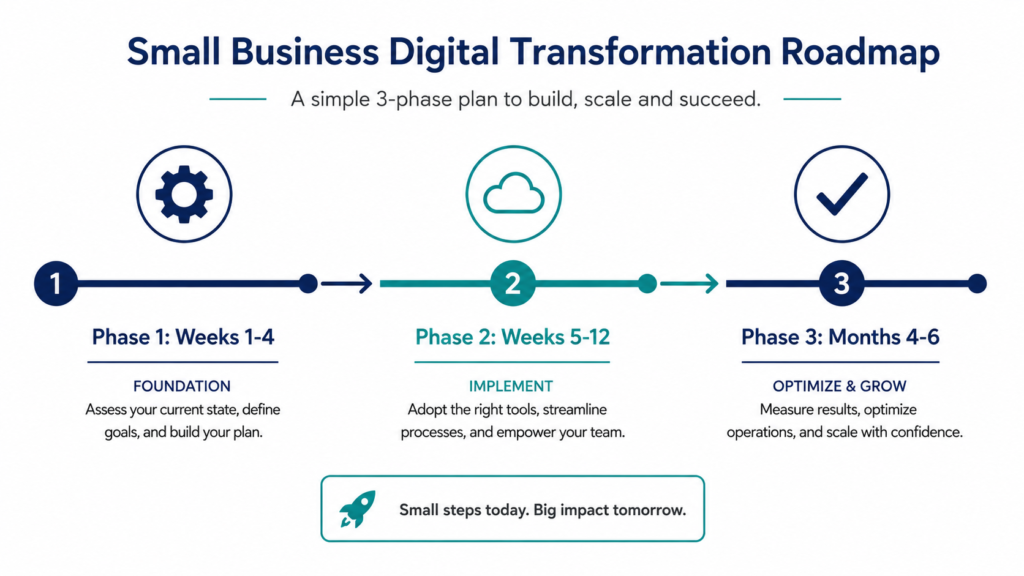
How to build a phased digital transformation roadmap for a small team comes down to three deliberately short phases instead of one long project — each one proving value before you commit budget to the next. This is the core of what makes a small business digital transformation roadmap different from an enterprise one: the milestone planning happens in weeks, not quarters. Bain’s Automation Scorecard found that companies investing at least 20% of their IT budget in automation captured an average 22% in cost savings, while those investing under 5% captured barely 8% (Bain) — the gap isn’t primarily about company size, it’s about committing to a real phase instead of dabbling with a free trial and letting it lapse. A small business can commit to a real phase with a fraction of that budget in absolute dollars and still see a proportional return.
Here is what each phase actually looks like when a five-person team runs it, not a theoretical implementation timeline drawn up by a consultant who’s never run a business this size:
- Phase 1, weeks one through four — fix the single highest-friction process identified in your readiness assessment. One tool, one workflow, nothing else. If it’s invoicing, you migrate invoicing and nothing else this month, not invoicing plus a new CRM plus a new website all at once.
- Phase 2, weeks five through twelve — connect that tool to the next process in your chain, usually customer data or payments, so information stops being re-typed between systems. This phase only starts once Phase 1 is running smoothly with zero complaints for at least two consecutive weeks.
- Phase 3, months four through six — automate the repetitive tasks that sit around the now-connected system, and formally retire any paper or spreadsheet workaround still lingering from before Phase 1 started.
What is a phased approach to digital transformation, in practice? It means Phase 2 never starts on a fixed calendar date — it starts only when Phase 1 is demonstrably working and your team is using it without pushback. A landscaping company we’ve seen implement this exact sequence spent Phase 1 entirely on scheduling software, waited until every crew lead had adopted it daily without reminders, and only then connected it to invoicing in Phase 2. Rushing that sequence — deploying scheduling and invoicing and a customer portal in the same month — is the most common way a digital transformation for small business teams attempt stalls out and gets quietly abandoned by month three. This is the same discipline the digital transformation roadmap methodology applies at larger organizational scale, compressed into a timeline a five-person team can actually run without a dedicated project manager or steering committee.
Cloud Migration for Small Business Without an IT Team
How to migrate to the cloud as a small business without an IT team starts with picking one category — file storage, accounting, or customer records — and moving it completely before touching a second one. This is the practical shape cloud migration for small business should take when there’s no dedicated IT staff to catch mistakes: narrow scope, one data migration at a time. Trying to migrate everything simultaneously is how migrations stall for months and end with half your data in the old system and half in the new SaaS platform, with nobody quite sure which copy is current. A Forrester-commissioned Total Economic Impact study found that hybrid cloud migration projects delivered a 145% return on investment within three years (Forrester) — driven mainly by eliminated hardware costs and recovered staff time, both of which apply at digital transformation for small business budgets even without the enterprise price tag attached to that study’s headline number.
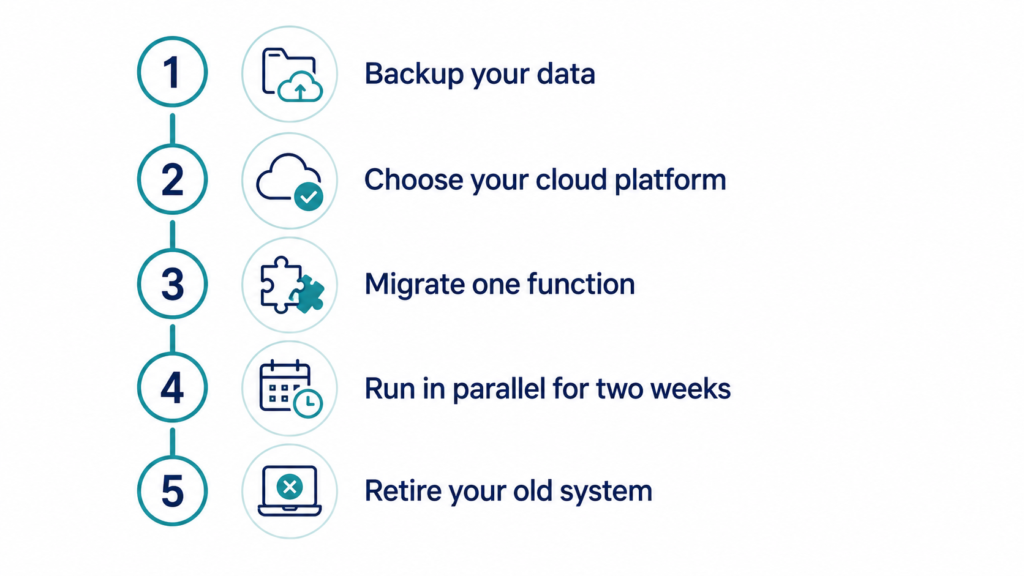
The sequence that works without in-house IT support, in order:
- Export a full backup of your current data before touching anything — this single step prevents almost every migration horror story you’ve heard about.
- Choose a mainstream cloud platform with transparent small-business pricing tiers and built-in migration or import tools, rather than a platform built primarily for enterprise procurement.
- Migrate a single department or function first — accounting is usually the safest starting point because the data is structured and the stakes of a small error are contained.
- Run the old and new systems in parallel for two full weeks to confirm nothing was lost or miscategorized in the data migration.
- Retire the old system only after a full billing cycle has closed cleanly inside the new one, with no reconciliation surprises waiting for you.
How do I move my small business to the cloud without breaking anything mid-migration? The two-week parallel-run step above is the answer — it’s the step every rushed migration skips, and it’s the exact step that catches missing or duplicated data before it becomes a customer-facing problem like a double-charged invoice or a lost booking that costs you a customer’s trust.
One more decision worth making deliberately: whether to migrate yourself or pay a freelancer for a single afternoon of setup help. For most digital transformation for small business projects at this stage, a few hours of paid setup help costs less than the time you’d spend troubleshooting an import error on your own, and it doesn’t commit you to an ongoing IT contract the way a managed-services agreement would. Use the freelancer for the one-time export-and-import step only — everything else in this guide is designed to be run by you or your team without outside help, and paying for more than that first step defeats the purpose of a phased, low-cost approach.
Quick-Win Automation Ideas for Small Businesses With No Budget
Quick win automation ideas for small businesses with no budget focus on repetitive, rules-based manual processes — the ones with no judgment call involved — because those are the easiest to hand to no-code automation and the fastest to show a return you can point to when justifying the next step. McKinsey estimates that automation enabled by generative AI could add 0.5 to 3.4 percentage points of annual productivity growth to the global economy through 2040 (McKinsey) — and a small business captures a proportionally larger share of that gain per action taken, because a single automated workflow can eliminate a task that currently consumes hours of a very small team’s week, not a rounding error in a thousand-person department.
What are quick wins in digital transformation for a business this size? Start with these small business process automation ideas, roughly in order of easiest to hardest to set up:
- Automated invoice reminders instead of manually chasing every late payment by phone or email.
- A public booking or scheduling link instead of back-and-forth emails trying to find a time that works.
- Auto-tagging or routing of incoming customer emails by topic, so nothing sits in a shared inbox unanswered.
- A recurring social post scheduler instead of remembering to post manually every single day.
- Automatic receipt or expense capture through a phone camera instead of a shoebox of paper receipts at tax time.
Every one of these runs on free or near-free tiers of mainstream tools already built for exactly this scale of buyer. None require touching your core systems or your customer records, which makes them the safest place to build team confidence in digital transformation for small business initiatives before Phase 2 of your roadmap introduces anything more connected or higher-stakes.
Pick one automation from the list above, not all five at once — the goal at this stage is proving the pattern works for your team, not maximizing the number of things running on autopilot in month one. Once the first automation has run cleanly for two weeks with no manual correction needed, add the second. This same one-at-a-time discipline that governs your larger three-phase roadmap applies just as much inside a single phase, and it’s the reason small teams that succeed with digital transformation for small business automation rarely describe it as overwhelming — they never took on more than one new habit at a time.
Choosing Digital Transformation Tools on a Small Business Budget
How to choose digital transformation tools on a small business budget means picking for your specific workflow gaps identified in the readiness assessment, not for the longest feature list on a comparison page built for enterprise procurement teams. IBM’s most recent enterprise research found that 66% of surveyed senior leaders report AI has already driven significant productivity gains — but small and mid-sized businesses are falling behind larger, private-sector firms in capturing those same gains (IBM) — largely because smaller teams pick enterprise-grade tools they never fully configure or learn to use, rather than simpler, cheaper freemium tools that actually fit their day and their tech stack.
Three selection criteria matter more than feature count for a small team choosing digital transformation tools for small business use: does it integrate with the one or two systems you already use without a developer, does it have a genuinely usable free or low-cost tier rather than a 14-day trial designed to expire before you’ve learned it, and can someone on your team learn it in an afternoon without a formal training session or a support ticket. If a tool fails any one of those three tests, it is the wrong tool for your business right now regardless of what its marketing page claims it can theoretically do. Resist the pull toward whatever tool a much larger competitor uses — their tech stack is built for a company solving a different problem than yours, at a scale you don’t operate at yet, and adopting it early usually means paying for capacity you’ll never touch.
A useful test before you sign up for anything: write down the specific task the tool replaces, in one sentence, before you look at pricing. If you can’t state the task in one sentence, you’re shopping for a solution before you’ve finished defining the problem, and that’s exactly how digital transformation for small business budgets get spent on tools that overlap in function and duplicate each other’s job six months later. A five-person accounting practice that ran this test before every purchase ended up with four tools instead of the nine a generic “recommended stack” article had suggested — and every one of the four was still in active daily use a year later, because each one passed the one-sentence test on its own merits.
Digital Transformation Budget: What Small Businesses Actually Spend
How much does digital transformation cost a small business? For the phased approach in this guide, most small businesses spend between $50 and $300 per month in Phase 1, covering one or two subscription tools, scaling to somewhere between $300 and $1,200 per month by Phase 3 once cloud migration and automation are both running — a fraction of the enterprise figures typically cited in broader industry reports written for a completely different buyer with a completely different tech spend. Forrester projects global technology spend will grow 7.8% in 2026 to reach $5.6 trillion (Forrester), and that growth is increasingly driven by cost-effective solutions and subscription software priced for exactly this scale of buyer, not just enterprise licensing deals — which means the tools a digital transformation budget for small business needs to cover are cheaper and more plentiful than they were even two years ago.
Budget in phases, matched directly to your roadmap, the same way you’d budget any digital transformation for small business initiative that has to earn its keep at every stage rather than being approved once and forgotten: allocate the smallest reasonable amount to Phase 1 and require it to prove it earns back its cost before you commit to Phase 2 spending on top of it. A tool that doesn’t pay for itself in recovered time within 60 days should be replaced or cancelled, not persisted with out of sunk-cost habit or because switching feels like admitting a mistake. Treat every subscription as provisional until it has proven its ROI once — that discipline alone prevents most of the tool-sprawl budget creep that eventually kills digital transformation for small business initiatives from the inside, well before the tech spend itself becomes unaffordable.
Getting Employee Buy-In for Digital Transformation in a Small Team
How to get employee buy-in for digital transformation in a small team starts with involving whoever actually does the work in choosing the replacement for it — not announcing a finished decision at a Monday meeting and expecting a smooth culture shift overnight. Gartner’s most recent HR research found that just 32% of business leaders report achieving healthy change adoption by their employees (Gartner) — and on a team of five, that gap shows up fast and visibly, because a single employee’s resistance to change can quietly keep the old spreadsheet running in parallel and effectively undo the entire migration without ever saying a word against it.
How do you get employees on board with new technology on a small team? Three things consistently work at this scale, drawn from teams that have successfully implemented change management for small business technology transitions: let the person who’ll use the tool daily test it and raise objections before you commit to buying it, run the old and new system in parallel long enough that switching feels low-risk rather than forced overnight, and be explicit about what problem the new tool removes from their day specifically, not what it adds to your reporting or visibility as the owner. A team that hears “this saves you an hour a day” adopts a digital transformation for small business initiative faster than a team that hears “this gives me better numbers.”
How to Measure Digital Transformation ROI as a Small Business
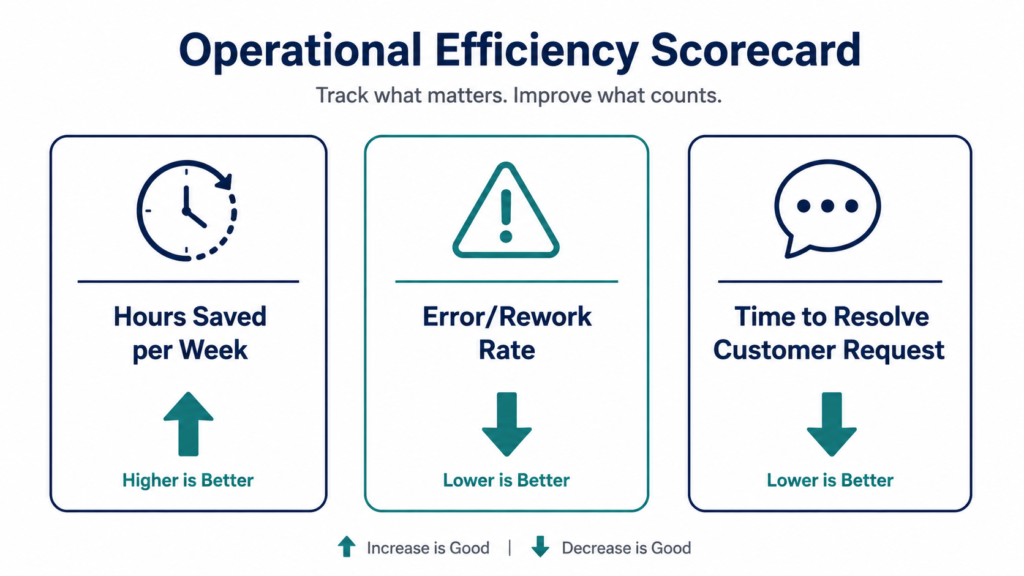
How to measure digital transformation ROI as a small business means tracking a small number of numbers you already have access to — hours saved, error rate, and customer response time — rather than building a formal KPI dashboard designed for a company with a dedicated business-intelligence team. Bain’s automation research found that companies seeing measurable returns from automation invest almost four times more into their next round of technology than companies that never measured returns in the first place (Bain) — which means the habit of measuring, not the sophistication of the measurement, is what determines whether Phase 2 of your digital transformation ROI for small business roadmap ever actually gets funded and built.
Three metrics carry real weight at this scale without turning ROI tracking into a project of their own: hours per week the team spends on the process before versus after the change, tracked for two weeks on each side and then compared directly for genuine efficiency gains, the error or rework rate on that specific process, and the time savings visible in how fast a customer request reaches resolution. Anything more elaborate than these three is measurement for its own sake at this stage of the business — save the fuller KPI framework for once you’re managing several simultaneous initiatives with a team large enough to own reporting as a job function rather than an evening task squeezed in after closing.
Write these three numbers down before Phase 1 even starts — a “before” baseline you never captured is a baseline you can’t ever prove improvement against, no matter how obviously better the new process feels day to day. A digital transformation for small business initiative that skips this baseline step still might work, but you’ll have no evidence to show a partner, a lender, or your future self when deciding whether Phase 2 deserves the same investment of time and money that Phase 1 got.
Common Digital Transformation Mistakes Small Businesses Make
Common digital transformation mistakes small businesses make almost always trace back to skipping a step in this guide’s sequence, not to picking the objectively “wrong” software or falling for why digital transformation fails for small business teams in the abstract. Gartner predicts 80% of data and analytics governance initiatives will fail by 2027 due to a lack of a real or manufactured sense of urgency (Gartner) — the small-business version of this mistake is waiting until a missed payment, a lost customer, or a compliance scare forces the issue, instead of running the readiness assessment on your own schedule while things are still calm.
The four mistakes worth watching for specifically, because they appear again and again in digital transformation for small business projects regardless of industry:
- Buying software before running a readiness assessment — the direct cause of most abandoned tools sitting unused six months later, a classic case of skipped readiness check leading straight to tool sprawl.
- Migrating every system at once instead of one category at a time, which multiplies the number of things that can go wrong simultaneously and overwhelms a small team.
- Announcing a new tool instead of involving the team that will use it daily in choosing it, which guarantees quiet resistance from day one.
- Never measuring the result, so the next budget request has no evidence behind it and gets harder to justify to yourself, let alone a partner or lender, each time.
Every one of these is avoidable simply by following the phased sequence already laid out earlier in this guide, in order, without skipping ahead because a vendor’s sales pitch made Phase 3 sound urgent before Phase 1 was actually finished and proven to work for your team. Notice that none of the four mistakes above are really about technology choice at all — they’re about sequencing and discipline, which is precisely why a digital transformation for small business plan built around phases, not a single big-bang rollout, sidesteps all four automatically as a side effect of how it’s structured, not because you have to remember a separate rule for each one.
Conclusion: Your Next 30 Days
Digital transformation for small business owners doesn’t require a transformation office, a seven-figure budget, or a total operational rewrite — it requires the sequence in this guide, run in order, at a pace your team can actually absorb without burning out on change. Spend this week on the readiness self-check, pick the single highest-friction process it surfaces, and commit to fixing only that one thing in the next 30 days. Everything else in this guide — cloud migration, automation, tool selection, budget, measuring the result — builds on that first decision, not the other way around, and that sequencing is the entire difference between digital transformation for small business efforts that stick and the far more common ones that quietly stall out by month three. For the broader strategic context this guide sits inside, and the full range of frameworks that apply once your business has outgrown a single-owner readiness check, revisit our complete guide to digital transformation for business leaders once your Phase 1 is running smoothly.
More from CorporatePlaybookPro.com
→ What Is Digital Transformation? The Complete Guide for Business Leaders
→ Digital Transformation Frameworks Compared: Which Model Fits Your Business
→ Digital Transformation Culture and Change Management (2026 Guide)
→ How to Create a Successful Digital Transformation Roadmap: A Leader’s Guide
→ Digital Maturity Assessment: Benchmark Your Organization’s Transformation Readiness (2025 Guide)
→ Top 7 Digital Transformation Trends to Watch in 2025: The Complete Guide
→ The 90-Day Digital Transformation Sprint: Quick Wins That Build Long-Term Success
→ Why Customer Centricity Should Drive Digital Transformation
→ Digital Transformation Consulting Firms : Which Type Fits Your Size and Maturity
→ Digital Maturity Assessment Calculator
Frequently Asked Questions
What are examples of digital transformation for small businesses on a budget?
A retail shop moving from a paper appointment book to an online booking link, a contractor switching from spreadsheet invoicing to automated billing, and a solo consultant automating email follow-ups are all real examples — each one addresses a single process, costs under $50/month, and shows results within weeks rather than requiring a company-wide rollout.
What tools do small businesses need for digital transformation?
Most small businesses need three categories covered: a cloud-based accounting or invoicing tool, a customer record system (even a simple CRM), and one automation tool for repetitive tasks like reminders or scheduling. Beyond those three, additional tools should map directly to a specific gap found in your readiness assessment — not a general “recommended stack.”
How long does digital transformation take for a small business?
Using the phased approach in this guide, Phase 1 typically takes 2–4 weeks, Phase 2 takes another 6–8 weeks, and Phase 3 runs 2–3 months — a full cycle of roughly 4–6 months for a small team. Businesses that skip phasing and try to do everything at once often take longer, because problems compound instead of surfacing one at a time.
Can a small business do digital transformation without a big budget?
Yes — most small businesses can start Phase 1 for $50–$300 per month using free or low-cost tiers of mainstream tools, as covered in the budget section above. The phased approach exists specifically so each stage has to earn its cost before the next stage gets funded, which keeps the whole initiative affordable by design rather than by luck.
What KPIs measure digital transformation success for a small business?
At small-business scale, three metrics are enough: hours saved per week on the process you changed, the error or rework rate on that process, and how quickly customer requests get resolved. A fuller KPI framework with additional metrics makes sense once you’re running several initiatives at once with a team large enough to own reporting as a dedicated function.
How do I know if my small business is ready for digital transformation without hiring a consultant?
Run the 7-question digital maturity self-check earlier in this guide — if you answer “no” to three or more questions, you have enough clarity to start Phase 1 without paying a consultant for a formal assessment. Consultants add value later, for coordinating multiple simultaneous initiatives, not for this first diagnostic step.
What is the cheapest way to start digital transformation for a one-person business?
Pick one quick-win automation — an invoice reminder or a booking link — and use its free tier before spending anything. Most solopreneurs can complete a meaningful first step for $0–$20/month, which is enough to prove the pattern works before committing budget to anything larger like a cloud migration.
How many employees do you need before digital transformation makes sense for a small business?
There’s no minimum headcount — a solopreneur benefits from the same core steps (readiness check, one tool at a time, measured ROI) as a 15-person team. What changes with headcount isn’t whether to start, it’s how much of the change-management section applies: a team of one skips buy-in entirely, while a team of five needs it front and center.
What order should a small business tackle digital transformation steps in?
Readiness assessment first, then Phase 1 (fix the single highest-friction process), then Phase 2 (connect that tool to the next process), then Phase 3 (automate and retire old workarounds) — in that order, never skipped or reordered. Budget and tool selection happen inside each phase, not as a separate step before Phase 1 begins.
What is digital transformation for small business?
It’s the process of replacing manual, disconnected ways of running your operations — invoicing, scheduling, customer records — with connected digital tools sized for a lean team, not an enterprise IT department. See the full definition earlier in this guide for the complete picture.
Is cloud migration part of digital transformation?
Yes — cloud migration is usually one specific phase within a broader digital transformation, not the whole thing. Most small businesses migrate one function (like accounting) to the cloud as part of Phase 1 or Phase 2, rather than treating “moving to the cloud” as a separate initiative on its own.
How much does digital transformation cost?
For a small business following a phased approach, expect $50–$300/month in the first phase, scaling to $300–$1,200/month by the third phase. Costs vary by how many processes you’re changing and how much of the work you do yourself versus paying for setup help.
Why do digital transformation projects fail?
Most failures trace back to buying software before assessing readiness, migrating everything at once, skipping employee buy-in, or never measuring results — all four are sequencing mistakes, not technology mistakes. Following a phased plan sidesteps all four by design, since each phase requires proof before the next one starts.