Digital transformation is the deliberate, cross-functional rewiring of how a business creates and delivers value — using digital technology, data, and new ways of working — so that it can compete, serve customers, and generate returns in ways its previous operating model could not. It is not a single project, a software rollout, or an IT initiative. It is a change to the operating model of the company itself: the products it builds, the processes it runs, the technology it stands on, and the culture that decides what “how we work” means day to day. When it works, digital transformation shows up as faster decisions, lower unit costs, better customer experience, and new revenue lines. When it fails, it shows up as spend without impact.
You already know the pain: budgets committed, vendors chosen, a program office spun up — and, two years in, the same customers, the same margins, the same complaints, and a leadership team quietly asking what happened. That is not a rare outcome. Roughly 70% of large-scale change and digital transformation efforts fail to deliver their intended results, according to McKinsey. Only 35% of organizations feel they have the leadership capability to actually run one, per Prosci’s transformation research. And global IT spending will cross $6.31 trillion in 2026, according to Gartner, most of it labelled as “transformation.” A lot of that money is being spent badly.
This digital transformation guide is written for the people who have to make the calls: CEOs, CTOs, CIOs, business unit heads, and the strategy consultants advising them. When you ask “what is digital transformation” and you mean the operational, board-level version of the question — not the marketing version — this is the answer. In the next 7,000 words you will get a clean definition, the four pillars, the difference between digitization and digitalization, how to pick a framework, how to build a strategy tied to business outcomes, the roadmap stages, how to handle culture, what actually belongs in the tech stack, how to measure ROI, why most efforts fail, real examples that worked, a readiness check, and the trends worth watching in 2026. Everything links out to a deeper Spoke where you’d want to go further. Read it end-to-end if you’re setting a strategy this quarter; jump to the section you need if you’re already in flight.
What Is Digital Transformation? A Clear Definition for Business Leaders
In simple terms, digital transformation is a business changing how it operates and serves customers so completely that digital technology becomes the way it works — not a tool bolted onto how it used to work. That is the digital transformation meaning for business leaders in one sentence. The word “transformation” is doing most of the load: it means the end state is different from the start state at the level of the business model, the operating model, and the customer experience, not just the tech. When someone asks what is digital transformation and expects a five-word answer, this is it: a whole-business change in how value gets created and delivered, with digital as the enabler.
The digital transformation meaning that gets thrown around casually — “we’re going digital” — is not what serious operators mean. When leaders ask what is digital transformation and want a useable answer, the sources that matter — McKinsey, Gartner, IBM, Deloitte, MIT — converge on three things every credible definition includes. First, digital transformation is strategic: it starts from what the business is trying to achieve (growth, margin, customer retention, new products), not from what technology looks interesting. Second, it is operational: processes get redesigned before technology is applied, not after. Third, it is continuous: it doesn’t end. It becomes the way the business changes itself from that point forward.
To sharpen this: digital transformation is the redesign of a business’s value chain — how it acquires, serves, and retains customers, and how it makes, sells, and improves what it sells — using digital capabilities as the enabler and the point of leverage. The specific capabilities that matter today are cloud, data, artificial intelligence and increasingly agentic AI, automation, connected devices, and modern software delivery. But the definition doesn’t rest on the technology. If you removed the current tech stack and replaced it with the next generation, the transformation would still be the transformation. The essence is the operating model change.
Digital transformation matters more in 2026 than it did five years ago because the cost of standing still has gone up. Only 27% of organizations now expect to see transformation ROI within six months, down from 42% the year before, according to 2026 industry analysis. That means leaders are being asked to commit multi-year budgets on a longer payback horizon than ever, in an environment where competitors that get it right compound their advantage every year. This isn’t a “should we do it” question anymore. It’s a “how do we do it without joining the failure rate” question. The rest of this guide answers that.
One more framing point before we dig in. When you ask what is digital transformation from the seat of someone who has to sign off the budget, you’re really asking three questions at once: what am I committing to, what will change if it works, and what’s the risk profile if it doesn’t. Every section below is written to answer at least one of those. Sections you skim in a first pass are worth coming back to when the specific decision they inform lands on your desk.
Digital Transformation vs Digitization vs Digitalization: Why the Distinction Matters
The words digitization, digitalization, and digital transformation get used as if they were synonyms. They are not. Confusing them is the first mistake most transformation programs make, because each describes a different level of change, needs a different budget, and produces a different ROI profile. Getting this wrong at the strategy stage is why so many transformation programs quietly become expense-heavy digitization projects labelled as strategy.
Here is the clean version. Digitization is converting analog information into digital form: paper contracts into PDF, printed invoices into structured data, tapes into audio files. It’s the input step. Digitalization is using digital technology to change how a process or role works: replacing manual invoice matching with an automated workflow, or moving from in-person sales to a digital self-serve portal. It changes how work happens. Digital transformation uses digitized information and digitalized processes to change what the business fundamentally does — its business model, its customer proposition, its economics. It changes what the business is.
Every credible reference from SAP to the Forbes analysis by Jason Bloomberg uses this three-tier structure. The short version is: we digitize information, we digitalize processes and roles, we digitally transform the business and its strategy. Confuse them at your peril.
The digital transformation vs digitalization distinction matters most in budgeting. A digitalization program can be scoped, delivered, and measured on a single workflow. A digital transformation cannot. If your executive team is calling a workflow modernization program a “digital transformation,” you will overspend on governance, under-deliver on impact, and burn credibility.
| Concept | What Changes | Typical Scope | Typical Duration | Owner | Success Signal |
|---|---|---|---|---|---|
| Digitization | Format of information | A dataset, an archive, a form set | Weeks to months | IT or operations lead | Data is searchable and machine-readable |
| Digitalization | How a process or role works | A single business process end-to-end | 3–12 months | Process owner + IT | Cycle time, cost, or error rate drops materially |
| Digital transformation | Business model and operating model | Whole business unit or company | 2–5+ years, ongoing | CEO + executive team | New revenue lines, new economics, new customer experience |
A useful test: if you can name the specific system going in and the specific process going out, you are digitalizing. If you have to describe a change in what the business does for its customers, and technology is one of several enabling threads, you are transforming. The three overlap — you can’t transform without digitalizing, and you can’t digitalize without digitizing something — but they are not the same job.
The Four Pillars of Digital Transformation Explained
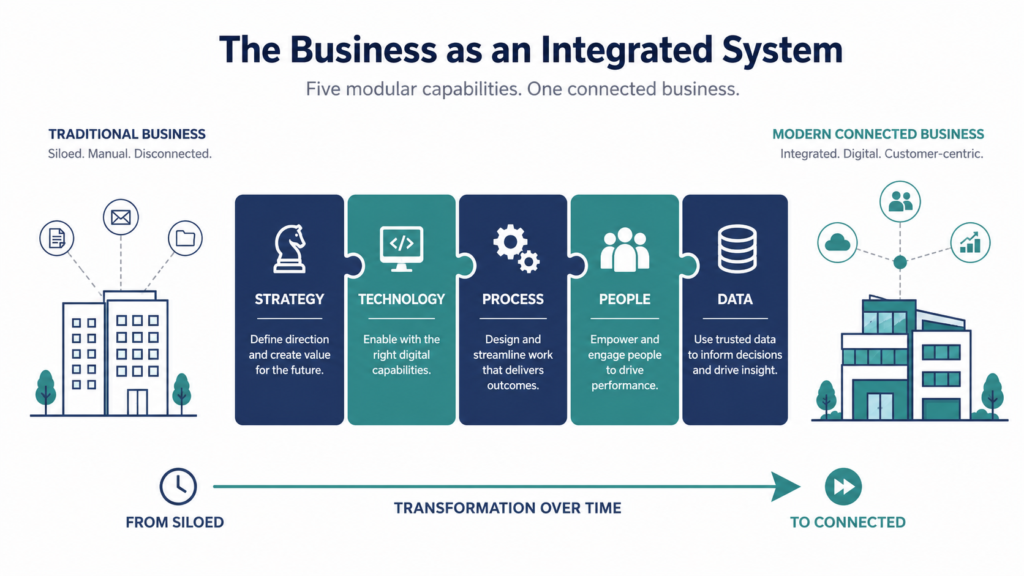
The four pillars of digital transformation explained by every serious framework — Harvard Business Review, MIT, Gartner, McKinsey — cover the same ground with slightly different labels. The version that holds up best in practice for a business leader is: technology, process, people, and data. Cover all four, and a transformation is coherent. Ignore any one, and it will fall over on that side. If a program leader can’t tell you in one minute what is happening on each of the four pillars right now, the program is not being managed as a transformation — it’s being managed as a technology deployment with change-management theatre bolted on the side.
These pillars of digital transformation are not sequential — you don’t finish one before starting another. They run in parallel, and they reinforce each other. Move technology without process, and you get expensive legacy on a new platform. Move process without people, and you get resistance. Move people without data, and you can’t measure whether anything is actually working. Below is what each pillar looks like when it is being done well.
The Technology Pillar
Technology is the enabler — the layer that makes the other three pillars possible at scale. In a digital transformation, this means moving away from monolithic, on-premise, custom-built systems toward a modern architecture: cloud-native infrastructure, API-first services, event-driven data flows, and increasingly AI and agentic automation. The point isn’t the technology itself. The point is that the technology stops constraining what the business can do. Data center systems spending grew 55.8% in 2026, per Gartner, most of it aimed at AI infrastructure — an indication of how heavily the technology pillar is being reweighted right now. The specific technology choices matter far less than the architectural principles: elasticity, composability, and the ability to change one part without breaking the rest. A transformation that gets the technology pillar right can support strategic pivots later. One that gets it wrong locks the business into today’s decisions for the next decade.
The Process Pillar
Every dollar spent on new technology on top of a broken process buys you a faster broken process. The process pillar is the discipline of redesigning workflows before automating them. It asks: does this step still need to exist? Does it need to happen this way? Can it be moved, merged, deleted? Redesign first, then automate. The organizations that get this right typically strip out 30–50% of the steps in a legacy process before they touch it with technology — which is where most of the actual ROI comes from. The reason this pillar gets skipped so often is uncomfortable: process redesign involves telling people that the work they’ve done for years is no longer needed the way it was done. Leadership teams that avoid that conversation ship expensive technology on top of preserved dysfunction and wonder why the ROI is thin.
The People and Culture Pillar
Technology and process changes only stick if the people who use them adopt them. That means skills (do people know how to use the new tools), roles (do the job descriptions still make sense), incentives (are people rewarded for the new behaviours), and culture (does the organization actually value speed, experimentation, and data-driven decisions). Prosci’s research shows organizations with excellent change management meet or exceed objectives 88% of the time, compared to just 13% for those with poor change management — the widest gap of any variable measured. Culture and change management is not a soft pillar. It is often the deciding one.
The Data and Insights Pillar
The data pillar is what turns transformation from an act of faith into a managed portfolio of decisions. It has three components. First, the data infrastructure — pipelines, warehouses, lakes, governance — that makes reliable data available where decisions are made. Second, the analytics and AI capability that turns data into insight. Third, the decision culture that actually uses insight instead of overruling it with hunch. Without this pillar, you have no idea whether anything you’re doing is working, which is the state most failing transformations are in. The under-investment in the data pillar is often invisible in the first year; it becomes visible in year two when AI investments stall for lack of trusted training data, and in year three when leadership loses confidence because the results dashboard shows numbers that no one in the business believes. Fixing this later costs several times what fixing it early does.
Choosing a Digital Transformation Framework That Fits Your Business
A digital transformation framework for business leaders is a structured way to think through the pieces so nothing important gets left out. There is no single “correct” digital transformation framework — the right one depends on your industry, your business size, your starting maturity, and whether you’re transforming a whole company or a single business unit. The mistake most leadership teams make is either picking a framework and treating it as gospel, or ignoring frameworks entirely because “we’re different.” The middle path — pick one that fits and adapt it — is the right one.
A digital transformation framework, in plain terms, is a set of dimensions or lenses that a transformation should be evaluated across, plus a sequence for how to work through them. Every credible framework covers strategy, technology, process, people, and measurement — the specific labels and emphasis are what differ. Here is a decision matrix for the frameworks a business leader is most likely to encounter.
| Framework | Best Fit | Strengths | Weaknesses |
|---|---|---|---|
| MIT Sloan Digital Transformation Framework | Mid-to-large enterprises with a change-management heavy culture challenge | Strong on culture, customer experience, and organizational change; academically rigorous | Less prescriptive on technology architecture |
| Gartner Digital Business Transformation Model | Technology-heavy transformations, IT-led enterprise programs | Deep on technology maturity, benchmarks, and capability modelling | Vendor and analyst-heavy; can under-emphasise business model change |
| McKinsey Digital Transformation Model | Executive-led, top-down transformations at scale | Strong strategy-to-execution linkage; heavy focus on operating model redesign | Consulting-heavy; hard to run without external support |
| Deloitte Digital DNA Framework | Established companies with strong existing culture | Focuses on the traits an organization needs to develop | Diagnostic rather than prescriptive |
| McKinsey 7S (Digital) | Smaller organizations, single business units, or first-time transformations | Familiar model; balances hard and soft dimensions; approachable | Was not designed for digital-specific transformation |
| Custom hybrid | Most real-world transformations | Adapted to your business; avoids fitting round pegs in square holes | Requires internal discipline to keep coherent |
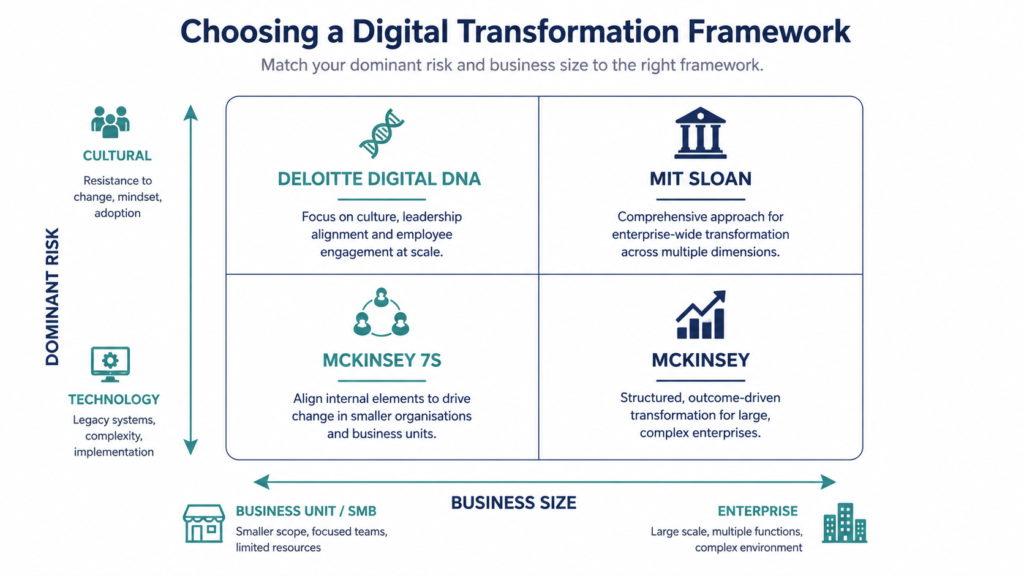
The practical answer for most leaders: pick a framework that matches your dominant risk. If your dominant risk is cultural resistance, pick MIT or Deloitte. If it is technology debt, pick Gartner. If it is strategy-to-execution slippage, pick McKinsey. If you’re smaller or transforming a single unit, adapt McKinsey 7S. And then — this is the point — customize it. No framework survives contact with a real organization unmodified. The value of the framework is that it stops you missing something obvious; the risk is that you optimize for the framework rather than the outcome.
One more note on frameworks: they are not badges. There is nothing to gain from telling the board you are using a specific named framework unless it is genuinely shaping your decisions. Leadership teams that treat framework selection as a substitute for strategic clarity end up with the worst of both worlds — the appearance of discipline, without the discipline. Use a framework to structure the conversation, then argue about the substance underneath it.
→ Full guide: Digital Transformation Frameworks Compared: Which Model Fits Your Business (coming soon)
How to Build a Digital Transformation Strategy Tied to Business Outcomes
A digital transformation strategy for business outcomes is a single-page answer to two questions: what business result are we trying to move, and what set of digital changes will move it? Most transformation strategies fail before they start because they answer neither. Instead they read like a list of technology bets — cloud migration, AI adoption, data platform build, ERP replacement — with no anchor to a business outcome anyone would notice if it moved.
A digital transformation strategy is not a technology plan with a strategy label on it. It is a business plan that names the specific customer, market, or operating outcome the transformation is intended to change, then works backward to the digital investments required to move it. Everything else — architecture decisions, vendor choices, program structure — flows from that.
The strategy has to answer, in this order:
- What business outcome are we transforming to achieve? Growth in a specific segment, cost reduction of a specific magnitude, customer retention above a specific bar, entry into a new market, or defense against a specific competitive threat. If you can’t name it in one sentence, you don’t have a strategy yet.
- Where in the value chain does the outcome live? Acquisition, onboarding, service, retention, product development, supply chain, back office. A transformation that tries to move the whole value chain at once is almost guaranteed to fail — pick where impact is highest and start there.
- What digital capabilities does that section of the value chain need? Named capabilities — real-time personalization, predictive service, automated underwriting, connected-product telemetry — not generic categories like “cloud” or “AI.”
- What operating model needs to be true to deliver those capabilities? Team structure, decision rights, funding model, technology architecture, data governance.
- What measurable KPIs will confirm the outcome is moving? Leading indicators (adoption, cycle time), lagging indicators (revenue, margin, retention), and a review cadence tight enough to course-correct.
Strategies that answer these five questions land. Strategies that don’t become expensive activity. McKinsey’s transformation research finds that companies that align digital investments to a small set of clear business outcomes are nearly five times more likely to see sustained financial gains than those that pursue technology-led programs without an outcome anchor. Outcome discipline is not a nice-to-have.
→ Full guide: Digital Transformation Strategy: How to Build One That Actually Works (coming soon)
The Digital Transformation Roadmap: From Strategy to Execution
The digital transformation roadmap steps for enterprise leaders are the phased plan that translates the strategy into a sequence of moves, in the right order, with the right stopping points. A digital transformation roadmap is not a Gantt chart of technology deliverables. It is the sequence of business capabilities the organization will build, in the order they build value on each other, with clear check-ins where the plan can be adjusted.
Every effective roadmap moves through four stages. These are the four stages of digital transformation most models refer to — labels vary, substance doesn’t.
Stage 1 — Assess: Current State and Readiness
Before you plan the future state, you have to be honest about the current one. Assess where the business actually sits today: business performance, customer experience, technology architecture, data maturity, skills, and culture. This is where digital maturity assessment tools come in — they force an unflinching view of what’s really there. A common failure mode is skipping this stage because leadership “already knows” the answer; the assessment almost always surfaces something they didn’t. The output of this stage is not a slide deck of what’s wrong — it is a shared, executive-team-signed view of where the business is on each dimension, which becomes the baseline everything else is measured against. Duration: 4–8 weeks.
Stage 2 — Design: Target State and Priorities
With current state known, design the target state — what the business will look like when the transformation is delivered — and the priorities to get there. This is where the strategy gets translated into a small number of transformation programs (usually three to seven), each with a named business outcome, a program owner at the executive level, and a rough budget envelope. This stage is where you decide what’s in and what’s out; a design that tries to do everything is worse than one that picks five things. Duration: 6–12 weeks.
Stage 3 — Pilot: Rapid Learning
Before scaling, pilot each program in a bounded environment: one business unit, one geography, one product line. Pilots are not proof-of-concepts — they are real production deployments at limited scope, designed to expose the integration issues, adoption issues, and business-value issues that only appear when the transformation meets reality. Every pilot has an explicit learning agenda and a go/no-go criteria for scaling. Pilots that turn into demonstrations instead of experiments — where the goal quietly shifts from “learn what happens” to “prove the concept works” — are a warning sign. The value of a pilot is the honest answer, including the negative one. Duration: 3–6 months per pilot.
Stage 4 — Scale: Roll Out and Institutionalize
Scaling is where transformation delivers, and it’s where most programs quietly stall. Gartner reports that as many as 85% of digital initiatives never scale successfully beyond the pilot stage, per industry failure-rate analyses. Scaling requires operating-model change, not just replication: standardized playbooks, centralized platforms, dedicated change-management resources, and executive air cover. Institutionalizing means the transformation becomes how the business runs, not a separate program that ends. The specific move that separates programs that scale from programs that don’t is that leadership treats institutionalization as its own workstream — not as something that “just happens” once the pilot works. Someone owns it, budget is committed to it, and the operating model changes required to sustain the new way of working are worked through explicitly. Duration: 12–36 months and continuing.
→ Full guide: How to Create A Successful Digital Transformation Roadmap — deep dive on each stage, gates, and executive artefacts.
The Culture and Change Management Side of Digital Transformation
Digital transformation culture and change management is the pillar that gets under-invested, under-staffed, and blamed after the fact. Culture is not the soft side of transformation; in transformation programs that fail, it is almost always the primary cause. 60% of organizations name culture as the biggest barrier to digital transformation, according to MIT Sloan Management Review research. Technology comes second. Budget comes third. Culture wins the ranking every time.
Digital transformation culture is not a mood or a tone — it is the set of behaviours the organization actually rewards. If your organization rewards not making mistakes, it will not experiment. If it rewards hitting quarterly numbers, it will not invest in multi-year change. If it rewards being right in meetings, it will not be data-driven. The transformation asks people to work differently; the culture decides whether they will. Change management is the discipline that bridges the two.
The core change management moves that hold up under scrutiny are: visible executive sponsorship (leaders are seen using the new tools, making decisions the new way, and telling the story publicly and repeatedly), a named change network (respected people across the organization who explain, translate, and unblock adoption on the ground), skills investment at scale (real training, not e-learning theater), incentive redesign (promotion, bonus, and recognition criteria reflect the new behaviours), and psychological safety (people can flag that something isn’t working without being punished). Miss any of these and adoption stalls.
The employees who are asked to adopt the new way have a rational response to change: they wait to see whether it’s real. If leadership sponsors it visibly, if incentives shift, if middle managers protect the time and effort required to learn the new tools — they engage. If any of those signals are missing, they quietly wait for the initiative to pass, which most initiatives do. This is not resistance; it is pattern recognition. Change management is the discipline of making sure the signals are consistent enough that engagement is the rational response.
There is one more culture pattern that separates transformations that stick from those that don’t: the way leadership treats early failure. Every transformation of any scale will produce a pilot that underdelivers, a program that misses its date, or a technology bet that doesn’t pan out. Organizations where these are met with post-mortems and portfolio adjustments continue. Organizations where they are met with blame quietly stop being told what’s really happening — which means leadership is running the transformation on filtered information, which means they cannot adjust, which means the transformation fails predictably from that point forward.
→ Full guide: Digital Transformation and Organizational Culture: Managing Change That Sticks (coming soon)
The Digital Transformation Technology Stack — What Actually Matters
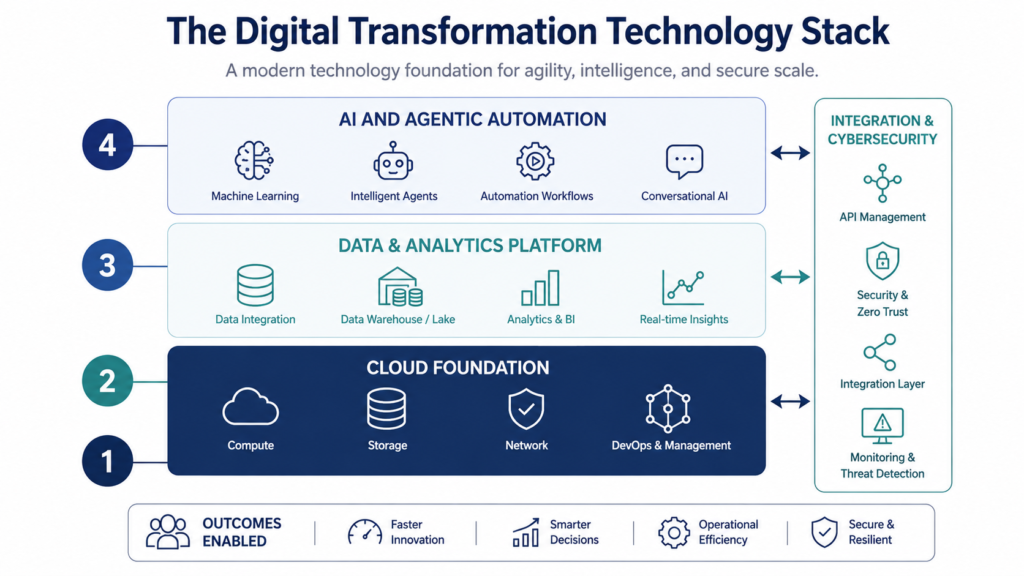
The digital transformation technology stack for enterprise environments has a lot of moving parts, but a small number of them actually determine whether the transformation compounds or collapses. The full digital transformation technology conversation covers dozens of categories; below is the version that matters to a business leader trying to decide where to focus attention.
Cloud Foundation
Cloud is the modernized substrate everything else runs on. In 2026 this means multi-cloud or hybrid architecture, containerized workloads, infrastructure-as-code, and platform engineering. The specific hyperscaler matters less than the architectural principles: elasticity, API-first services, and separation of state from compute. A cloud foundation that is really just legacy applications lifted onto virtual machines produces most of the cost of cloud with none of the benefit. The “lift and shift” trap is common enough that CFOs now scrutinise cloud spend line by line — leadership teams that can’t show a modernization plan alongside the migration usually get their cloud budgets cut in the second year.
Data and Analytics Platform
Modern transformation runs on modern data. That means a unified data platform (lakehouse-style architecture is now the default), clear governance and lineage, real-time streaming where the business needs it, and self-service analytics for teams closest to the decisions. The data platform is the piece that determines whether AI investments produce anything valuable — models trained on messy data produce messy answers. The unglamorous decisions here — data ownership, master data management, taxonomy, quality — are where transformations either compound over years or stall. Every leadership team eventually wishes it had invested more here earlier.
AI and Agentic Automation Layer
Artificial intelligence has moved from optional to structural. In 2026, the leading edge is agentic AI — systems that don’t just answer questions but plan, take multi-step actions, and coordinate across tools on behalf of humans. Gartner projects generative AI software spending to more than double year-over-year in 2026. For business leaders, the pragmatic move is to pick a small number of high-value use cases (contact centre, sales enablement, service delivery, engineering productivity), deploy AI seriously in those, and use them to build the enterprise AI capability before trying to boil the ocean.
Integration and Cybersecurity
The unglamorous pieces are frequently what determines whether the transformation delivers. Integration — how systems talk to each other, how data moves between them, how customer experiences stay coherent across channels — is where most transformation programs quietly break. Cybersecurity, similarly, is the piece that turns a successful transformation into a business-continuity liability if it’s not embedded from the design stage. Both belong at the executive table, not as afterthoughts.
The practical test for whether the digital transformation technology stack for enterprise is sound: can a decision made in one part of the business — a change to a pricing rule, a new customer segment, a new product feature — be reflected across every channel and every downstream system within days, not months? When the answer is days, the stack is doing its job. When it’s months, the technology pillar is failing whatever else the transformation is trying to do.
→ Full guide: Digital Transformation Tools: How to Build the Right Stack for Your Business Size and Stage (coming soon)
How to Measure Digital Transformation ROI and KPIs
How to measure digital transformation ROI is the question that separates programs that get renewed from programs that get quietly wound down. If leadership can’t point to a moving number that credibly ties back to the transformation, the transformation loses the argument to the next quarter’s cost cut. Digital transformation ROI measurement rests on three moves: measure the right things, measure them at the right cadence, and connect them to a business case the CFO believes.
The right KPIs sit in four categories. Below is the version that works for a Hub-level executive dashboard.
| KPI Category | Example KPIs | What It Tells You | Review Cadence |
|---|---|---|---|
| Business outcome | Revenue per customer, retention rate, market share, new revenue lines | Whether the transformation is moving the number leadership actually cares about | Quarterly |
| Operational efficiency | Cycle time, cost-to-serve, throughput, error rate | Whether the process redesign is working | Monthly |
| Customer experience | NPS, customer effort score, first-contact resolution, digital adoption rate | Whether the transformation is felt by customers | Monthly |
| Adoption and enablement | Feature adoption rate, active users, training completion, sentiment | Whether people inside are actually using the new capabilities | Weekly early, monthly later |
Only 27% of organizations expect transformation ROI within six months in 2026, down from 42% the year before, per industry analysis — which means measurement is harder now, not easier. Longer payback horizons make leading indicators more important than ever. Adoption metrics tell you whether the transformation is on track months before revenue metrics do; leadership teams that measure both catch problems in time to fix them.
The single most important measurement discipline is to name the KPIs before the transformation starts. Retrofitting metrics after the fact produces confirmation bias; setting them at the strategy stage produces accountability. Every transformation program should have a named executive sponsor, a small set of named KPIs, and a fixed review cadence where the numbers are looked at honestly.
The measurement discipline also decides how the ROI conversation lands with the CFO. Transformations that measure only inputs (spend, headcount, systems deployed) are treated as costs. Transformations that measure outputs (business KPIs moving) are treated as investments. The difference is not accounting — it’s storytelling backed by numbers, and it is what determines whether the next tranche of funding gets approved.
→ Full guide: How to Measure Digital Transformation ROI: KPIs and Metrics That Matter (coming soon)
Why Digital Transformations Fail — And What Business Leaders Can Do About It
Why digital transformations fail for enterprises is a well-studied question with a depressingly consistent answer. The problem is almost never the technology. McKinsey’s transformation research finds that roughly 70% of transformation programs fall short of their objectives, and Bain’s 2024 study puts the failure rate at 88% for business transformations more broadly, per 2026 industry analysis. Different studies, different definitions, same story: the majority of transformations do not deliver what they promised. So why do digital transformations fail this consistently?
Six causes account for the overwhelming majority of failures. Each of them is preventable if leadership decides it is.
Cause 1 — Strategy that’s really a technology plan. The program is named after a technology (cloud migration, ERP replacement, AI adoption) instead of after a business outcome. When the technology arrives and the outcome hasn’t moved, leadership loses conviction. Fix: name every program after the outcome it delivers, not the technology it deploys.
Cause 2 — Executive sponsorship that fades. The CEO announces the transformation, the team stands up, and the CEO turns attention elsewhere. Middle management fills the vacuum with day-job priorities, and the transformation quietly loses. Fix: the executive sponsor stays visible for the duration, not just the launch.
Cause 3 — Culture and change management under-invested. This is the biggest one. 60% of organizations cite culture as the primary barrier to transformation, per MIT Sloan Management Review, and Prosci’s research shows organizations with excellent change management meet objectives 88% of the time versus 13% for those with poor change management. Fix: fund change management as a real workstream, not a training line item.
Cause 4 — Pilot success without scaling. The proof-of-concept works. The rollout doesn’t. Every pilot needs a named path to scale from day one, with the operating model changes required to scale worked through in parallel.
Cause 5 — Data debt that swamps the AI investments. The organization pours money into AI while the underlying data is fragmented, ungoverned, and unreliable. Models produce answers no one trusts, and the AI investment is written off as hype. Fix: fix the data platform before scaling AI, not after.
Cause 6 — No measurement, or measurement of the wrong things. The program measures activity (systems deployed, users trained) instead of outcomes (business KPIs moving). Twelve months in, leadership can’t tell whether it’s working, and defaults to cutting. Fix: measure outcomes from the start.
The pattern under all six causes is the same: transformation fails when leadership treats it as a program to be delegated instead of a change to how the business is run. Leaders who stay engaged, keep the business outcome in the centre, invest in culture and change, and measure honestly deliver transformations. Those who don’t fund the failure statistics.
If you’re mid-transformation and reading this, the useful exercise is to score your own program against these six causes right now, honestly. Cause 1 present? Cause 3 present? A “yes” on two or more is the reliable early warning signal that the program is drifting toward the 70%. The good news is that all six have known interventions — none of them are terminal at the point they show up. The bad news is that most of the interventions require the executive team to acknowledge, out loud, that something isn’t working. That acknowledgement is the hardest part of turning a struggling transformation around, and it is also the necessary one.
→ Full guide: Why Digital Transformation Fails: The Real Reasons Behind Low Success Rates (coming soon)
Digital Transformation Examples: What Success Actually Looks Like
Real world digital transformation examples 2026 leaders should study are the ones where the outcome moved, not just the technology shipped. Below are four short digital transformation examples across industries, each chosen because the transformation was strategic, cross-functional, sustained, and produced results a CFO would recognize. If you’re presenting to a skeptical board on what is digital transformation and why it’s worth the investment, these are the cases to point at — not because they’re perfect templates to copy, but because they show what a successful outcome actually looks like in practice.
Retail — Home Depot
Home Depot’s transformation moved the business from a physical DIY retailer to a connected commerce platform. It rebuilt its data foundation, invested in supply chain visibility, and turned every store into a fulfillment node for online orders. Result: sustained e-commerce growth, better inventory turns, and a customer experience where store, digital, and pro-customer channels reinforce each other. The transformation is now years old and continuing — the point is that it never ended. What separates the Home Depot story from countless failed retail transformations is that leadership kept the customer at the centre of every architectural decision, not the technology.
Banking — DBS Bank
DBS Bank became the “world’s best digital bank” by Euromoney’s ranking, and its transformation is now taught at Harvard Business School. The bank rebuilt its technology platform, ran hackathons and design thinking programs at scale, and reoriented the culture around start-up-style experimentation. Its operational excellence program saved S$60 million in the first year and 240 million hours of customer wait time — hard numbers, sustained over years, across a whole institution.
Manufacturing — Siemens
Siemens’s Industry 4.0 transformation turned traditional factories into connected, data-rich production environments. Its Amberg electronics plant is frequently cited as a benchmark: near-total automation, digital twins for every product, and a real-time data platform driving decisions. The result is a level of production efficiency and quality that competitors are still working to match. What made it work was the pairing of technology with process redesign and workforce upskilling in parallel. Notably, Siemens didn’t just automate its existing manufacturing lines — it reconceived what a factory could be, given modern digital capability, and rebuilt around that vision.
Healthcare — Cleveland Clinic
Cleveland Clinic transformed patient experience and care coordination through digital scheduling, virtual visits, and an integrated data platform that follows patients across specialties. The transformation was strategic (compete on patient experience, not just clinical outcomes), operational (redesigned care pathways), and continuous (the digital layer keeps expanding). Patient satisfaction scores and volume both moved. In an industry where digital transformation is often reduced to “put the medical records online,” Cleveland Clinic treated it as a fundamental redesign of how care is delivered end-to-end.
The common thread across all four digital transformation examples above is not the technology. It is that leadership treated the transformation as strategic and sustained, invested in the culture and workforce alongside the tech, redesigned processes before automating them, and measured business outcomes. Real world digital transformation examples 2026 leaders can benchmark against all look like this. The counter-examples — the transformations that didn’t work — usually share the opposite pattern: technology-first, executive attention that faded, culture treated as a training exercise, and metrics that measured activity instead of results.
Signs Your Business Is Ready for Digital Transformation (Or Not)
Signs your business is ready for digital transformation are practical, observable signals — not aspirations. Digital transformation readiness is the difference between a program that has a chance and one that will burn budget for two years and produce a slide deck. Before you commit, run through the readiness checklist below honestly. This is the part of the guide most transformation programs skip.
Business strategy readiness. There is a named business outcome the transformation is meant to deliver. It is written down. The executive team can articulate it in one sentence. If any of those three are missing, you’re not ready — go back to strategy.
Executive alignment. The CEO or business unit head owns the transformation personally, not just the CIO or CTO. The full executive team agrees on the priority — visibly, publicly, and consistently. If executives are misaligned, resolve that before you launch anything.
Funding horizon. The business can commit multi-year investment. Transformation is not a fiscal-year initiative. If the funding is contingent on quarterly re-approval, you have a project, not a transformation.
Change capacity. The organization is not already saturated with other change programs. Front-line teams have enough bandwidth to absorb what’s coming. If change fatigue is already high, sequence, don’t stack.
Data maturity. The organization can access reliable data on the areas the transformation is targeting. If the answer is “we’d have to pull that manually,” fix the data platform first or scope the transformation around what you can measure.
Culture signals. The organization can name recent examples of learning from failure without punishment, experiments that were run and lessons taken forward, and cross-functional work that produced results. If these examples are hard to find, the culture is not yet ready to absorb transformation-level change.
Talent depth. There is real digital talent — not just IT — in the business. Product managers, data scientists, engineers, and change agents who can operate at pace. If the talent bench is thin, transformation will bottleneck immediately.
Score each of these seven honestly. Green on 5+ means you’re ready to launch with focused programs to strengthen the weak areas. Green on 3–4 means you have foundational work to do first — usually 6–12 months — before committing to a full transformation. Green on fewer than 3 means don’t start; you’ll fund the failure statistics. This isn’t defeatism; it’s the difference between the 30% that succeed and the 70% that don’t.
→ Full guide: Digital Maturity Assessment: Benchmark Your Organization’s Transformation Readiness — a structured scoring tool that goes deeper on each dimension.
Digital Transformation Trends Every Business Leader Should Watch in 2026
Digital transformation trends business leaders 2026 should watch cluster around a small number of shifts that are already reshaping how transformations are designed. These digital transformation trends 2026 aren’t predictions; they are already underway in most enterprise programs. The strategic question is whether your transformation is on the right side of them or is being designed to a 2023 playbook.
Agentic AI moves from pilot to structural. AI agents that plan, take multi-step actions, and coordinate across tools are being deployed in contact centres, engineering, sales, and back-office operations. The productivity and cost implications are large enough that transformation programs that treat AI as “add later” will look outdated within 18 months.
Composable and modular architecture becomes the default. The days of the monolithic ERP-defines-the-business era are ending. Composable business — assembling capabilities from best-of-breed services connected through APIs — is now the architectural stance most transformation frameworks assume.
Data and AI governance rises to the executive table. As AI usage scales, the associated governance — model risk, data lineage, regulatory compliance, ethical use — has moved from a specialist concern to a board-level one. Transformation programs that skip this now will be paying for it in 2027.
Cyber-resilience gets designed in, not bolted on. The frequency and cost of breaches has made cyber a first-order transformation concern. It sits at the same table as strategy, not underneath it.
Sustainability and digital transformation converge. Emissions reporting, supply chain transparency, and circular-economy business models are increasingly enabled by the same digital capabilities that drive commercial transformation. Programs that separate the two miss the leverage.
Human capability and reskilling become the constraint. Technology is not the bottleneck for most transformations in 2026; the ability to reskill people at pace is. Programs that under-invest here will hit the same wall repeatedly.
The strategic implication of these digital transformation trends 2026 for the executive team is that the shape of what a “good” transformation looks like has shifted. Programs designed even 24 months ago against an older playbook are being outpaced by ones designed with agentic AI, composable architecture, and reskilling-at-pace built in from the start. If your transformation strategy hasn’t been reviewed against this list in the last six months, it is time.
Conclusion
So: what is digital transformation, at the level a board or executive team should hold in their heads? It is a change to the business itself — the operating model, the value proposition, and the culture — enabled by digital technology but not defined by it. The seventy percent that fail treat it as a technology program; the thirty percent that succeed treat it as a strategic and cultural one, funded honestly, measured seriously, and led from the top. If you take one thing from this digital transformation guide, take the readiness checklist above and score your organization honestly before you commit budget. Then pick a framework, name the outcome, build the roadmap, and stay engaged. The organizations that do all four win the decade. Every Spoke referenced above goes deeper on one specific piece — start with the one that matches whatever decision is on your desk this week.
→ Full guide: Top 7 Digital Transformation Trends to Watch — the deeper Spoke on each of these.
Frequently Asked Questions About Digital Transformation
What is digital transformation in simple terms?
Digital transformation is a business changing how it operates and delivers value so completely that digital technology becomes the way it works, not a tool added on top. It touches strategy, processes, culture, and customer experience — not just the systems the IT team runs. Think of it as rewiring the business itself, with digital as the enabler.
What are the 4 pillars of digital transformation?
The four pillars are technology, process, people and culture, and data and insights. Technology provides the modern architecture; process discipline strips out and redesigns workflows before automating them; the people pillar drives adoption and cultural change; and the data pillar turns transformation into a managed portfolio of decisions rather than an act of faith.
Who leads digital transformation in an organization?
The CEO or business unit head owns digital transformation, with the CTO, CIO, or a dedicated Chief Digital Officer running execution. Programs led by the technology function alone consistently underperform because transformation is a change to how the business operates, not just how technology is delivered. The full executive team has to be visibly aligned for adoption to hold.
How long does a digital transformation take?
A serious enterprise digital transformation typically runs three to five years to full institutionalization, with meaningful business impact starting to show in year one to two. Anything promised in months is either digitalization (single process) or marketing. Once mature, transformation becomes continuous — the business is always changing, so there is no ‘end date.’
How much does digital transformation cost?
Enterprise digital transformation budgets typically run 2–5% of annual revenue over a multi-year horizon, though the range widens substantially by industry and starting maturity. The more useful cost question is not ‘how much’ but ‘against what business outcome’ — programs that can name the target outcome and its financial impact defend budgets far more successfully than those that quote industry benchmarks.
What is the difference between digital transformation and digitalization?
Digitalization uses digital technology to change how a specific process or role works — one workflow at a time. Digital transformation uses digitized information and digitalized processes to change what the whole business does — its model, its proposition, its economics. Digitalization is a project. Transformation is a change to the business itself.
Why do most digital transformations fail?
Most digital transformations fail because leadership treats them as technology programs instead of strategic and cultural ones. The dominant causes are executive sponsorship that fades after launch, culture and change management left underfunded, pilots that don’t scale, and measurement of activity rather than business outcomes. Around 70% fall short of their objectives — almost always for those reasons, not technology.
What is the role of AI in digital transformation in 2026?
AI has moved from optional to structural in digital transformation. In 2026 the leading edge is agentic AI — systems that plan, take multi-step actions, and coordinate across tools on behalf of humans. The pragmatic move is to pick a small number of high-value use cases (contact centre, sales enablement, service delivery, engineering productivity), deploy AI seriously there, and build enterprise AI capability from those wins rather than chasing every use case at once.
Is digital transformation the same as IT transformation?
No. IT transformation modernizes the technology function itself — infrastructure, applications, operating model of the IT department. Digital transformation modernizes the business the IT function serves. IT transformation is often a prerequisite for digital transformation, but delivering the first without the second produces expensive technology change with no business outcome to show for it.
What are the biggest risks in digital transformation for CTOs?
The biggest risks are strategy that’s really a technology plan, executive sponsorship fading after launch, culture change under-invested, pilots that never scale, and data debt that undermines every AI investment. CTOs who name these risks explicitly at the strategy stage and assign owners to each one dramatically improve the odds. Ignoring them until they materialize is what puts programs in the 70% failure statistic.
Do small businesses need digital transformation?
Yes, but the shape is different. Small businesses don’t need enterprise-scale transformation programs; they need phased, high-leverage moves — cloud tools, automated workflows, digital customer channels, basic data visibility — that compound over time. The strategic logic is the same as enterprise transformation; the execution is lighter, faster, and closer to what a founder can drive personally.
What is a digital transformation office and do I need one?
A digital transformation office (DTO) is a dedicated team that coordinates strategy, program management, change management, and reporting across the transformation portfolio. Enterprises with three or more concurrent transformation programs generally benefit from one; smaller organizations can usually operate with a lighter steering committee. The decision comes down to portfolio complexity, not size alone.
How do you measure digital transformation success beyond ROI?
Beyond financial ROI, measure operational efficiency (cycle time, cost-to-serve), customer experience (NPS, effort score, first-contact resolution), and adoption (active users, feature usage, sentiment). Leading indicators like adoption tell you months earlier whether the transformation is on track than lagging financial metrics do. The strongest programs review both cadences — weekly for adoption, quarterly for business outcomes.