Imagine running a business where 99.99966% of everything you do is done perfectly. Sounds impossible? That’s exactly what Six Sigma methodology promises – and delivers. This powerful quality management system has helped companies like General Electric save $12 billion in just five years and transformed how businesses think about perfection.
But here’s the thing: most people think Six Sigma is just another business buzzword that’s too complicated for regular folks to understand. That couldn’t be further from the truth.
What You’ll Learn in This Complete Guide
By the time you finish reading this article, you’ll understand:
- What Six Sigma really means (in simple terms anyone can grasp)
- How the proven DMAIC process works step-by-step
- Real case studies showing exactly how companies saved millions
- Why 85% of Fortune 500 companies use this methodology
- How Six Sigma compares to other quality methods like Lean and Kaizen
- Whether Six Sigma could transform your business (spoiler: it probably can)
Ready to discover why everyone from Amazon to Toyota swears by this approach? Let’s dive in.
Understanding Six Sigma Methodology: A Simple Explanation
Six Sigma is a data-driven methodology that helps businesses eliminate defects and improve quality by reducing variation in processes. Think of it as a systematic way to make your business run as close to perfect as possible.
The name “Six Sigma” comes from statistics. In simple terms, it means that out of every million things you do, only 3.4 will be mistakes. To put that in perspective, if airlines operated at Six Sigma levels, there would be only one delayed flight every 2.5 years at a major airport.
According to the American Society for Quality, companies implementing Six Sigma see an average 20% improvement in operating margins within the first two years. But Six Sigma isn’t just about numbers – it’s about creating a culture where everyone thinks about improvement every single day.
The Origins and Evolution of Six Sigma
Six Sigma was born in 1986 at Motorola when engineer Bill Smith noticed that products failing early in their lifecycle also failed during manufacturing. This insight led to a revolutionary approach: prevent defects instead of finding and fixing them later.
The methodology gained worldwide attention when Jack Welch, CEO of General Electric, made it the cornerstone of GE’s business strategy in 1995. Under his leadership, GE saved $12 billion over five years using Six Sigma principles. Today, it’s used across industries from healthcare to software development.
How Six Sigma Works: The DMAIC Process Breakdown
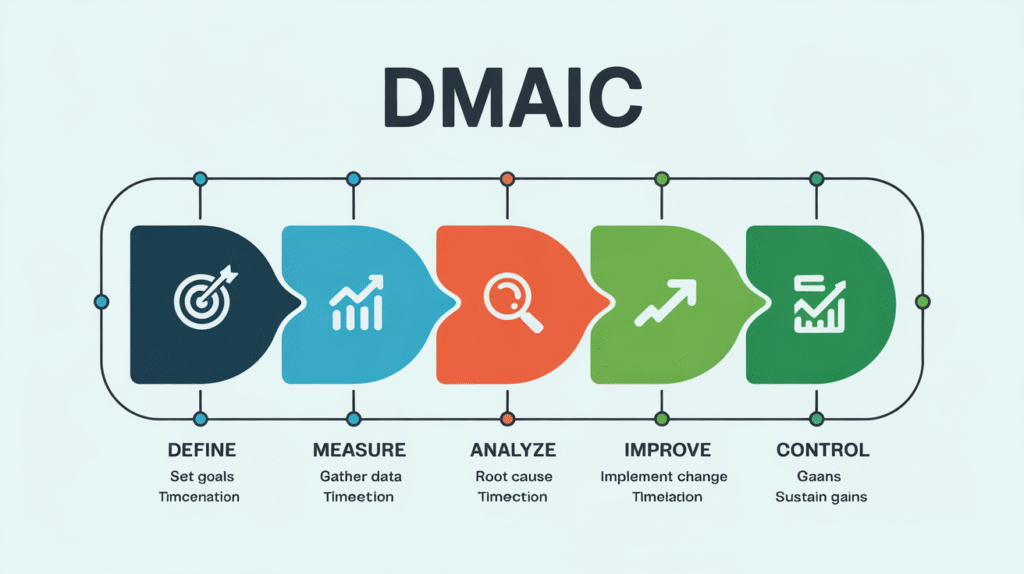
The heart of Six Sigma methodology lies in a five-step process called DMAIC (pronounced “duh-may-ick”). Each letter represents a crucial phase that guides teams from identifying problems to implementing lasting solutions.
| Phase | What It Means | Key Activities | Typical Duration |
|---|---|---|---|
| Define | Identify the problem | Set goals, define scope | 2-4 weeks |
| Measure | Collect baseline data | Gather current performance metrics | 3-6 weeks |
| Analyze | Find root causes | Use statistical tools to identify issues | 4-8 weeks |
| Improve | Implement solutions | Test and deploy improvements | 6-12 weeks |
| Control | Sustain the gains | Monitor and maintain improvements | Ongoing |
Define Phase: Setting Clear Project Goals
The Define phase is where magic begins. Teams start by clearly stating what problem they’re solving and why it matters. According to the International Association for Six Sigma Certification, projects with well-defined problems are 3x more likely to succeed.
During this phase, teams create a project charter that answers three critical questions:
- What specific problem are we solving?
- How will we measure success?
- What’s the business impact if we succeed?
For example, when Bank of America wanted to reduce customer wait times, they defined their goal as “reduce average teller wait time from 8 minutes to 3 minutes within 6 months.”
Measure Phase: Collecting Data and Establishing Baselines
You can’t improve what you don’t measure. The Measure phase focuses on gathering data about current performance to establish a baseline. This isn’t just collecting random numbers – it’s about finding the right metrics that truly matter to customers.
Teams typically collect data for 4-6 weeks to ensure they have enough information to make reliable decisions. They also validate their measurement systems to ensure the data is accurate and consistent.
Analyze Phase: Identifying Root Causes
Here’s where Six Sigma gets interesting. Instead of guessing why problems occur, teams use statistical tools to find the real root causes. The Institute for Healthcare Improvement reports that 80% of quality problems have root causes that aren’t obvious without proper analysis.
Common analysis tools include:
- Fishbone diagrams to map potential causes
- Pareto charts to identify the most impactful issues
- Statistical correlation analysis to find relationships between variables
Improve Phase: Implementing Solutions
Once teams know what’s causing problems, they design and test solutions. The key here is to pilot changes on a small scale first. Research from McKinsey & Company shows that companies piloting improvements see 40% higher success rates compared to those implementing changes across the board immediately.
This phase typically involves:
- Brainstorming potential solutions
- Testing changes on a small scale
- Measuring results
- Refining the approach before full implementation
Control Phase: Sustaining Improvements
The Control phase ensures that improvements stick. According to the Lean Enterprise Institute, 70% of improvement initiatives fail because organizations don’t have proper control measures in place.
Successful control plans include:
- Regular monitoring dashboards
- Clear procedures for maintaining improvements
- Training for all affected employees
- Response plans when performance starts to drift
Six Sigma Benefits: Why Companies Choose This Methodology
When done right, Six Sigma delivers results that make CFOs smile and customers cheer. But the benefits go far beyond just cost savings and quality improvements.
Cost Reduction and Efficiency Gains
The numbers speak for themselves. Companies implementing Six Sigma typically see:
- 15-25% reduction in operational costs within the first year
- 20-50% faster cycle times for key processes
- $150,000-$250,000 in annual savings per Black Belt project
Motorola, the birthplace of Six Sigma, estimates it has saved the company $17 billion since 1986. General Electric saw similar results, with $12 billion in savings over five years.
But here’s what’s really interesting: these aren’t one-time gains. According to research from Arizona State University, companies maintain 85% of their Six Sigma improvements five years after implementation.
Quality Improvement and Customer Satisfaction
Six Sigma directly impacts what customers experience. When processes work better, customers notice. The American Customer Satisfaction Index shows that companies with formal Six Sigma programs score 12% higher in customer satisfaction compared to those without.
Real examples include:
- Motorola reduced defect rates by 99.7% in their manufacturing processes
- Amazon achieved 99.95% order accuracy using Six Sigma principles in their fulfillment centers
- Mayo Clinic reduced patient wait times by 50% while improving care quality
Employee Engagement and Skills Development
Here’s a benefit many organizations don’t expect: employees love working in Six Sigma environments. Why? Because they’re empowered to fix problems instead of just working around them.
The Society for Human Resource Management reports that companies with active Six Sigma programs have 23% lower employee turnover and 18% higher employee engagement scores.
Six Sigma vs Other Quality Methodologies
Six Sigma isn’t the only quality improvement methodology out there. Let’s see how it stacks up against other popular approaches.
Six Sigma vs Lean Manufacturing
While Six Sigma focuses on reducing defects and variation, Lean Manufacturing concentrates on eliminating waste and improving flow. Think of Six Sigma as making things more consistent, while Lean makes things faster and more efficient.
| Aspect | Six Sigma | Lean Manufacturing |
|---|---|---|
| Primary Focus | Reduce defects and variation | Eliminate waste and improve flow |
| Tools Used | Statistical analysis, DMAIC | Value stream mapping, 5S, Kanban |
| Best For | Complex problems requiring data analysis | Streamlining processes and reducing waste |
| Timeline | 3-6 months per project | Continuous, smaller improvements |
Many companies now use Lean Six Sigma, combining both approaches. Toyota pioneered this integration, resulting in their legendary quality and efficiency.
Six Sigma vs Kaizen
Kaizen focuses on continuous small improvements made by everyone in the organization. Six Sigma, on the other hand, uses structured projects to solve bigger problems.
According to the Japan Productivity Center, companies using both approaches see 30% better results than those using either method alone.
Six Sigma vs Agile
Agile methodology emphasizes speed and flexibility, especially in software development. Six Sigma prioritizes quality and consistency. Neither is better – they serve different purposes.
Tech companies like Microsoft successfully use both methodologies: Agile for product development and Six Sigma for operational excellence.
Six Sigma vs Total Quality Management (TQM)
TQM is a broader philosophy about quality culture, while Six Sigma provides specific tools and processes. Think of TQM as the mindset and Six Sigma as the toolkit.
Real-World Six Sigma Success Stories
Let’s look at how real companies have used Six Sigma to achieve remarkable results. These aren’t theoretical examples – they’re documented case studies with verified outcomes.
General Electric’s Six Sigma Transformation
When Jack Welch introduced Six Sigma at GE in 1995, skeptics called it “just another management fad.” By 2000, those skeptics were eating their words.
The Challenge: GE wanted to improve quality across all business units while reducing costs.
The Approach: GE trained over 100,000 employees in Six Sigma methodology and made Six Sigma training mandatory for promotion to senior positions.
The Results:
- $12 billion in cost savings over five years
- Customer satisfaction increased by 15% across all business units
- Operating margins improved by 2.5 percentage points company-wide
- Stock price increased 300% during the Six Sigma implementation period
Key Lesson: Leadership commitment is crucial. When the CEO makes Six Sigma a priority, the entire organization follows.
Motorola’s Manufacturing Excellence
As the creator of Six Sigma, Motorola had to prove the methodology worked. Their semiconductor division became the testing ground.
The Challenge: Reduce defect rates in semiconductor manufacturing while maintaining production speed.
The Approach: Implemented rigorous statistical process control and trained all manufacturing employees in Six Sigma tools.
The Results:
- Defect rates dropped from 6,000 parts per million to less than 3.4
- Manufacturing costs reduced by 30% over three years
- Production cycle time decreased by 50%
- Won the Malcolm Baldrige National Quality Award in 1988
Key Lesson: Six Sigma works best when applied systematically across entire operations, not just individual projects.
Bank of America’s Service Quality Improvement
Banks face unique challenges: they deal with people’s money, which means zero tolerance for errors. Bank of America used Six Sigma to transform their customer service operations.
The Challenge: Reduce customer wait times and eliminate errors in transaction processing.
The Approach: Applied DMAIC methodology to analyze customer flow patterns and identify bottlenecks in service delivery.
The Results:
- Average customer wait time reduced from 8 minutes to 2.5 minutes
- Transaction error rates decreased by 85%
- Customer satisfaction scores increased by 22%
- Annual cost savings of $180 million from improved efficiency
Key Lesson: Six Sigma applies to service industries just as effectively as manufacturing.
Toyota’s Lean Six Sigma Integration
Toyota didn’t invent Six Sigma, but they perfected the integration of Lean and Six Sigma methodologies in their production system.
The Challenge: Maintain world-class quality while continuously reducing costs and improving efficiency.
The Approach: Combined Six Sigma’s statistical rigor with Lean’s waste elimination principles across all manufacturing processes.
The Results:
- Defect rates of less than 10 parts per million across all production lines
- Inventory levels reduced by 40% while maintaining production flexibility
- Customer complaints decreased by 75% over five years
- Became the world’s largest automaker while maintaining premium quality reputation
Key Lesson: Combining methodologies can create synergies that exceed the sum of their parts.
Amazon’s Operational Excellence
Amazon uses Six Sigma principles throughout their fulfillment and delivery operations to maintain their reputation for fast, accurate service.
The Challenge: Scale operations to handle billions of packages while maintaining accuracy and speed.
The Approach: Applied Six Sigma methodology to warehouse operations, inventory management, and delivery logistics.
The Results:
- 99.95% order accuracy rate across all fulfillment centers
- Delivery time reduced by 30% over three years
- Operational costs decreased by 20% despite massive volume increases
- Customer satisfaction scores remain above 90% despite exponential growth
Key Lesson: Six Sigma scales effectively with proper technology integration and data analytics.
[See how Six Sigma consulting can help your organization achieve similar results →]
Industries That Benefit Most from Six Sigma
While Six Sigma can improve any business process, certain industries see particularly dramatic results due to their specific characteristics and requirements.
Manufacturing and Automotive
Manufacturing was Six Sigma’s birthplace, and it remains the industry with the most documented success stories. Research from the Manufacturing Institute shows that manufacturers using Six Sigma see 25% higher productivity compared to those who don’t.
Why it works so well:
- High volume, repetitive processes
- Clear measurement criteria
- Direct impact on costs and quality
- Established culture of continuous improvement
Typical results:
- Defect rates below 50 parts per million
- 15-30% reduction in manufacturing costs
- 20-40% improvement in cycle times
Healthcare and Pharmaceuticals
Healthcare organizations use Six Sigma to improve patient outcomes while reducing costs. The Institute for Healthcare Improvement reports that hospitals using Six Sigma reduce medical errors by an average of 50%.
Common applications:
- Reducing patient wait times
- Eliminating medication errors
- Improving surgical outcomes
- Streamlining administrative processes
Impressive example: Mayo Clinic used Six Sigma to reduce heart surgery complications by 40% while cutting surgery time by 25%.
Financial Services and Banking
Banks and insurance companies use Six Sigma to improve accuracy and customer service. According to the American Bankers Association, financial institutions implementing Six Sigma see 35% fewer customer complaints within the first year.
Key focus areas:
- Transaction processing accuracy
- Loan approval time reduction
- Customer service improvement
- Regulatory compliance
Technology and Software Development
Tech companies apply Six Sigma principles to software development, customer support, and data center operations. Microsoft reports that Six Sigma helped reduce software defects by 60% in their Windows division.
Applications include:
- Bug reduction in software releases
- Improving customer support response times
- Data center reliability
- Product development cycle optimization
Getting Started with Six Sigma Implementation
Thinking about implementing Six Sigma in your organization? Here’s a practical roadmap that works for companies of all sizes.
Assessment and Planning Phase
Before jumping in, you need to understand where you stand. Companies that conduct thorough assessments before implementation are 3x more likely to succeed, according to research from the International Association for Six Sigma Certification.
Key assessment questions:
- What are your biggest quality or efficiency challenges?
- Do you have reliable data about current performance?
- Is leadership committed to supporting the initiative?
- What resources can you dedicate to Six Sigma projects?
Planning essentials:
- Set realistic timelines (most successful implementations take 12-18 months)
- Identify pilot projects with clear, measurable outcomes
- Secure executive sponsorship and budget approval
- Choose initial project areas where success is likely
Training and Certification Requirements
Six Sigma uses a belt system similar to martial arts. Each level represents different skills and responsibilities:
| Belt Level | Training Duration | Project Requirements | Typical Role |
|---|---|---|---|
| White Belt | 4-8 hours | None | Team member, basic awareness |
| Yellow Belt | 2-3 days | Support projects | Process participant |
| Green Belt | 5-10 days | Lead small projects | Part-time project leader |
| Black Belt | 15-20 days | Lead major projects | Full-time improvement specialist |
| Master Black Belt | 25+ days | Train others, consult | Six Sigma coach and mentor |
Cost considerations:
- Green Belt training: $1,500-$3,000 per person
- Black Belt certification: $5,000-$15,000 per person
- Master Black Belt programs: $15,000-$30,000 per person
ROI timeline: Most companies see positive ROI within 6-12 months of training completion.
Pilot Project Selection
Choose your first projects carefully. Success breeds success, and early wins create momentum for broader implementation.
Ideal pilot project characteristics:
- Clear, measurable problem
- Manageable scope (can be completed in 3-6 months)
- Strong business case (potential savings of $50,000+)
- Supportive stakeholders
- Available data for analysis
Projects to avoid initially:
- Anything involving major organizational change
- Projects with unclear success criteria
- Highly political or sensitive areas
- Problems requiring significant technology investment
Measuring ROI and Success Metrics
Track both hard and soft benefits to demonstrate Six Sigma’s value:
Hard benefits (quantifiable):
- Cost reduction and savings
- Quality improvement (defect reduction)
- Efficiency gains (cycle time reduction)
- Revenue increases
Soft benefits (qualitative):
- Employee engagement improvement
- Customer satisfaction increases
- Enhanced problem-solving capabilities
- Stronger culture of continuous improvement
According to the International Association for Six Sigma Certification, successful Six Sigma programs typically deliver:
- $150,000-$250,000 in annual benefits per Black Belt
- $25,000-$50,000 in annual benefits per Green Belt project
- 15-25% improvement in key performance metrics within the first year
Ready to Transform Your Business with Six Sigma?
Six Sigma isn’t just another business improvement fad – it’s a proven methodology that has delivered billions in savings and improvements across thousands of organizations worldwide. Whether you’re looking to reduce costs, improve quality, or enhance customer satisfaction, Six Sigma provides the tools and framework to achieve measurable results.
The question isn’t whether Six Sigma can help your business. The question is: are you ready to commit to the discipline and rigor required to make it work?
Start your Six Sigma journey today. Every day you wait is another day your competitors might be getting ahead.
Frequently Asked Questions
How much does Six Sigma certification cost?
Six Sigma certification costs vary by level and provider. Green Belt certification typically costs $1,500-$3,000, while Black Belt programs range from $5,000-$15,000. Many companies see ROI within 6-12 months through project savings that exceed training costs.
Is Six Sigma still relevant in 2025?
Absolutely. 85% of Fortune 500 companies currently use Six Sigma or Lean Six Sigma methodologies. Modern applications include digital transformation, artificial intelligence implementation, and sustainability initiatives. The core principles of data-driven improvement remain as relevant as ever.
What’s the salary increase with Six Sigma certification?
According to the International Association for Six Sigma Certification, professionals with Six Sigma certification earn 15-25% more than their non-certified counterparts. Green Belt certified professionals earn an average of $8,000 more annually, while Black Belt certification can increase earnings by $15,000-$25,000.
How long does it take to implement Six Sigma?
Full Six Sigma implementation typically takes 12-18 months for most organizations. However, you can see results from individual projects within 3-6 months. The timeline depends on organization size, complexity, and commitment level.
Can small businesses use Six Sigma effectively?
Yes, but small businesses should focus on simplified approaches and select projects carefully. Many successful small business implementations start with one or two Green Belt trained employees working on high-impact projects. The key is choosing projects with clear ROI potential.
What’s the difference between Six Sigma and ISO quality standards?
ISO standards define what you should do, while Six Sigma provides tools for how to improve. They’re complementary rather than competing approaches. Many companies use ISO standards as their quality framework and Six Sigma as their improvement methodology.
Do I need statistical expertise to use Six Sigma?
While Six Sigma uses statistics, you don’t need to be a statistician. Modern Six Sigma training focuses on practical application rather than complex mathematical theory. Most statistical analysis is done using software tools with user-friendly interfaces.
How do you sustain Six Sigma improvements long-term?
Successful long-term sustainability requires ongoing monitoring, regular training refreshers, and integration into daily management practices. Organizations that treat Six Sigma as a culture change rather than a project initiative see the best long-term results.