Think your organization is ready for digital transformation? Think again. With 87% of digital transformation initiatives failing to meet their goals, the harsh reality is that most companies are walking blindfolded into a digital minefield. The difference between success and failure often comes down to one crucial step that 90% of organizations skip: a comprehensive digital maturity assessment.
In today’s hyper-competitive landscape, where $3.4 trillion will be spent on digital transformation by 2026, understanding your organization’s true digital readiness isn’t just smart business—it’s survival. Companies that conduct thorough digital maturity assessments are 5 times more likely to achieve breakthrough performance compared to those that dive in unprepared.
But here’s the kicker: most leaders think they know where their organization stands digitally, yet 54% of employees feel completely unprepared for technological changes. This disconnect between leadership perception and ground reality is costing businesses millions in failed initiatives.
Key Takeaways: What You’ll Discover in This Guide
By the end of this article, you’ll have a crystal-clear understanding of how to evaluate your organization’s digital readiness and avoid becoming another statistic. Here’s what we’ll uncover together:
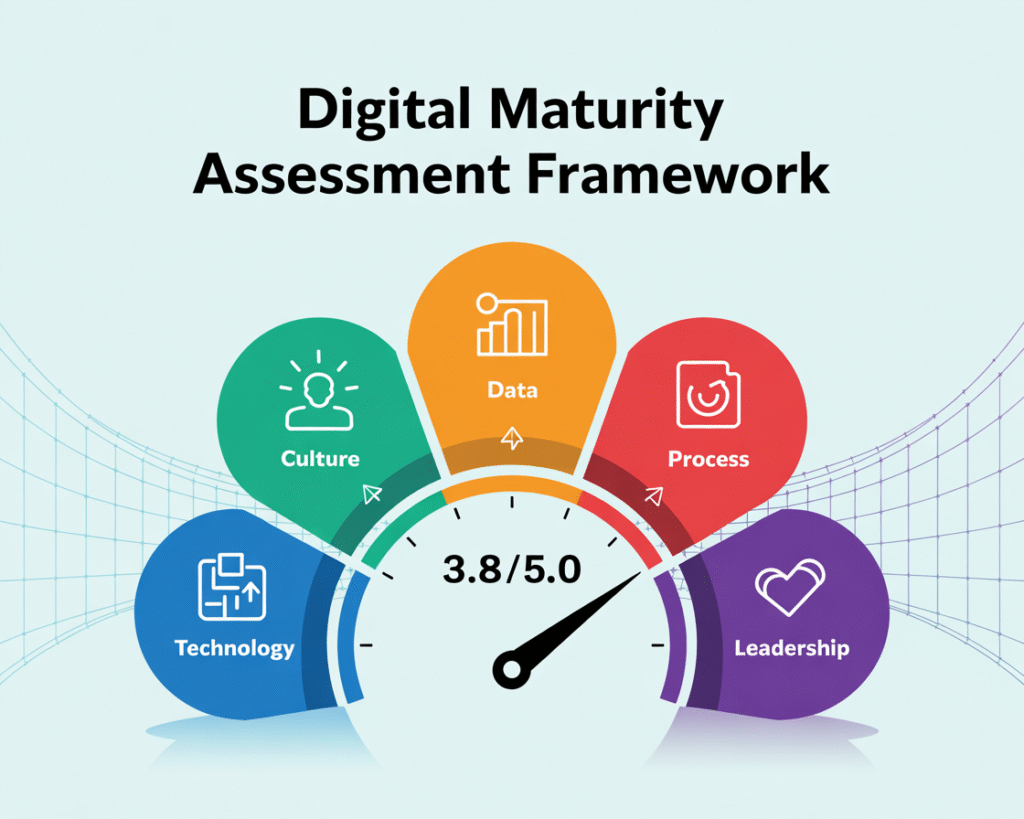
• The 5-dimensional framework that separates digital leaders from digital laggards
• Step-by-step assessment methodology used by Fortune 500 companies to benchmark their transformation readiness • Real case studies of organizations that transformed their digital maturity from 2.1 to 4.8 out of 5 within 18 months
• Hidden pitfalls that cause even well-funded digital initiatives to crash and burn
• Actionable roadmap creation based on your assessment results • Free and premium tools that can jumpstart your digital maturity evaluation today
Whether you’re a CEO planning your first digital transformation or a CTO trying to understand why your last initiative didn’t deliver expected results, this guide will arm you with the insights needed to succeed where others have failed.
What is Digital Maturity Assessment? Understanding the Foundation
A digital maturity assessment is your organization’s GPS for navigating the complex terrain of digital transformation. Think of it as a comprehensive health check-up, but instead of examining your body, it evaluates your company’s ability to successfully adopt, integrate, and leverage digital technologies to achieve business objectives.
According to the Institute for Digital Transformation, only 16% of employees believe their company’s digital reforms have enhanced productivity and created sustainable long-term value. This staggering statistic reveals a fundamental truth: most organizations are implementing digital solutions without understanding their baseline capabilities.
Digital Maturity vs Digital Transformation: Key Differences
Here’s where many leaders get confused. Digital transformation is the journey—the actual implementation of new technologies, processes, and cultural changes. Digital maturity, however, is your organization’s readiness and capability to undertake that journey successfully.
Consider this analogy: if digital transformation is like climbing Mount Everest, digital maturity assessment is evaluating whether you have the right equipment, physical fitness, weather conditions, and team expertise before attempting the climb. McKinsey research shows that 70% of transformation failures occur because organizations weren’t properly prepared—not because they chose the wrong technology.
The Cost of Poor Digital Readiness Assessment
The financial impact of skipping proper digital maturity assessment is brutal. According to Deloitte’s latest study, companies that don’t conduct thorough readiness evaluations experience:
• 45% higher project costs due to unexpected complexities and rework
• 60% longer implementation timelines because of unforeseen organizational resistance
• 30% lower ROI in the first two years post-implementation
• 25% higher employee turnover during transformation periods
One Fortune 500 manufacturing company learned this lesson the hard way. They invested $50 million in an ERP transformation without assessing their digital maturity. Result? The project failed after 18 months, with only 30% of planned functionality implemented. A post-mortem revealed that basic data governance structures, change management capabilities, and technical infrastructure weren’t mature enough to support the transformation.
The Alarming Reality: Why 87% of Digital Transformations Fail
The statistics are sobering. Despite unprecedented investment in digital technologies, between 70% and 95% of digital transformation initiatives fail to achieve their stated objectives. But why do smart organizations with deep pockets consistently stumble?
According to the latest research from McKinsey, cultural and behavioral challenges account for 33% of all failures. When combined with organizational structure issues, rigid processes, and lack of understanding, the picture becomes clear: organizations aren’t technically ready for change.
Real Case Studies of Failed Digital Transformations
Case Study 1: Global Retail Chain’s $200M Mistake A major international retailer invested $200 million in omnichannel transformation without conducting proper digital maturity assessment. The company assumed their existing infrastructure could handle the integration of online and offline systems. Within 12 months, the project was abandoned due to:
- Legacy systems that couldn’t communicate with new platforms
- Staff lacking digital skills to operate new technologies
- Customer data scattered across 47 different systems
- No unified governance structure for decision-making
Case Study 2: Healthcare Network’s Integration Nightmare A regional healthcare network with 23 hospitals attempted to digitize patient records and implement AI-driven diagnostic tools. Despite having a $150 million budget, the initiative collapsed because:
- 82% of staff reported feeling unprepared for new technologies
- Existing data quality was too poor to train AI algorithms effectively
- Regulatory compliance frameworks weren’t digitally mature enough
- Leadership lacked unified vision for digital transformation
These failures weren’t due to technology limitations—they happened because organizations overestimated their digital readiness.
The $3.4 Trillion Digital Transformation Market Reality
The global digital transformation market is exploding, with spending projected to reach $3.4 trillion by 2026. However, this massive investment is creating a dangerous illusion that technology alone drives successful transformation.
Research from Gartner reveals that 89% of companies have adopted or plan to adopt a digital-first business strategy, yet only 21% of organizations state that their entire C-Suite takes responsibility for overseeing digital transformation initiatives. This leadership gap is creating transformation efforts that lack strategic alignment and proper readiness assessment.
The harsh truth? Companies are treating digital transformation like a shopping spree instead of a strategic capability-building exercise. They’re buying solutions before understanding their problems, leading to the astronomical failure rates we see today.
5 Core Dimensions of Digital Maturity Assessment Framework
Successful digital maturity assessment isn’t about checking boxes—it’s about understanding your organization’s capability across five critical dimensions. Organizations scoring above 3.5 out of 5 across all dimensions are 78% more likely to achieve successful digital transformation outcomes.
Technology Infrastructure Readiness
Your technology foundation determines how quickly and effectively you can implement digital solutions. According to Cisco’s Digital Readiness Index, 92% of leaders worldwide report their companies have adopted cloud technology, but only 43% have achieved full integration across their technology stack.
Key Assessment Areas:
- Legacy System Integration Capability: Can your existing systems communicate with modern platforms?
- Data Architecture Maturity: Is your data accessible, clean, and analytics-ready?
- Cybersecurity Posture: 82% of IT executives experienced at least one data breach during digital transformation
- Scalability and Performance: Can your infrastructure handle increased digital demand?
- Cloud Readiness: Are you ready for hybrid, multi-cloud environments?
A leading financial services company discovered their technology infrastructure scored only 2.1 out of 5 during assessment. Instead of proceeding with their planned $75 million digital banking platform, they invested 8 months strengthening their foundation. Result? Their eventual digital transformation was completed 40% faster and 25% under budget.
Digital Culture and Employee Preparedness
Culture kills more digital transformations than technology ever will. Research shows that 54% of employees feel unprepared to handle changes brought by new technologies, yet 70% of companies focus primarily on technical aspects during planning.
Critical Cultural Indicators:
- Change Adaptability: How quickly does your organization embrace new ways of working?
- Digital Skills Distribution: 36% of leaders worry their workforce lacks digital transformation skills
- Innovation Mindset: Are employees encouraged to experiment with digital solutions?
- Collaboration Across Silos: Can different departments work together effectively?
- Leadership Digital Fluency: Do your leaders understand digital technologies beyond surface level?
Data and Analytics Capabilities
Data is the fuel of digital transformation, yet fewer than 50% of corporate strategies identify data and analytics as critical to delivering enterprise value. Organizations with mature data capabilities see 19% higher revenue growth compared to those with immature data practices.
Assessment Components:
- Data Quality and Governance: Is your data accurate, consistent, and trustworthy?
- Analytics Infrastructure: Can you process and analyze data in real-time?
- Data-Driven Decision Making: Are decisions based on insights or intuition?
- Privacy and Compliance: Do you meet GDPR, CCPA, and industry-specific requirements?
- Predictive Capabilities: Can you anticipate trends and customer behavior?
Business Process Digital Integration
70% of organizations prioritize using technology to simplify workflows and manual processes. However, successful digital maturity requires more than automation—it demands complete process reimagination.
Integration Maturity Markers:
- End-to-End Process Visibility: Can you track processes from start to finish?
- Automation Sophistication: Are you using RPA, AI, or intelligent automation?
- Customer Journey Integration: Are all touchpoints connected and consistent?
- Supplier and Partner Connectivity: Can external stakeholders easily integrate with your systems?
- Process Agility: How quickly can you modify workflows when needs change?
Leadership and Governance Maturity
Companies with an actively involved Chief Digital Officer are 6 times more likely to achieve successful digital transformation. Yet 28% of digital transformation initiatives are still owned by CIOs rather than having proper C-Suite governance.
Governance Assessment Areas:
- Digital Strategy Alignment: Is digital transformation connected to business objectives?
- Resource Allocation: Are you investing adequately across all transformation areas?
- Risk Management: Do you understand and mitigate digital transformation risks?
- Performance Measurement: Can you track transformation progress effectively?
- Stakeholder Engagement: Are all departments aligned and committed to digital goals?
Step-by-Step Digital Readiness Assessment Process
Conducting an effective digital maturity assessment requires a systematic approach that goes beyond surface-level technology audits. Organizations following this structured methodology see 65% better transformation outcomes compared to those using ad-hoc assessment approaches.
Phase 1: Current State Analysis
The foundation of any meaningful assessment starts with brutally honest evaluation of where you stand today. This phase typically takes 4-6 weeks and involves multiple stakeholder groups across your organization.
Week 1-2: Data Collection and Stakeholder Interviews Begin by gathering quantitative data from your existing systems while conducting structured interviews with key stakeholders. Target 15-20 people across different departments, seniority levels, and functions. Focus on understanding:
- Current technology utilization rates
- Pain points in existing processes
- Digital skills confidence levels
- Previous transformation experiences
- Cultural resistance patterns
Week 3-4: Technology and Process Audit Dive deep into your technical infrastructure and business processes. Create a comprehensive inventory of:
- Software applications and their integration levels
- Data flows and storage systems
- Manual vs. automated processes
- Customer touchpoints and experiences
- Vendor relationships and dependencies
Assessment Tools and Methodologies:
- Digital Maturity Scoring Matrix: Rate each dimension from 1-5 using specific criteria
- Process Mapping: Visualize current workflows to identify digitization opportunities
- Skills Gap Analysis: Compare current capabilities with digital transformation requirements
- Technology Stack Assessment: Evaluate integration, scalability, and modernization needs
Phase 2: Gap Identification and Benchmarking
Once you understand your current state, the next phase focuses on identifying gaps and comparing your maturity against industry benchmarks. Companies that benchmark effectively are 2.3 times more likely to achieve above-average digital transformation results.
Industry Benchmarking Process: Research shows significant digital maturity variations across industries:
- Financial Services: Average digital maturity score of 3.8/5
- Technology: Average score of 4.2/5
- Manufacturing: Average score of 2.9/5
- Healthcare: Average score of 2.7/5
- Retail: Average score of 3.4/5
Compare your scores against these benchmarks while considering your organization’s size, resources, and competitive landscape.
Gap Prioritization Framework: Not all gaps are created equal. Prioritize based on:
- Business Impact: Which gaps affect customer experience or revenue most significantly?
- Implementation Complexity: What’s the effort required to close each gap?
- Resource Requirements: Do you have budget and people to address the gap?
- Risk Level: What happens if you don’t address this gap?
- Competitive Advantage: Will closing this gap differentiate you from competitors?
Phase 3: Roadmap Development
The final assessment phase transforms your findings into an actionable roadmap. Organizations with clear digital roadmaps are 67% more likely to achieve their transformation objectives within planned timelines.
Roadmap Components:
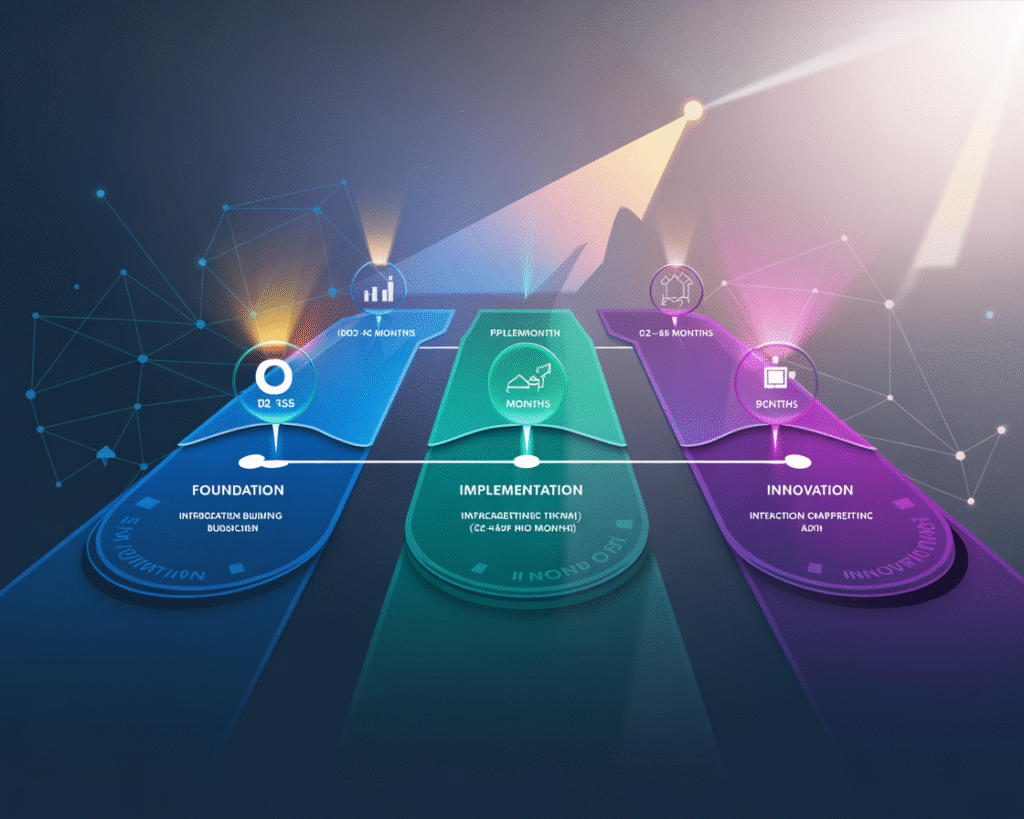
- Quick Wins (0-6 months): Low-effort, high-impact improvements
- Foundation Building (6-18 months): Infrastructure and capability development
- Transformation Initiatives (18-36 months): Major digital transformation projects
- Innovation Projects (ongoing): Continuous improvement and emerging technology adoption
Digital Maturity Assessment Tools and Methodologies
The right assessment tools can accelerate your evaluation process while ensuring comprehensive coverage of all maturity dimensions. 93% of workers across industries affirm that being digitally savvy is essential, making proper assessment tools critical for success.
Free vs Premium Assessment Platforms
Free Assessment Options: Several organizations offer complimentary digital maturity assessments that provide valuable starting points:
Google’s Digital Maturity Benchmark: Offers industry-specific assessments across customer experience, marketing, and technology dimensions. Results include comparative data against industry peers.
KPMG’s Connected Enterprise Assessment: Evaluates customer-centricity, operational efficiency, and digital capabilities. Provides customized reports with specific recommendations.
MIT’s Digital Business Assessment: Academia-backed framework focusing on digital intensity and transformation management capabilities.
Premium Assessment Platforms: For organizations requiring deeper analysis and ongoing monitoring:
Deloitte’s Digital Maturity Model: Comprehensive assessment covering strategy, technology, operations, culture, and workforce. Includes industry benchmarking and implementation support.
Accenture’s Digital Transformation Assessment: AI-powered evaluation with predictive analytics for transformation success probability.
McKinsey’s Digital Capability Assessment: Focuses on organizational capabilities needed for sustained digital success.
Industry-Specific Assessment Frameworks
Different industries require specialized assessment approaches due to unique regulatory, operational, and competitive requirements.
Manufacturing Digital Maturity:
- Industry 4.0 Readiness: Smart factory capabilities, IoT integration, predictive maintenance
- Supply Chain Digitization: End-to-end visibility, supplier integration, demand forecasting
- Quality Management Systems: Digital quality control, compliance automation, traceability
Healthcare Digital Assessment:
- Electronic Health Records: Interoperability, data quality, patient privacy
- Clinical Decision Support: AI integration, evidence-based protocols, outcome tracking
- Patient Experience: Digital touchpoints, telemedicine capabilities, engagement tools
Financial Services Framework:
- Digital Banking: Omnichannel experience, mobile-first design, API integration
- Regulatory Technology: Compliance automation, risk management, reporting capabilities
- Customer Analytics: Personalization, fraud detection, behavioral insights
Real Success Stories: Companies That Got Digital Maturity Right
Learning from organizations that successfully navigated digital transformation provides valuable insights into the power of proper digital maturity assessment. These case studies demonstrate how systematic evaluation leads to breakthrough results.
Case Study 1: Manufacturing Giant’s Digital Transformation
Company: Global automotive parts manufacturer with 45,000 employees across 23 countries
Challenge: Aging infrastructure, disconnected operations, and increasing competition from digital-native competitors
Assessment Results: Initial digital maturity score of 2.3/5
- Technology Infrastructure: 2.1/5 (legacy systems, poor integration)
- Digital Culture: 1.9/5 (high resistance to change)
- Data Capabilities: 2.8/5 (siloed data, limited analytics)
- Process Integration: 2.4/5 (manual workflows, paper-based systems)
- Leadership Maturity: 2.3/5 (limited digital understanding)
Transformation Strategy: Based on assessment findings, the company implemented a three-phase approach:
Phase 1 (Months 1-8): Foundation Building
- Invested $25 million in cloud infrastructure migration
- Launched digital skills training for 8,000 employees
- Established data governance framework
- Created cross-functional digital transformation team
Phase 2 (Months 9-20): Process Digitization
- Implemented IoT sensors across 120 manufacturing lines
- Deployed predictive maintenance system reducing downtime by 34%
- Automated quality control processes using computer vision
- Integrated supply chain systems for real-time visibility
Phase 3 (Months 21-36): Advanced Analytics and AI
- Developed AI-powered demand forecasting improving accuracy by 28%
- Implemented autonomous inventory management
- Created digital twin models for production optimization
- Launched customer portal for real-time order tracking
Results After 36 Months:
- Digital maturity score increased to 4.6/5
- $78 million in cost savings through operational efficiency
- 22% reduction in production lead times
- 89% employee satisfaction with new digital tools
- 15% increase in customer satisfaction scores
Case Study 2: Financial Services Digital Evolution
Company: Regional bank with $12 billion in assets serving 2.3 million customers
Challenge: Losing market share to fintech competitors, outdated customer experience, regulatory compliance issues
Initial Assessment Score: 2.8/5
- Technology Infrastructure: 3.2/5 (decent core banking, poor integration)
- Digital Culture: 2.1/5 (traditional banking mindset)
- Data Capabilities: 3.4/5 (good data collection, limited insights)
- Process Integration: 2.6/5 (fragmented customer journey)
- Leadership Maturity: 2.9/5 (some digital awareness, lacking strategy)
Transformation Approach: The assessment revealed that while technical infrastructure was relatively strong, cultural and process barriers were major impediments.
Cultural Transformation Initiative:
- Created “Digital Champions” program across 150 branches
- Implemented agile working methodologies
- Established innovation labs in 5 major markets
- Launched internal digital transformation success stories campaign
Customer Experience Overhaul:
- Redesigned mobile banking app increasing usage by 156%
- Implemented AI-powered chatbot handling 67% of customer inquiries
- Created unified customer data platform
- Launched personalized financial wellness tools
Process Reengineering:
- Digitized loan application process reducing approval time from 14 days to 2 hours
- Automated compliance reporting saving 2,400 hours annually
- Implemented real-time fraud detection reducing losses by 43%
- Created seamless omnichannel experience across all touchpoints
Results After 24 Months:
- Digital maturity score reached 4.4/5
- 31% increase in customer acquisition
- $45 million in operational cost savings
- Net Promoter Score improved from 32 to 67
- 0 regulatory compliance violations (down from 23 in previous period)
Case Study 3: Retail Chain’s Omnichannel Success
Company: Fashion retailer with 580 stores and growing e-commerce presence Challenge: Siloed online and offline experiences, inventory management issues, declining store traffic
Assessment Baseline: 3.1/5 overall maturity
- Technology Infrastructure: 3.5/5 (modern POS, legacy warehouse systems)
- Digital Culture: 2.8/5 (mixed digital adoption)
- Data Capabilities: 2.9/5 (fragmented customer data)
- Process Integration: 2.7/5 (disconnected channels)
- Leadership Maturity: 3.6/5 (strong digital vision)
Omnichannel Transformation: The assessment revealed that while leadership commitment was strong, operational integration was lacking. The company focused on creating seamless customer experiences.
Unified Commerce Platform:
- Implemented single inventory management system across all channels
- Created “buy online, pick up in store” capability
- Launched virtual styling services connecting online customers with in-store stylists
- Developed unified customer profile accessible by all touchpoints
Data-Driven Personalization:
- Deployed AI-powered recommendation engine increasing average order value by 27%
- Implemented dynamic pricing based on inventory levels and demand
- Created targeted marketing campaigns using unified customer data
- Launched loyalty program with gamification elements
Store Experience Innovation:
- Installed smart mirrors with virtual try-on capabilities
- Implemented mobile POS for anywhere-in-store checkout
- Created digital wardrobes for VIP customers
- Launched augmented reality size and fit recommendations
Results After 18 Months:
- Digital maturity score increased to 4.7/5
- 38% increase in omnichannel customer lifetime value
- 23% reduction in inventory holding costs
- Online sales grew 89% while maintaining store revenue
- Customer satisfaction scores improved from 3.2 to 4.6/5
Common Digital Maturity Assessment Mistakes (And How to Avoid Them)
Even well-intentioned organizations make critical errors during digital maturity assessment that can derail entire transformation initiatives. Research shows that 63% of assessment failures stem from these common mistakes.
Mistake 1: Technology-Only Focus The Problem: 78% of organizations evaluate only technical capabilities while ignoring cultural, process, and leadership dimensions. The Reality: Technology accounts for only 30% of digital transformation success. Culture, change management, and leadership contribute 70% of the outcome. The Solution: Use balanced scorecards covering all five maturity dimensions equally. Spend 50% of assessment time on non-technical factors.
Mistake 2: Leadership Echo Chamber The Problem: Conducting assessments only with senior executives who may be disconnected from operational realities. The Impact: 67% of leadership teams overestimate their organization’s digital readiness by at least one maturity level. The Solution: Include frontline employees, middle management, and customer-facing staff in assessment interviews. Their insights often reveal critical gaps that leadership misses.
Mistake 3: Benchmarking Against Wrong Peers The Problem: Comparing your organization to companies in different industries, sizes, or market conditions. The Risk: Setting unrealistic expectations or missing opportunities for competitive advantage. The Solution: Benchmark against 3-5 similar organizations in your industry, market size, and geographic region. Consider both leaders and laggards for complete perspective.
Mistake 4: Snapshot vs. Continuous Assessment The Problem: Treating digital maturity assessment as a one-time activity rather than ongoing capability. The Reality: Digital landscapes change rapidly. Assessment results become outdated within 6-12 months. The Solution: Implement quarterly mini-assessments focusing on specific dimensions. Conduct comprehensive annual reviews to track progress and identify new gaps.
Mistake 5: Perfectionism Paralysis The Problem: Waiting for perfect assessment before starting any digital initiatives. The Consequence: Organizations delay transformation by an average of 8 months seeking complete understanding. The Solution: Follow the 80/20 rule. Start transformation initiatives when you have 80% confidence in your assessment. Learn and adjust as you progress.
Creating Your Digital Transformation Roadmap Based on Assessment Results
Your digital maturity assessment is only valuable if it translates into actionable transformation initiatives. Organizations with clear roadmaps are 4.2 times more likely to achieve their digital transformation objectives.
Step 1: Prioritize Based on Impact and Effort Create a impact vs. effort matrix plotting all identified gaps and opportunities:
- High Impact, Low Effort (Quick Wins): Implement immediately
- High Impact, High Effort (Major Projects): Plan for next 12-24 months
- Low Impact, Low Effort (Nice to Have): Consider if resources allow
- Low Impact, High Effort (Avoid): Deprioritize or eliminate
Step 2: Sequence for Maximum Success Research shows that transformation success rates increase by 43% when initiatives follow logical sequencing:
- Foundation First: Address infrastructure and basic digital skills
- Process Optimization: Streamline and automate existing workflows
- Customer Experience: Enhance external-facing capabilities
- Innovation Initiatives: Experiment with emerging technologies
Step 3: Resource Allocation Strategy Successful digital transformations typically allocate resources using the 70-20-10 principle:
- 70%: Core transformation initiatives addressing major gaps
- 20%: Adjacent improvements and capability building
- 10%: Experimental projects and emerging technology exploration
Step 4: Success Metrics and Milestones Define specific, measurable outcomes for each roadmap phase:
- Financial Metrics: ROI, cost savings, revenue growth
- Operational Metrics: Efficiency gains, process improvements, automation levels
- Customer Metrics: Satisfaction scores, engagement rates, experience improvements
- Employee Metrics: Digital skills progression, adoption rates, satisfaction
Measuring Success: KPIs for Digital Maturity Progress
Tracking digital maturity progress requires a balanced approach combining leading indicators (predictive) and lagging indicators (outcome-based). Organizations using comprehensive KPI frameworks are 2.8 times more effective at sustaining digital transformation momentum.
Technology Infrastructure KPIs
- System Integration Score: Percentage of systems with seamless data exchange
- Cloud Adoption Rate: Workloads migrated to cloud platforms
- API Utilization: Number of active integrations and data connections
- Infrastructure Scalability: Ability to handle 3x current data volumes
- Cybersecurity Posture: Security assessment scores and incident frequency
Digital Culture and Employee Metrics
- Digital Skills Confidence: Employee self-assessment scores across digital competencies
- Training Completion Rates: Percentage of staff completing digital skills programs
- Innovation Participation: Employees actively contributing improvement ideas
- Change Adaptation Speed: Time required to adopt new digital tools
- Internal Net Promoter Score: Employee advocacy for digital transformation
Data and Analytics Maturity
- Data Quality Index: Accuracy, completeness, and consistency scores
- Decision-Making Speed: Time from data insight to business action
- Analytics Adoption: Percentage of decisions backed by data insights
- Predictive Accuracy: Forecast precision across key business metrics
- Self-Service Analytics: Non-technical users accessing data independently
Business Process Integration
- Process Automation Rate: Percentage of workflows automated
- End-to-End Visibility: Complete process tracking capability
- Customer Journey Completion: Seamless experience across touchpoints
- Process Cycle Time: Speed improvements in key workflows
- Error Reduction: Quality improvements through digitization
Leadership and Governance Effectiveness
- Strategic Alignment: Digital initiatives connected to business objectives
- Budget Allocation: Investment distribution across maturity dimensions
- Stakeholder Engagement: Cross-functional collaboration effectiveness
- Risk Management: Proactive identification and mitigation of digital risks
- Performance Monitoring: Regular tracking and course correction capabilities
Frequently Asked Questions
How long does a comprehensive digital maturity assessment take?
A thorough digital maturity assessment typically requires 4-6 weeks for organizations with fewer than 1,000 employees and 8-12 weeks for larger enterprises. This includes stakeholder interviews, data collection, analysis, and report generation. However, you can get preliminary insights using online assessment tools in as little as 30 minutes.
What’s the difference between digital maturity and digital transformation?
Digital maturity measures your organization’s current capability and readiness to successfully adopt digital technologies. Digital transformation is the actual process of implementing new technologies, processes, and cultural changes. Think of maturity as your “fitness level” and transformation as the “training program.”
How often should we conduct digital maturity assessments?
Most organizations benefit from comprehensive annual assessments with quarterly mini-assessments focusing on specific areas. Given the rapid pace of digital change, assessment results can become outdated within 12-18 months. Companies undergoing active transformation should assess progress every 6 months.
Can small businesses benefit from digital maturity assessments?
Absolutely. Small and medium enterprises (SMEs) actually benefit more from digital maturity assessments because they have limited resources and can’t afford failed digital initiatives. Many assessment tools offer SME-specific frameworks that account for resource constraints and simpler organizational structures.
What’s a good digital maturity score?
Digital maturity scores typically range from 1-5, with 3.0 considered “industry average” and 4.0+ indicating “digital leader” status. However, scores should be evaluated relative to your industry, company size, and competitive landscape. A manufacturing company scoring 3.2 might be ahead of most peers, while a technology company needs 4.0+ to remain competitive.
How much should we budget for digital maturity assessment?
Professional assessments range from $25,000-$150,000 depending on organization size and scope. However, many valuable assessments can be conducted internally using free or low-cost tools. Budget approximately 0.5-1% of your planned digital transformation investment for comprehensive assessment activities.
Who should lead the digital maturity assessment process?
The most successful assessments are led by cross-functional teams including representatives from IT, operations, HR, finance, and customer experience. While CIOs often coordinate the process, CEO sponsorship is critical for honest participation and meaningful results.
What happens if our digital maturity score is low?
Low scores aren’t failures—they’re valuable insights that can save you from costly mistakes. Organizations starting with lower maturity scores often achieve better transformation ROI because they focus on foundational improvements before advanced initiatives. Use low scores as motivation to build proper foundations for future success.
How do we get employee buy-in for honest assessment participation?
Transparency and psychological safety are crucial. Emphasize that assessment results will be used for improvement, not punishment. Share the business case for digital transformation and how it benefits employees. Consider using anonymous surveys for sensitive topics and communicate results transparently to build trust.
Can we use multiple assessment frameworks simultaneously?
Yes, but be strategic. Using 2-3 complementary frameworks can provide broader perspective, but more than that creates confusion and assessment fatigue. Consider combining a comprehensive general framework with an industry-specific assessment for optimal insights.