Agentic AI in business process optimization is the practice of deploying autonomous AI agents to continuously analyse, execute, and self-improve an organisation’s operational workflows — without waiting for human instruction at every step. To understand why this matters, both terms deserve a precise definition
Business process optimization is the careful design and refinement of workflows to maximize productivity, minimize waste, and drive impactful outcomes — achieved by fine-tuning the orchestration of people, procedures, tools, and methods to eliminate inefficiencies, reduce redundancies, and accelerate delivery. (Reference:Intelligent CIO LATAM)
For decades, that fine-tuning had a hard ceiling: every efficiency gain still depended on human decision-making at the critical junctions — the exceptions, the escalations, the judgement calls. Agentic AI removes that ceiling. With agentic AI, operations autonomously learn, adapt, and optimise in real time — not just faster and more efficient, but intelligent agents that proactively anticipate challenges, personalize experiences, and drive innovation.(Reference: Processexcellencenetwork)
The shift is not incremental. It is a move from systems of record to systems of action — where AI agents go beyond support to interpret signals, uncover patterns, initiate actions, and continuously optimize processes on your behalf. (Reference:Strategyintheclouds) That is what agentic AI in business process optimization actually means — and it is why every operational leader needs to understand it now.
The length of tasks that AI can reliably complete has doubled approximately every seven months since 2019 — and every four months since 2024. (Reference:Microsoft) We have crossed the threshold where AI no longer just assists with tasks. It owns them — end to end, without supervision, and with growing precision. That shift has a name: agentic AI in business process optimization. And it is rewriting the rules of operational efficiency faster than most businesses realize.
This guide explains exactly what it is, how it works, where it delivers the greatest ROI, and how to implement it without the 40% failure rate that derails unprepared organizations.

What Is Agentic AI in Business Process Optimization?
Agentic AI refers to AI systems that autonomously pursue goals, execute multi-step tasks, make real-time decisions, and self-correct — all without constant human input. In the context of business process optimization, that means AI agents that don’t just respond to instructions but actively manage entire workflows from start to finish.
The distinction matters enormously. Unlike traditional automation that performs predefined tasks, agentic AI operates with flexibility, autonomy, and intelligence. It makes independent decisions, adapts to shifting priorities, and actively pursues objectives without waiting for human input. (Reference:cloudkeeper)
Think about what that means practically. A traditional automation tool follows a script. An AI agent reads the situation, chooses the right action, executes it, evaluates the outcome, and adjusts — in a continuous loop. It moves from being a system of record to a system of action: interpreting signals, uncovering patterns, and continuously optimising processes on your behalf.(Reference: CIO)
The adoption curve confirms this is no longer theoretical. While 30% of organisations are currently exploring agentic options and 38% are piloting solutions, only 14% have systems ready to deploy and just 11% are actively in production. (Reference:Processexcellencenetwork) The window to build a meaningful lead is open — but not indefinitely.
Agentic AI vs. RPA vs. Intelligent Process Automation: Key Differences
| Capability | RPA | Intelligent Process Automation | Agentic AI |
|---|---|---|---|
| Decision-making | Rule-based only | Predictive, limited | Autonomous, contextual |
| Handles exceptions | ❌ Breaks down | ⚠️ With human help | ✅ Self-resolves |
| Learns over time | ❌ | ⚠️ Limited | ✅ Continuously |
| Multi-system coordination | ⚠️ Scripted | ⚠️ Partial | ✅ Native |
| Works without supervision | ❌ | ⚠️ Partial | ✅ Yes |
RPA was a giant leap forward. Agentic AI makes it look like a calculator.
How Agentic AI Optimizes Business Processes: The Autonomous Workflow Loop
Here is the fundamental shift: traditional automation asks “what step comes next?” Agentic AI asks “what outcome am I trying to achieve?” That reorientation — from task execution to goal pursuit — is what makes autonomous workflow orchestration so powerful.
AI agents continuously analyse real-time data, detect anomalies, and take corrective actions without waiting for human intervention, ensuring operations remain resilient and responsive.(Reference: Nextgov.com) They integrate seamlessly across ERP, CRM, data warehouses, and cloud platforms, eliminating the silos that have always been the enemy of true process efficiency.
The practical result: 64% of AI agent deployments are focused on automating workflows across support, HR, sales operations, and administrative tasks (Reference:Strategyintheclouds) — not isolated point solutions, but connected, end-to-end process ownership.
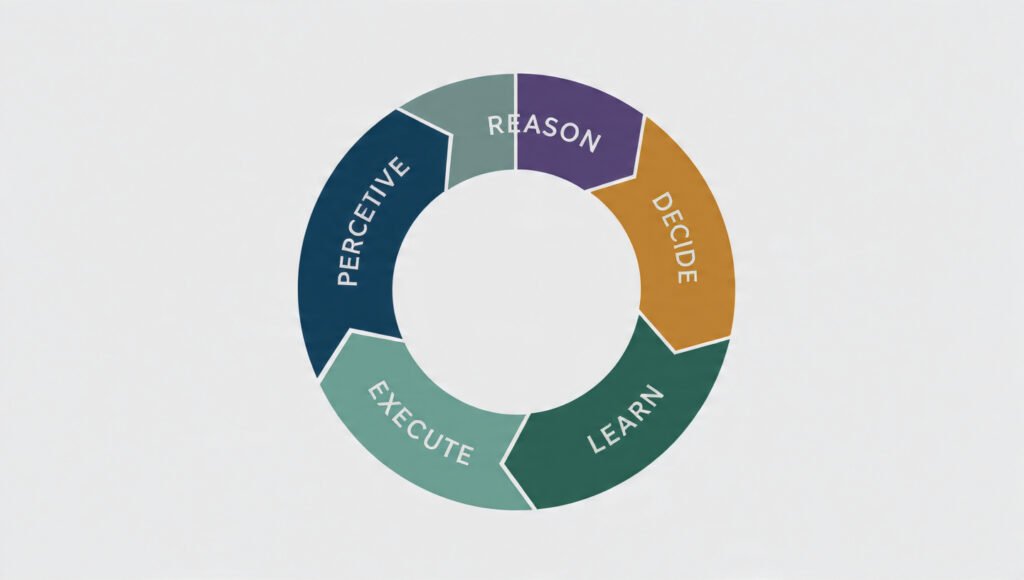
From Perception to Execution: How AI Agents Handle Multi-Step Business Workflows
Every AI agent operates in the same continuous cycle: Perceive → Reason → Decide → Execute → Learn. What makes agentic systems different is that this loop runs autonomously, at scale, across multiple systems simultaneously.
A procurement agent doesn’t wait for you to notice a supplier risk. It monitors news feeds, contract terms, and market prices in real time. When it detects a disruption, it identifies alternatives, evaluates them against your criteria, and either executes a switch or flags the decision for human approval — whichever you have configured. The entire multi-step workflow happens without a single email from you.
AI systems could potentially complete four days of work without supervision by 2027 — an evolution from intern-level employee requiring constant supervision to a mid-tenure employee who can operate independently. (Reference:Microsoft) That is the trajectory your operational planning needs to account for now.
Human-in-the-Loop: Where People Remain Essential in Autonomous Operations
Agentic AI does not remove humans from the process. It repositions them. Companies should maintain an architectural North Star but sustain progress with fit-for-purpose, domain-specific, and human-in-the-loop builds — particularly for decisions where context, judgement, and accountability matter. (Reference:UiPath)
The data backs this up as a performance differentiator, not just a safety measure. Organisations that get this balance right significantly outperform those that do not. The winning model is clear: agents handle execution; humans own strategy, exceptions, and outcomes governance.
Agentic AI Use Cases: Business Process Optimization Across Core Functions
Abstract capability means nothing without concrete results. Here is where agentic AI is delivering measurable process transformation right now — across the functions that drive most operational cost and customer experience.
Finance and Accounting: Autonomous Invoice Processing and Intelligent Reconciliation
Finance is the highest-density opportunity for agentic AI. Invoice processing, reconciliation, fraud detection, and financial close are all high-volume, rules-intensive, data-heavy workflows — exactly the conditions where autonomous agents outperform human teams.
AI agents validate transactions, match invoices across systems, flag anomalies, automate journal entries, and escalate genuine exceptions — not routine processing noise. The IBM IBV research confirms finance leaders project accounts payable cycle times improving by 35% and forecast accuracy by 24% through agentic AI by 2026. Organisations are achieving up to 70% cost reduction by automating finance workflows with agentic AI systems.(Reference: Processexcellencenetwork)
Customer Service: End-to-End Autonomous Process Automation at Scale
McKinsey estimates AI could reduce human-serviced customer contacts by up to 50% in banking, telecommunications, and utilities.(Reference: Intelligent CIO LATAM) But the more important metric is what happens to the contacts that remain. With agents handling the routine — order status, returns, FAQs, account changes — human service teams redirect entirely toward complex, high-value customer relationships. One company with 5,000 customer service agents achieved a 14% increase in issue resolution per hour and a 9% reduction in handling time. (Reference:Intelligent CIO LATAM) Those numbers compound fast at scale.
For a deeper breakdown of agentic AI in this function, read our complete Agentic AI Customer Service Automation Guide.
Supply Chain and Procurement: Self-Optimising Workflows and Real-Time Sourcing
Supply chains have many disparate systems, humans across specialised roles, and manual processes. Agents are always on, can bridge multiple systems, and can both reason and understand the data.(Reference: Electromech) That combination — 24/7 availability, multi-system reasoning, real-time data processing — makes supply chain one of the highest-ROI applications for agentic AI.
Procurement agents monitor supplier risk, market pricing, and compliance requirements simultaneously. When conditions shift, they act — recommending alternative sources, drafting contract changes, and updating purchase orders — while procurement professionals focus on strategic supplier relationships and innovation partnerships, not operational firefighting.
HR and Operations: Predictive Workforce Planning and Touchless Process Execution
IBM IBV research confirms HR leaders project agentic AI will improve employee productivity by 35% and recruitment will move to 62% touchless automation by 2027. Agents manage the talent acquisition lifecycle — from forecasting demand to screening candidates to onboarding coordination — while HR professionals focus on culture, development, and the complex human decisions that no model should make alone.
The Business Case: Measuring ROI from Agentic AI Workflow Automation
Let’s put real numbers on this. 57% of organisations adopting AI agents report cost savings, 55% report faster decision-making, and 54% report improved customer experience.(Reference: Nextgov.com) These are not pilot-stage projections — they are reported outcomes from live deployments.
The aggregate ROI picture is compelling. Organisations project an average 171% return from agentic AI deployments, with U.S. enterprises forecasting 192% — exceeding traditional automation ROI by 3×. 66% of organisations adopting AI agents say they are already delivering measurable value through increased productivity. (Reference:Nextgov.com)
One important caveat that builds rather than erodes trust: of organisations already using agentic AI, only 10% report significant ROI today — but half expect substantial returns within three years. (Reference:Processexcellencenetwork) This is not a quick fix. It is a compounding investment. The businesses starting now are building the data, governance, and operational muscle that will translate into durable competitive advantage — not a one-quarter efficiency bump.
Key Performance Metrics: What to Measure Before and After Deployment
Do not start an agentic AI deployment without baselining these metrics first:
- Cycle time — end-to-end process duration before and after agent deployment
- Error rate — manual errors per 1,000 transactions vs. agent-managed
- Touchless rate — percentage of transactions completing without human intervention
- Cost per transaction — fully loaded, including oversight time
- Employee hours redirected — time freed from execution tasks and reinvested in strategic work
- Customer satisfaction — NPS or CSAT for agent-managed touchpoints
These six metrics tell the full ROI story — cost reduction, quality improvement, and strategic capacity gain together.
How to Implement Agentic AI for Business Process Optimization: A 4-Phase Roadmap
40% of agentic AI projects fail due to inadequate infrastructure and governance foundations. (Reference:Processexcellencenetwork) That failure rate is entirely preventable. Every one of those failures shares a common cause: organisations deployed agents on top of broken processes, dirty data, or absent governance. The roadmap below is designed to eliminate each of those failure modes before they occur.
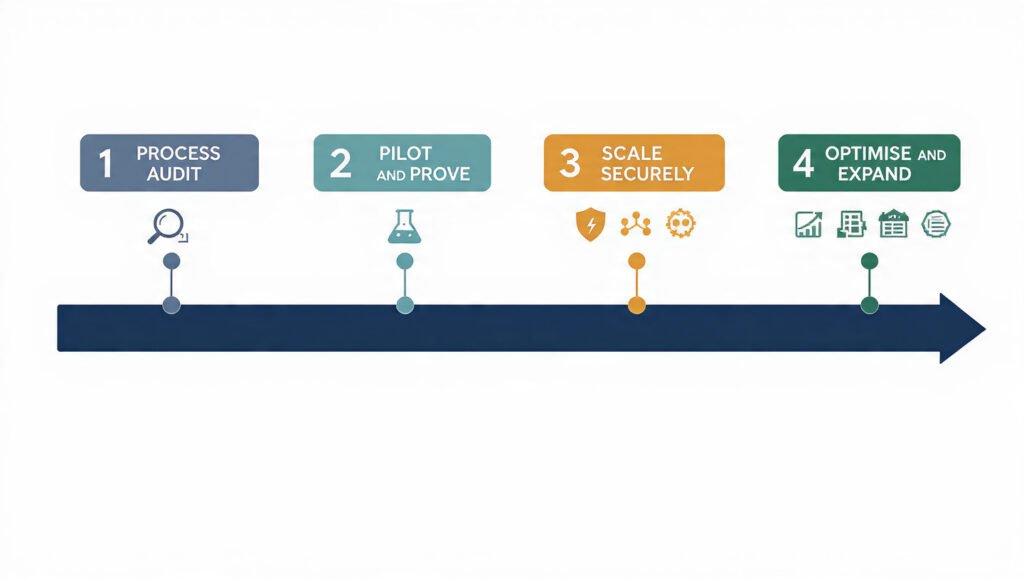
Phase 1 — Process Audit: Identify Which Workflows Are Ready for Autonomous AI
Start with an honest inventory of your processes. The best candidates share four characteristics: high volume, rules-intensive decision-making, significant manual handling time, and measurable outcomes. Processes involving complex decision trees, high volumes of data, and repetitive yet nuanced tasks benefit most — including customer service, back-office operations, and supply chain management. (Reference:cloudkeeper)
Score each candidate process on impact (time saved × volume) versus complexity (data readiness, system integration requirements). Start at the top-right of that matrix — high impact, lower complexity. Quick wins build the organisational confidence and learning that harder deployments require later.
Phase 2 — Pilot and Prove: Running a Controlled Agentic AI Proof of Concept
In 2025, 65% of U.S. C-suite leaders have progressed from early experimentation into fully-fledged AI agent pilot programmes — up from 37% the previous quarter. (Reference:UiPath) The pilot stage is where most organisations currently sit. The difference between pilots that scale and pilots that stall is almost always measurement discipline.
Define your success metrics before launch — not after. Set a 30–60 day evaluation window. Establish a clear threshold: if the agent achieves X% accuracy and Y% cycle time reduction, it proceeds to full deployment. If not, you refine. That binary decision framework prevents pilots from drifting into perpetual “evaluation” mode that delivers no organisational value.
Phase 3 — Scale Securely: AI Governance, Data Management, and Agent Oversight
This is where most failures happen. Nearly half of organisations cite searchability of data (48%) and reusability of data (47%) as challenges to their AI automation strategy.(Reference: Processexcellencenetwork) And nearly 60% of AI leaders cite legacy systems and compliance issues as the main barriers to scaling agentic AI.
Governance is not optional at this stage — it is the foundation. Assign named human accountability for every agent’s actions. Build audit trails into every workflow. Manage agent identities through your existing IAM framework. As agents operate continuously, governance must become real time, data driven, and embedded — with humans holding final accountability.(Reference: Microsoft) That principle is non-negotiable. Agents that operate without it are a liability, not an asset.
Agentic AI Readiness for Business Process Optimization: A Quick Self-Assessment
Before you begin, be honest about where you stand. 88% of senior executives plan to increase AI-related budgets in the next 12 months specifically because of agentic AI (Reference:Nextgov.com) — the competitive pressure is real. But deployment without readiness compounds problems rather than solving them.
Use this checklist:
- ✅ Process clarity — Can you document the target workflow step by step today?
- ✅ Data accessibility — Is the data your agents need centralised, clean, and queryable?
- ✅ Integration capability — Do your core systems (ERP, CRM) support API-level connection?
- ✅ Governance framework — Do you have a human accountability structure for AI decisions?
- ✅ Pilot discipline — Do you have defined success metrics before you deploy?
- ✅ Change readiness — Has your team been briefed on how roles shift, not disappear?
If you answered yes to four or more: you are ready to begin. Start your process audit this week.
If you answered yes to fewer than four: invest the next 30 days closing the gaps above. A well-prepared deployment in 60 days outperforms a rushed one that fails and has to restart.
93% of business leaders believe organisations that successfully scale AI agents within the next 12 months will gain a competitive advantage over peers that do not.(Reference: Microsoft )The technology is production-ready. The pricing is accessible. The implementation path is clear.
The only remaining variable is the decision to start.
For a practical guide to deploying agentic AI in a resource-constrained environment, read our companion article: Agentic AI for Small Business: Use Cases & Roadmap.
FAQs
Q: What is agentic AI in business process optimization?
Agentic AI is a next-generation AI approach that autonomously navigates complex tasks, learns from data, and dynamically pursues goals without constant human direction.(Reference: cloudkeeper) In business process optimization specifically, this means AI agents that don’t just execute predefined steps — they perceive the full context of a workflow, reason through exceptions, take action, and self-correct in real time. The result is a shift from processes you manage to processes that manage themselves.
Q: What is the difference between agentic AI and RPA in business processes?
RPA automates fixed, rule-based tasks by following explicit scripts — it works brilliantly when processes are predictable and structured, but it has real limitations when exceptions or unfamiliar inputs arise. (Reference:OneReach) Agentic AI operates at a fundamentally different level: it understands context, reasons through ambiguity, handles unstructured data like emails and PDFs, and adapts when conditions change — without needing to be reprogrammed. The simplest framing: RPA executes instructions; agentic AI pursues outcomes.
Q: Will agentic AI replace RPA?
Not entirely — and the most successful organisations are not treating it as a binary choice. AI agents will handle complex and dynamic tasks requiring decision-making capabilities, while RPA will continue to be used for repetitive, rule-based processes. (Reference:Landbase )The emerging model is hybrid automation: RPA handles deterministic, high-volume execution while agentic AI manages reasoning, exceptions, and cross-system orchestration. Together they deliver more than either can alone.
Q: Which business processes are best suited for agentic AI automation?
Processes involving complex decision trees, high volumes of data, and repetitive yet nuanced tasks benefit most — including customer service, back-office operations, and supply chain management. cloudkeeper More specifically, the highest-ROI starting points are workflows where exceptions currently require human escalation, where data arrives in multiple unstructured formats, or where end-to-end cycle time is a competitive differentiator. Finance, HR, procurement, and order-to-cash consistently rank as the top four deployment priorities across enterprise surveys.
Q: How does agentic AI differ from generative AI in a business context?
Generative AI models like GPT-4, Claude, and Gemini operate reactively — they require explicit prompts and cannot independently plan, execute, and optimize business workflows without human intervention. UiPath Agentic AI builds on generative AI’s capabilities but adds autonomous goal-setting, multi-step planning, tool usage, and continuous self-correction. Think of generative AI as a highly capable assistant waiting for your next instruction. Agentic AI is the system that reads the broader objective, builds the plan, and executes it — with or without you in the loop.
Q: What are the biggest risks of agentic AI in business process optimization?
Three risks consistently surface in enterprise deployments. First, governance gaps: agents operating without clear accountability structures and audit trails create compliance exposure. Second, data readiness: where business processes require real-time analysis, pattern recognition, and predictive insights, agents must be grounded in clean, accessible, governed data (Reference:Nextgov.com) — poor data quality degrades agent decisions at scale. Third, agent-washing: widespread relabelling of existing RPA scripts and chatbots as agents without true autonomy, decision boundaries, or accountability (Reference:Google Cloud) creates false confidence and failed deployments. Mitigation for all three starts with a structured governance framework before deployment, not after.
Q: How long does it take to implement agentic AI in a business workflow?
Timeline depends heavily on process complexity and data readiness — but the pattern across documented enterprise deployments is consistent. A well-scoped pilot on a single, clearly defined workflow — invoice processing, customer service triage, or lead qualification — typically delivers measurable results within 30 to 60 days. Agentic process automation delivers measurable ROI across multiple dimensions within 90 days when properly deployed,(Reference: Nextgov.com) including both direct cost savings and strategic gains like faster decision-making. Full enterprise scaling across multiple functions is a 12 to 18 month journey, not a 90-day transformation.
Q: How do you measure the ROI of agentic AI in business process optimization?
When building the ROI framework for agent-driven automation, evaluate both tangible savings and strategic gains through clear, quantifiable metrics — capturing direct savings by tracking reductions in manual effort, shorter cycle times, and fewer process errors, while measuring how faster and more accurate decision-making translates into higher conversion rates, retention, and upsell opportunities.(Reference: Nextgov.com) The six metrics that give the most complete picture are: process cycle time, error rate per 1,000 transactions, touchless completion rate, cost per transaction, employee hours redirected to strategic work, and customer satisfaction scores for agent-managed touchpoints.
Q: Does agentic AI require replacing existing systems like ERP or CRM?
No — and this is one of the most common misconceptions that delays adoption. Agentic AI seamlessly integrates workflows across ERP, CRM, data warehouses, and cloud platforms to eliminate silos and create end-to-end process visibility. (Reference:Nextgov.com) Agents connect to your existing systems via APIs, reading from and writing to them as needed — the same way a skilled employee would work across multiple platforms. The integration requirement is API accessibility, not system replacement. Most modern ERP and CRM platforms already support this. Legacy systems without API layers are the exception that requires additional planning, not the rule.
Q: How do you govern autonomous AI agents operating in business processes?
All actions taken by AI agents should be closely monitored and logged, allowing businesses to align with governance requirements and safeguard their use of the technology.(Reference: Microsoft) Four non-negotiable governance pillars apply to every deployment: named human accountability for each agent’s scope of action, full audit trails embedded into every workflow, IAM-controlled agent identities that limit what each agent can access and execute, and defined escalation triggers that automatically route decisions above a risk threshold to a human approver. Governance is not a constraint on agentic AI performance — it is the foundation that makes autonomous operation safe enough to scale.