You bought the platform. You hired the consultants. You ran the town hall. Six months later, adoption sits at 22%, your best engineer is quietly rewriting the process in Excel, and your CFO is asking what the licence renewal is actually buying. That is the reality of digital transformation culture and change management in most organisations — and it is almost never a technology problem. An organisation’s digital transformation culture is the shared set of behaviours, assumptions, and everyday incentives that determine whether people actually use new digital tools, workflows, and data — or quietly work around them. Change management is the deliberate mechanism you use to shift that culture, one team and one decision at a time. Most leaders treat culture as the soft closer to a hard tech programme; the evidence says it is the primary determinant. Only 30% of digital transformations meet their objectives (BCG), and the difference between the 30% that succeed and the 70% that stall is almost entirely how they handled the people. This guide gives you the playbook: how to define the culture you need, get stakeholder buy-in, defuse resistance, upskill your teams, and measure whether the change is actually taking hold — grounded in Prosci, McKinsey, BCG, and Gartner research, and battle-tested across CTOs, HR leaders, and executive sponsors running real programmes today.
Why Digital Transformation Fails Without Culture Change
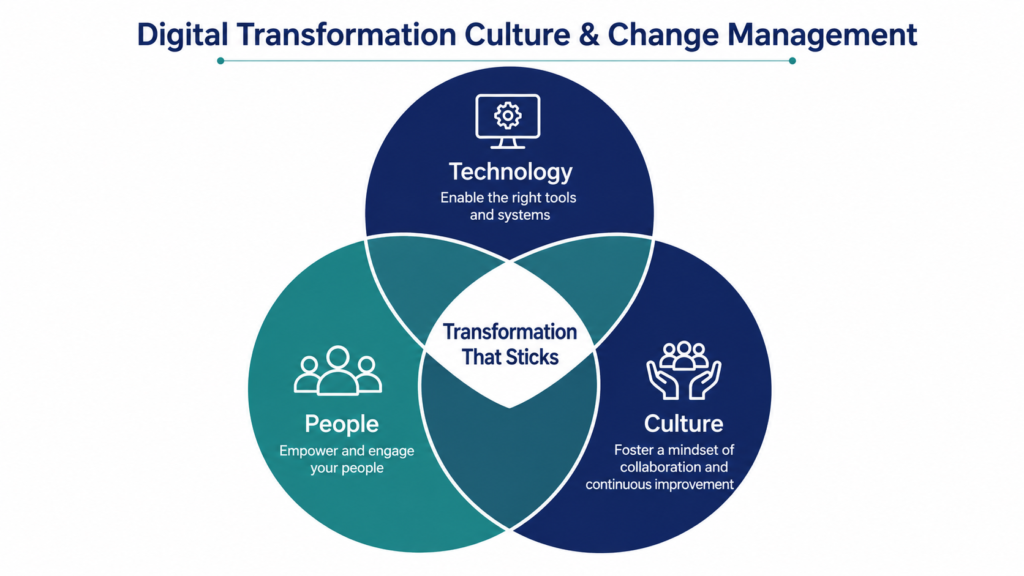
Digital transformation fails without culture change because the technology succeeds and the people don’t. The tool goes live on time, on budget, and technically works. Then usage plateaus, workarounds proliferate, and the promised ROI evaporates. That is not a rollout problem; that is a culture problem.
The digital transformation failure rate has held stubbornly near 70% for more than a decade. McKinsey’s global survey of executives found that 70% of complex, large-scale transformation programmes fail to achieve their stated goals (McKinsey), and the pattern in digital is even sharper. BCG’s analysis of roughly 40 digital transformations found that 90% of companies that put culture first delivered breakthrough or strong financial performance, versus just 17% among those that neglected it (BCG) — a fivefold gap that dwarfs any effect of tooling choice.
Why is the gap so wide? Because digital tools rewrite how work gets done, and if the behaviours around them don’t rewrite too, the tool becomes ceremonial. A CRM without disciplined pipeline hygiene is a Rolodex. A data lake without a data-literate front line is expensive storage. An AI copilot without a team that trusts its output is a browser tab nobody opens. Gartner reports that 85% of digital transformation projects will fail to scale beyond the pilot stage (Gartner), and the near-universal reason cited by CIOs is not the technology — it is the surrounding operating model and workforce readiness.
There is also a budget mismatch that leaders rarely notice until it bites. Culture and behaviour work reliably receives a fraction of the investment that the technology stack does — even inside programmes where executives openly acknowledge culture as the biggest risk. When Microsoft rolled out Teams to its own 220,000+ workforce, the internal post-mortem attributed adoption speed less to the product and more to the deliberate manager-enablement programme wrapped around it — a cultural intervention, not a software one (Microsoft WorkLab). The lesson generalises: you cannot buy transformation. You can only invest in the conditions under which it takes root. If your programme spend on training, comms, sponsorship, and behavioural reinforcement is under 15% of your tech spend, your failure risk is priced in at day one.
The practical implication is simple. Treat every digital transformation as a change programme with a technology deliverable — not a technology programme with a change workstream bolted on. Your digital transformation strategy should be built around the human system as much as the tech stack; every downstream decision in this guide flows from that premise.
There is one more failure pattern worth naming, because it hides inside programmes that look healthy on paper. Call it the “green-dashboard” pattern: the transformation office reports on-time delivery, on-budget spend, and completed training modules — all green — while the underlying business KPI the programme was funded to move sits flat or drops. This is what happens when a programme measures the machinery of change instead of the change itself. Any credible digital transformation culture and change management approach reports the underlying business outcome first and the delivery metrics second; reverse that order and you are optimising for the wrong signal. Ask your programme office to lead every steering committee with the outcome KPI, not the delivery RAG status. If they resist, that is diagnostic.
How to Define a Digital Transformation Culture Strategy
A digital transformation culture strategy is a written, leader-endorsed definition of the behaviours, decision rights, and reward signals that must become normal for your target operating model to work. It answers one question in one page: what will people around here do differently, every day, once the transformation is real? Change management is the discipline that gets you from today’s behaviour to that written definition.
Start by defining the four cultural shifts every digital programme requires, then translate each into a specific, observable behaviour for your organisation. MIT Sloan’s research on 40+ digital transformations identified four cultural pillars that separate leaders from laggards: impact orientation, speed, openness, and autonomy (MIT Sloan Management Review). Impact orientation means teams measure themselves against customer or business outcomes, not activity. Speed means preferring an 80% decision today to a 95% one next quarter. Openness means sharing data and code across function lines by default. Autonomy means front-line teams get to act on what the data tells them without escalating three levels.
Translate each pillar into two or three observable behaviours you could put on a wall poster — because if you cannot describe the behaviour, you cannot coach it, reinforce it, or measure it. “Impact orientation” becomes “every squad publishes a weekly outcome scorecard.” “Openness” becomes “team dashboards are default-public inside the domain.” Vague culture statements (“we are innovative”) produce no behavioural change. Specific ones (“engineers merge to main daily”) do.
Then align your incentives. This is where most culture strategies die. If your bonus structure still rewards individual utilisation and your promotion criteria still favour tenure over impact, no amount of poster art will move behaviour. Adobe rebuilt its performance system around continuous check-ins during its shift to a subscription model — a cultural change that Adobe leaders have repeatedly credited with accelerating the wider digital transformation (Adobe). Match the behaviour you want with the reward that reinforces it, or the behaviour will not stick.
Finally, publish the culture strategy as a live artefact — not a PDF that lives on a shared drive. The best-performing digital transformation programmes treat the culture definition the same way engineering teams treat an API contract: versioned, visible, updated when reality changes. Print it on a page. Put it behind every meeting invite for the first quarter. When someone new joins the programme, hand it to them in the first hour. Cultures shift because a small number of behaviours become obvious, expected, and rewarded — not because a values statement was signed off in a leadership offsite.
The Role of Leadership in Digital Transformation Culture Change
The role of leadership in digital transformation culture change is to model the target behaviours visibly, protect the teams doing the change work, and remove the incumbent processes that quietly punish it. Employees do not read culture memos; they watch what their leaders do in meetings. If the CEO still asks for slide decks when the target operating model calls for dashboards, the dashboards will not survive.
Effective leadership digital transformation shows up in three unglamorous places. First, calendar allocation: a visibly senior sponsor must give the programme 20% or more of their week for the first two quarters — not a monthly steering committee. Prosci’s research shows that projects with active and visible executive sponsorship are seven times more likely to meet or exceed objectives than projects without it (Prosci). Second, public decision-making: leaders should make small transformation-aligned decisions in front of the organisation — killing a legacy report, choosing the digital-first workflow in a meeting, promoting the person who ran the messiest pilot rather than the cleanest one. Third, budget defence: when the annual planning cycle starts and the CFO asks what can be cut, the transformation training budget must not be first on the list. If it is, the culture change is optional — and the organisation will read that signal correctly within a week.
How to Build Stakeholder Buy-In for Digital Transformation Initiatives
Stakeholder buy-in for digital transformation initiatives is earned by mapping every stakeholder group’s specific stake, tailoring the value narrative to each, and giving each group a real role in the design of what changes. It is not earned by a launch email or a roadshow deck. Stakeholder buy-in digital transformation programmes fail when leaders confuse compliance (“nobody said no”) with commitment (“we changed how they were measured, and they still leaned in”).
Start with a stakeholder map that lists every affected group and, for each, three columns: what they gain, what they lose, and what they fear. Executive sponsors gain strategic optionality but fear a public failure on their watch. Middle managers often lose control over information they used to broker and fear becoming redundant. Front-line teams gain new tools but fear looking incompetent using them. The line “we’re all in this together” flattens differences that will torpedo you at execution time. Leaders who engage stakeholders formally before a digital change begins are 1.4 times more likely to succeed (Contentstack citing industry research) — and the multiplier compounds when engagement continues through rollout.
Use this five-step process every time:
- Map stakeholders in an influence-interest grid — high-influence/high-interest groups get direct sponsor time; low-influence/high-interest groups get transparent updates and channels.
- Interview one person per group before you design anything — 30 minutes, one question: what would make this succeed for you, and what would make it fail?
- Tailor the value narrative — the CFO hears the unit-cost story, the CX lead hears the retention story, the front-line manager hears the reduced-firefighting story. Same programme, three narratives.
- Co-design at least one visible artefact — the new workflow, the new dashboard, the new SLA. Ownership is created when people build, not when they are briefed.
- Run a fortnightly buy-in check — a 5-question pulse survey routed by group. Sponsor reviews the deltas, not the absolutes. Falling scores signal a fix, not a follow-up email.
Publish the map. Refresh it every quarter. When JPMorgan Chase rolled its firm-wide AI platform to 200,000+ employees, the internal change team ran named sponsorship for every business unit and a separate enablement track for team leads — the same principle at scale (Reuters coverage of JPMorgan’s LLM Suite). If you are running a 200-person programme rather than a 200,000-person one, the map is smaller, but the discipline is the same.
One trap to name: do not confuse steering-committee attendance with buy-in. Executives who show up to the monthly review and nod are not sponsors — they are witnesses. Real sponsorship shows up as unprompted internal advocacy, personal calendar time with sceptical stakeholders, and willingness to escalate blockers inside their own peer group. If your sponsor cannot name the top three sources of resistance in their business unit without notes, they are not sponsoring — they are attending. Fix that before the next milestone, or the buy-in you think you have is a mirage.
How to Overcome Employee Resistance to Digital Transformation
How to overcome employee resistance to digital transformation: identify what people are actually protecting, address that specific fear with a real remedy, and give them agency in shaping the change. Generic “communication plans” do not defuse resistance. Named, specific responses to named, specific fears do. Resistance to digital transformation is almost always rational from the resister’s point of view — your job is to see it that way.
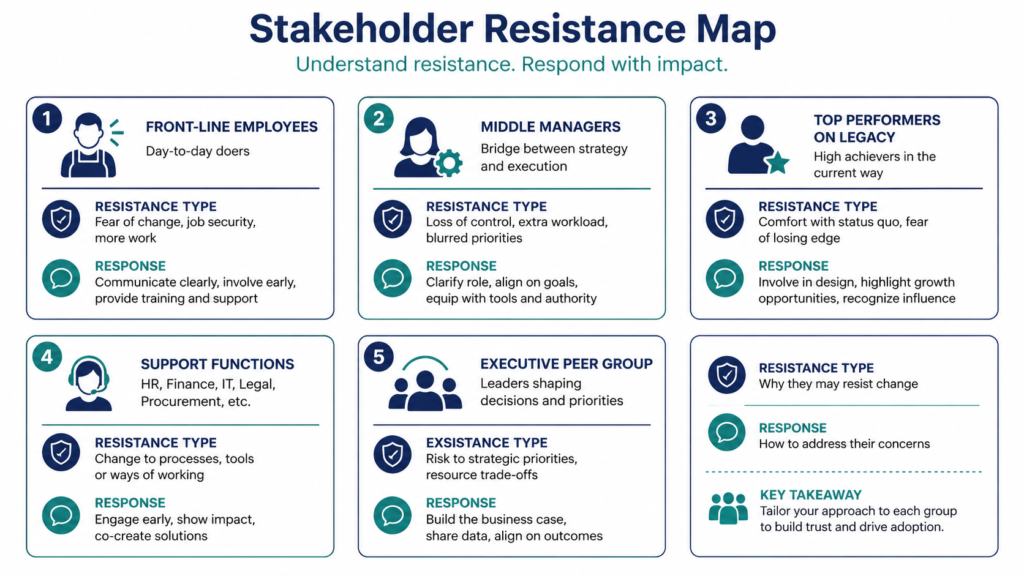
Resistance shows up in four flavours, and each requires a different response. Passive resistance (using the tool minimally, then reverting to the old process) usually signals a skills gap or a workflow that has not been re-plumbed to require the new tool. Active resistance (visible pushback in meetings) usually signals fear of status loss or genuine disagreement with the direction. Silent departure (your best people quietly interview elsewhere) signals a leadership credibility gap. And organisational antibody response — the compliance team, procurement, or legal reflexively blocking the new workflow — usually signals a control-loss fear inside a supporting function.
Use a resistance heat-map before you launch, not after adoption stalls:
| Group | Likely resistance type | Underlying driver | Response |
|---|---|---|---|
| Long-tenure front-line team | Passive | Skill anxiety, muscle memory | Micro-training, peer coaching, temporary dual-run |
| Middle management | Active | Loss of information brokerage | Redesign role around coaching and outcomes, not reporting |
| Top performers on legacy stack | Silent departure | Fear of losing expert status | Public re-skilling role, early access, “founding user” recognition |
| Support functions (legal/compliance/procurement) | Antibody | Uncontrolled risk exposure | Embed function in design; give veto on a narrow, defined scope |
| Executive peer group | Political | Programme cuts across their territory | Sponsor-to-sponsor negotiation; shared success metric |
Prosci’s benchmarking finds that projects with excellent change management are six times more likely to meet objectives than projects with poor change management (Prosci) — and the largest single driver of that gap is the quality of resistance management. AT&T’s decade-long “Future Ready” reskilling programme, which retrained over 100,000 employees for digital roles, treated resistance as a design input from day one — reskilling paths were negotiated with unions and line managers in advance, not announced after the fact (HBR). That preparation is why the programme held together across three CEOs.
One final trap: do not confuse silence with buy-in. If nobody is pushing back, nobody is engaged. Ask your change champions to bring you the top three complaints from the field every fortnight; the fastest-moving programmes act on them within the sprint. In every mature digital transformation culture and change management setup we’ve observed, complaints are treated as free market research — the people bringing them are usually the ones who will design the fix if you give them room to do so.
Digital Transformation Training and Upskilling Program for Employees
A digital transformation training and upskilling program for employees is a structured, role-differentiated learning path that closes the specific capability gaps between today’s workforce and the target operating model — measured by observable performance on the new tools, not by course completion rates. Certificate-farming is not upskilling. Behavioural change on the actual job is.
The mistake most organisations make is to buy a generic digital upskilling program off the shelf and expect it to translate. It won’t. Roles differ, tools differ, starting proficiency differs. The World Economic Forum estimates that 50% of all employees will need reskilling by 2027 as digital adoption accelerates (World Economic Forum) — and the organisations getting ahead of that are building bespoke pathways, not licensing courseware and hoping.
Design the programme in six steps:
- Baseline capability audit per role — score current staff against the target-state role definition on a 1–5 scale. Anonymise; the goal is a gap map, not a performance review.
- Segment the population — advocates (already at target), close (1 level below), stretch (2 levels below), rebuild (3+ levels). Each segment gets a different intervention intensity.
- Build role-specific pathways — a maximum of 8–12 hours per person per month; anything more is aspirational and gets dropped when the day job intrudes.
- Anchor in real work — 70% of learning must happen inside real project work with a coach, not in a classroom. Microlearning bites are for reinforcement, not primary transfer.
- Deploy internal coaches, not external trainers — advocates from step 2 become coaches. Peer credibility beats vendor credibility every time on this kind of change.
- Measure adoption, not attendance — the metric is “can this person execute the target workflow unassisted at target quality within 30 days of training?” — verified by observation or telemetry, not self-report.
Amazon’s Upskilling 2025 pledge — a $1.2 billion commitment to reskill 300,000 employees — is the largest recent public example, and its playbook maps almost exactly onto those six steps: baseline, segment, role-specific pathways, internal Amazon-run academies rather than pure vendor content (Amazon). You do not need the budget to copy the discipline.
Two failure modes to avoid. First, don’t chase certifications; certifications correlate poorly with behavioural change on the job. Second, don’t defer training until “after go-live” to preserve delivery timelines — a workforce that meets the platform cold is guaranteed to underuse it, and the political cost of a low-adoption launch far exceeds the schedule cost of pre-training. See the digital transformation roadmap guide for how to sequence enablement inside a wider programme plan.
One further design principle: build a graduation path from learner to coach into the programme itself. When your best “close” learners from cohort one become the paid coaches for cohort two, three things happen simultaneously — coaching capacity scales without hiring, promotion signals validate the new capabilities, and the culture starts describing itself as a place where digital skill leads to visible advancement. That last effect is the one leaders undervalue most. Career-advancement stories move behaviour faster than any comms deck.
ADKAR vs Kotter: Change Management Model for Digital Transformation
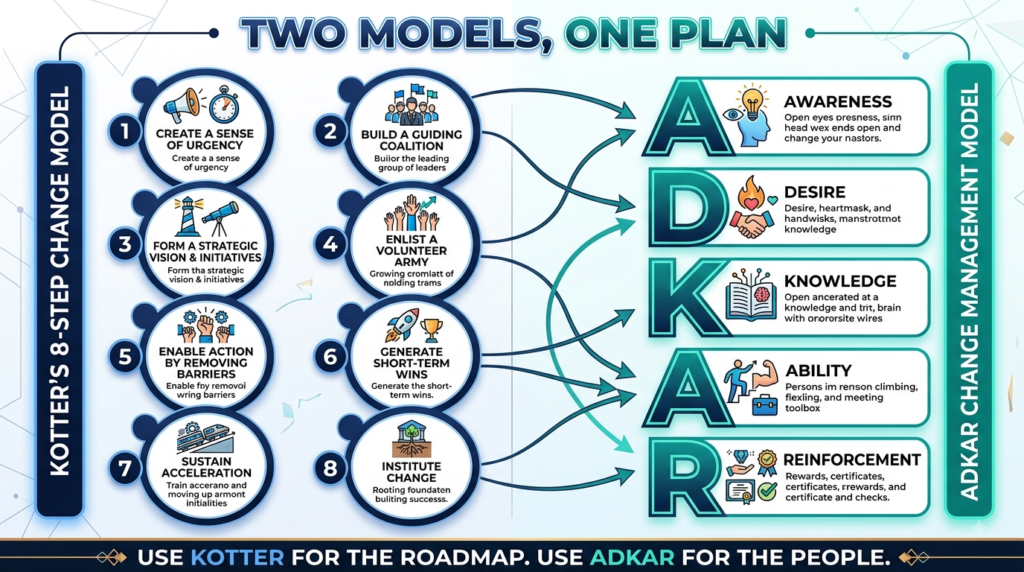
ADKAR vs Kotter change management for digital transformation: use Kotter for the organisational plan and ADKAR for the individual transitions inside it. They solve different halves of the same problem, and the best digital programmes use both, not one. Choosing a single change management model digital transformation teams can rally around is less important than choosing intentionally and applying it consistently.
Kotter’s 8-step model — created by Harvard Business School’s John Kotter — is a top-down organisational plan: create urgency, form a coalition, define a vision, communicate it, remove obstacles, secure short-term wins, consolidate gains, anchor change in culture. It answers the question “how do we, as a leadership team, sequence the programme?” ADKAR — developed by Prosci — is a bottom-up individual model: Awareness, Desire, Knowledge, Ability, Reinforcement. It answers the question “how do I, as a manager or coach, help this specific person through the change?”
| Dimension | Kotter’s 8-Step | ADKAR |
|---|---|---|
| Level | Organisational | Individual |
| Best for | Setting programme direction, executive sequencing | Manager conversations, resistance diagnosis, coaching |
| Time horizon | Multi-year | Per-person, ongoing |
| Weakest at | Diagnosing why a specific team stalled | Setting cross-organisational strategy |
| Best digital use | Enterprise-wide programme design | Front-line adoption, resistance response |
Two other frameworks deserve a mention because they show up in board decks and consulting proposals often enough that leaders need a fast take. Lewin’s unfreeze-change-refreeze is still useful as a lightweight sequencing metaphor for smaller programmes, but it under-specifies the individual work that digital adoption requires — pair it with ADKAR if you use it. McKinsey’s 7-S framework (strategy, structure, systems, shared values, skills, style, staff) is not a change model at all; it is a diagnostic checklist for organisational fit. Use it once, at the start, to confirm your transformation is aligned across all seven — not as a running programme tool. Choosing well means matching model to scope: enterprise-wide → Kotter + ADKAR, business-unit → ADKAR + Lewin, single-team pilot → ADKAR alone.
For a typical enterprise digital programme, run Kotter as the master plan and use ADKAR as the diagnostic and coaching frame at team level. When a team’s adoption stalls, ADKAR gives you a fast diagnosis: is it an Awareness problem (they don’t know why the change matters), a Desire problem (they don’t want to), a Knowledge problem (they don’t know how), an Ability problem (they can’t yet execute), or a Reinforcement problem (the old behaviour is still being rewarded)? Each answer has a different response. A Desire problem doesn’t respond to more training. A Knowledge problem doesn’t respond to more town halls. Prosci reports that 93% of projects with excellent change management met or exceeded objectives, vs 15% with poor change management (Prosci) — and the diagnostic sharpness ADKAR gives you at team level is a large part of that gap.
If your programme is smaller — say a 50-person unit adopting a new CRM — you may not need the full Kotter plan. Use ADKAR as the primary lens and Lewin’s classic unfreeze-change-refreeze as a lightweight sequencing frame. If your programme is truly enterprise-wide, run both models; assign ADKAR ownership to your HR business partners and Kotter ownership to the transformation office. The two do not conflict — they interlock.
Your Digital Transformation Change Management Plan Step by Step
Your digital transformation change management plan step by step is a written 8-step sequence — sponsor, stakeholder map, culture definition, change team, comms cadence, training design, resistance response, and reinforcement — completed before the first line of production code ships. Treat it as pre-launch infrastructure, not post-launch cleanup. A serviceable change management plan template can be built in a fortnight; delaying it three months does not save time — it multiplies rework.
Follow these eight steps in order:
- Name a named executive sponsor — one person, C-level, 20% time commitment, publicly accountable for adoption metrics. If nobody will accept this role, the programme is not ready.
- Build the stakeholder map — every affected group, with their gain / loss / fear columns as described earlier. Refresh quarterly.
- Write the one-page culture definition — the four cultural shifts, translated into observable behaviours, endorsed by the executive team.
- Constitute the change team — a full-time change lead, an HR partner, embedded change champions in every business unit (target 1 per 25 affected employees).
- Design the comms cadence — weekly team stand-ups, fortnightly programme update, monthly sponsor letter, quarterly all-hands. Same channels every time. Never skip a cycle.
- Design the training and enablement track — using the six-step upskilling framework above. Training starts at least 30 days before the affected group goes live on the new tools.
- Pre-map resistance and prepare responses — using the resistance heat-map. Every high-risk group has a named owner and a fortnightly pulse check.
- Build reinforcement loops — recognition of new behaviours, quiet withdrawal of legacy shortcuts, updated performance criteria, updated hiring criteria. Reinforcement runs for at least 12 months after go-live; without it, cultures snap back within a quarter.
Prosci’s 2023 benchmarking of over 2,000 change practitioners identified “dedicated change management resources” as the single largest predictor of programme success (Prosci Best Practices in Change Management). Translation: the change team must be full-time on the change, not borrowed from another workstream. If your plan says “the PM will run change too,” restaff before you start. The dual-hat pattern is the single most common structural error in enterprise digital transformation change management — and it is fixable with one hiring decision.
Two rules of thumb. First, invest 15–20% of programme budget in change management. If you cannot get above 10%, escalate — you are being set up to miss. Second, sequence the plan into 90-day waves with visible checkpoints. Nothing sustains sponsorship like a 90-day story of what changed, told in numbers. Programmes that go quiet lose their sponsor within two quarters, and losing sponsor commitment is the single most reliable predictor of failure.
If you’re running the change plan against a fixed technology deadline, resist the urge to compress steps 6 and 7 to protect the go-live date. Training compression and abandoned resistance planning are the two most common causes of a launch that hits schedule and misses adoption — a combination that is politically worse than a delayed launch, because it burns credibility with the exact stakeholders you’ll need for the next wave. Push the go-live date rather than skip the change work; a programme that lands soft and grows is worth ten that land hard and stall.
How to Measure Culture Change During Digital Transformation
How to measure culture change during digital transformation: track a small basket of behavioural, adoption, sentiment, and outcome metrics on a fixed cadence — and hold yourself accountable to the trend, not the absolute. Culture is a lagging indicator; measuring it takes patience. What kills programmes is not slow movement; it is unmeasured movement, because unmeasured movement cannot be defended when the budget conversation happens.
Use four categories of culture change metrics, review them monthly, and share the trend line with the sponsor and the affected teams:
| Category | Example metric | Source | Cadence |
|---|---|---|---|
| Adoption | % of target users active weekly on new tool | Platform telemetry | Weekly |
| Behavioural | % of decisions made in target workflow (vs legacy) | Workflow audit / process mining | Monthly |
| Sentiment | eNPS for the transformation, split by affected group | Pulse survey (5 questions) | Fortnightly |
| Capability | % of role holders passing the target-workflow assessment | Assessment tool | Quarterly |
| Outcome | Business outcome KPI the transformation was funded to move | Business reporting | Monthly, 90-day trend |
Deloitte’s Global Human Capital Trends found that only 15% of executives believe their organisation is highly effective at measuring the impact of workforce change (Deloitte) — a gap you can close cheaply by installing this five-row scorecard on day one. Do not wait for a perfect measurement system; a rough monthly read on all five categories beats a beautiful annual read on one.
Run a formal 30/60/90-day review at every rollout milestone. At day 30, look at adoption and sentiment. At day 60, add behavioural and capability. At day 90, add outcome. Trends across those three checkpoints tell you whether the programme is actually landing or whether you are watching a launch-and-drift pattern that will need a sponsor conversation before the next quarter closes.
Guard against two common measurement mistakes. First, do not average sentiment across the whole workforce; the interesting signal is always at the segment level (long-tenure operators, middle managers, a specific business unit) and averaging erases it. Second, do not celebrate a jump in the adoption number without asking whether the target workflow is actually being used correctly — logging in is not adopting. Pair the telemetry number with a monthly workflow-quality audit on a sample of transactions. If quality lags adoption, you have a training problem hiding behind a green metric.
Bringing It All Together
Digital transformation culture and change management is not a workstream inside a technology programme — it is the programme. Define the culture you need in observable behaviours, engineer stakeholder buy-in through named responses to named fears, defuse resistance by treating it as rational information, build role-specific training that measures adoption rather than attendance, pick your models deliberately (Kotter for the plan, ADKAR for the people), write an eight-step plan before you ship code, and measure the trend on five categories every month. Do all of that and you will be inside the 30% that succeeds rather than the 70% that stalls. For the wider strategic frame this fits inside, see the digital transformation Hub guide; for the sequencing scaffolding, the digital transformation roadmap; for the CX lens on why any of this matters commercially, why customer centricity should drive digital transformation. The digital transformation change management discipline is not glamorous. It is boring, sequential, and human. That is also why it works.
More from CorporatePlaybookPro.com
→ What Is Digital Transformation? The Complete Guide for Business Leaders
→ Digital Transformation for Small Business: A Practical, Phased Guide
→ Digital Transformation Frameworks Compared: Which Model Fits Your Business
→ How to Create a Successful Digital Transformation Roadmap: A Leader’s Guide
→ Digital Maturity Assessment: Benchmark Your Organization’s Transformation Readiness (2025 Guide)
→ Top 7 Digital Transformation Trends to Watch in 2025: The Complete Guide
→ The 90-Day Digital Transformation Sprint: Quick Wins That Build Long-Term Success
→ Why Customer Centricity Should Drive Digital Transformation
→ Digital Transformation Consulting Firms : Which Type Fits Your Size and Maturity
Frequently Asked Questions
What is change management in digital transformation?
Change management in digital transformation is the structured discipline of preparing, equipping, and supporting people to adopt the new tools, workflows, and behaviours that a digital programme requires. It runs in parallel with the technology delivery — not after it — and covers sponsorship, communication, training, resistance response, and reinforcement over a 12–24 month horizon.
Why do 70% of digital transformations fail?
Roughly 70% of digital transformations fail because organisations under-invest in the people side — culture, capability, sponsorship, and resistance management — while over-investing in the technology stack. McKinsey and BCG research consistently identifies culture and workforce readiness as the top failure drivers, not tool selection or implementation quality.
What is a digital transformation change champion?
A digital transformation change champion is an embedded, credible peer inside a business unit who advocates for the change, coaches teammates, surfaces resistance early, and translates the programme narrative into the local context. Champions carry more adoption weight than executive sponsors because their credibility is peer-earned, not positional.
How do you measure the success of digital transformation?
Measure digital transformation success on five categories tracked monthly: adoption (weekly active users on the new tool), behavioural (percentage of decisions made in the target workflow), sentiment (fortnightly eNPS split by group), capability (percentage of role holders passing the target-workflow assessment), and outcome (the business KPI the programme was funded to move). Trend beats absolute; segment beats average.
How long does a digital transformation take?
A full enterprise digital transformation typically runs 3–5 years end-to-end, though individual workstreams (a CRM rollout, a data platform migration) usually complete inside 12–18 months. The cultural reinforcement phase — the part that determines whether the change sticks — runs at least 12 months beyond the technology go-live, which is why most programmes still look shaky at year two even when the tech is live.
Who leads digital transformation in a company?
Digital transformation is typically led by a triad: an executive sponsor (CEO or COO for cross-functional programmes, or a business-unit head for unit-scoped ones), a delivery lead (Chief Digital Officer, CTO, or transformation office director), and a people lead (CHRO or dedicated change director). Programmes with a single named executive sponsor spending 20% or more of their time on the initiative significantly outperform those without.
What is the role of HR in digital transformation?
HR owns the workforce-transition half of digital transformation: capability audits, role redesign, upskilling and reskilling programmes, incentive alignment, change-champion networks, and the sentiment measurement that tells leadership whether adoption is real. In mature programmes, HR business partners are embedded in every affected business unit — not sitting in a central HR function waiting to be asked.
What percentage of digital transformations fail?
Roughly 70% of large-scale digital transformations fail to meet their stated objectives, a figure consistent across McKinsey, BCG, and Gartner research since 2018. The success rate rises to about 90% among organisations that put culture change on equal footing with technology delivery — the largest single lever in the data.
What are the biggest barriers to digital transformation?
The biggest barriers to digital transformation are cultural, not technical: organisational culture (cited by 87% of executives in McKinsey’s transformation research), skills gaps, weak or absent executive sponsorship, siloed operating models, and misaligned incentives. Technology selection failures are a distant secondary cause.
What are digital transformation KPIs for culture?
The most useful culture KPIs during digital transformation are adoption rate (weekly active users of the new workflow), behavioural conformity (percentage of decisions made in the target workflow versus legacy), transformation eNPS split by segment, target-workflow capability assessment pass rate, and time-to-productivity for new joiners. Report the trend, not the absolute — and always split by affected group.
How do you handle change fatigue in a long transformation?
Handle change fatigue by sequencing the programme into 90-day waves with visible checkpoints, ruthlessly killing legacy processes and tools as new ones land (rather than running them in parallel indefinitely), rotating change champions before they burn out, and publishing genuine wins on a fixed monthly cadence. Fatigue is almost always a symptom of ambiguous progress, not too much change.
How much of a digital transformation budget should go to change management?
Allocate 15–20% of the total digital transformation budget to change management — sponsorship, communication, training, coaching, and reinforcement. Programmes running below 10% consistently underperform on adoption and outcome metrics. If your finance team resists that ratio, escalate before the programme starts, not after adoption stalls.
What is the difference between ADKAR and Kotter for digital transformation?
ADKAR is an individual-level model (Awareness, Desire, Knowledge, Ability, Reinforcement) used to diagnose and coach one person through change; Kotter is an organisational-level 8-step plan used to sequence the programme from urgency-setting to anchoring change in culture. In digital transformation, use Kotter as the master plan and ADKAR as the diagnostic tool at team level — they interlock rather than compete.
Can small businesses use these change management principles?
Yes — every principle in this guide scales down. A 20-person business still needs a named sponsor, a written culture definition, tailored communication, resistance mapping, and adoption measurement — the artefacts are just smaller and lighter. In a small business the CEO usually is the sponsor, change lead, and comms channel, which is an advantage: one voice, one calendar, one reinforcement loop.