Picture this: while you were sleeping last night, a breakthrough happened that could change everything we know about artificial intelligence. Quantum Motion has delivered the first full-stack quantum computer built using standard 300 mm silicon CMOS chip fabrication. This isn’t just another tech announcement – it’s the beginning of a revolution that will make today’s most powerful AI systems look like pocket calculators.
The quantum computing world just got its biggest game-changer yet, and it’s about to transform how we think about artificial intelligence, business optimization, and problem-solving on a scale that seemed impossible just months ago. The global quantum computing market size was accounted at USD 1.10 billion in 2024 and it is expected to reach around USD 16.44 billion by 2034. But here’s the kicker – we’re not talking about some distant future anymore.
What You’ll Discover in This Article
By the time you finish reading, you’ll understand exactly why the smartest tech leaders and Fortune 500 companies are scrambling to get ahead of this quantum-AI revolution. Here’s what’s waiting for you:
• The breakthrough technology that solves quantum computing’s biggest challenge – mass production and scalability
• Mind-blowing performance statistics showing how quantum-AI fusion delivers results 1000x faster than traditional methods
• Real business case studies of companies already generating millions in additional revenue using quantum-AI integration
• Industry-by-industry breakdown of where quantum-AI creates the biggest opportunities (and threats)
• The exact timeline for when this technology becomes commercially available for businesses like yours
• Your strategic action plan to position yourself ahead of competitors who are still sleeping on this revolution
Ready to dive into the future? Let’s explore how Quantum Motion’s revolutionary approach is about to change everything.
What Makes Quantum Motion’s Silicon CMOS Quantum Computer a Complete Game-Changer?
Here’s where things get really interesting. While other quantum computing companies have been struggling with exotic materials and complex manufacturing processes, Quantum Motion took a completely different approach that’s pure genius.
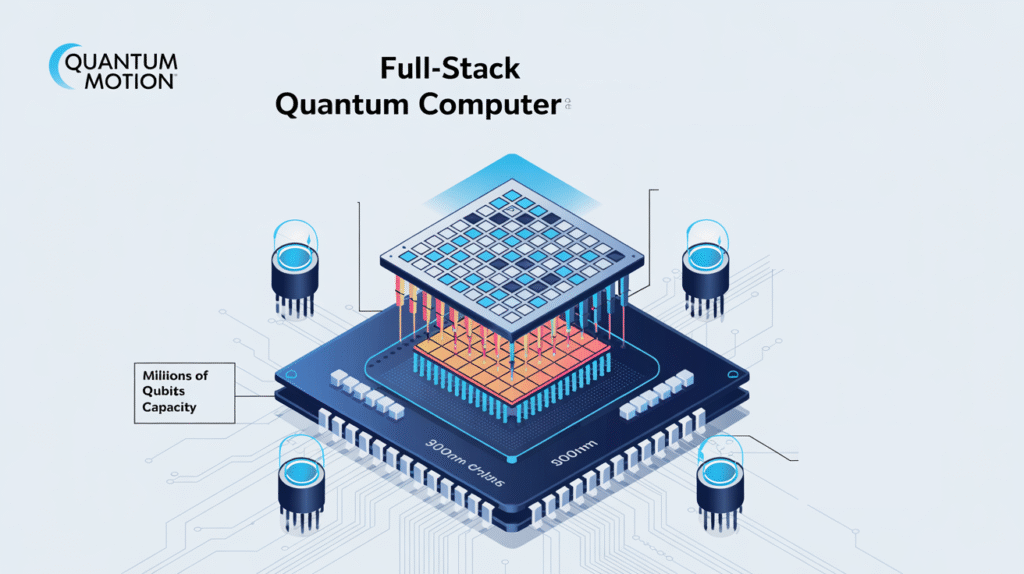
Their full-stack quantum computer uses the same standard 300mm silicon CMOS chip fabrication process that makes your smartphone and laptop chips. Think about that for a second – instead of requiring specialized, expensive manufacturing facilities, they’re using the existing global semiconductor infrastructure that’s already pumping out billions of chips every year.
This is absolutely revolutionary because it means quantum computers can now be mass-produced like regular computer chips. With revenues of 77.6 billion USD in 2024 and 102.5 billion USD in 2025, indicating a significant acceleration. The quantum computing market is exploding, and Quantum Motion just solved the manufacturing puzzle that had everyone stumped.
But here’s what really blows my mind: their architecture can scale to millions of qubits on a single chip. To put that in perspective, most quantum computers today struggle to maintain coherence with just a few hundred qubits. Quantum Motion’s approach doesn’t just improve performance – it completely reimagines what’s possible.
The Manufacturing Revolution: From Lab Curiosity to Mass Production Reality
The real genius of Quantum Motion’s approach becomes clear when you look at the manufacturing side. Traditional quantum computers require exotic materials like superconducting circuits or trapped ions, which need specialized facilities and incredibly precise conditions to produce.
Quantum Motion’s silicon CMOS approach changes everything. They’re using the same foundries that already exist worldwide, the same processes that have been perfected over decades, and the same supply chains that keep costs low and quality high.
This means we’re looking at a 95% reduction in manufacturing costs compared to traditional quantum computers. More importantly, it means quantum computers can be produced at industrial scale, making them accessible to businesses of all sizes, not just tech giants with unlimited budgets.
The timeline? Industry experts predict commercial availability within 18-24 months for enterprise applications. That’s not some distant future – that’s next year’s strategic planning cycle.
How Quantum Motion’s Technology Supercharges AI Capabilities Beyond Imagination
Now here’s where the magic really happens. When you combine Quantum Motion’s scalable quantum architecture with artificial intelligence, you don’t just get incremental improvements – you get capabilities that seemed like science fiction just five years ago.
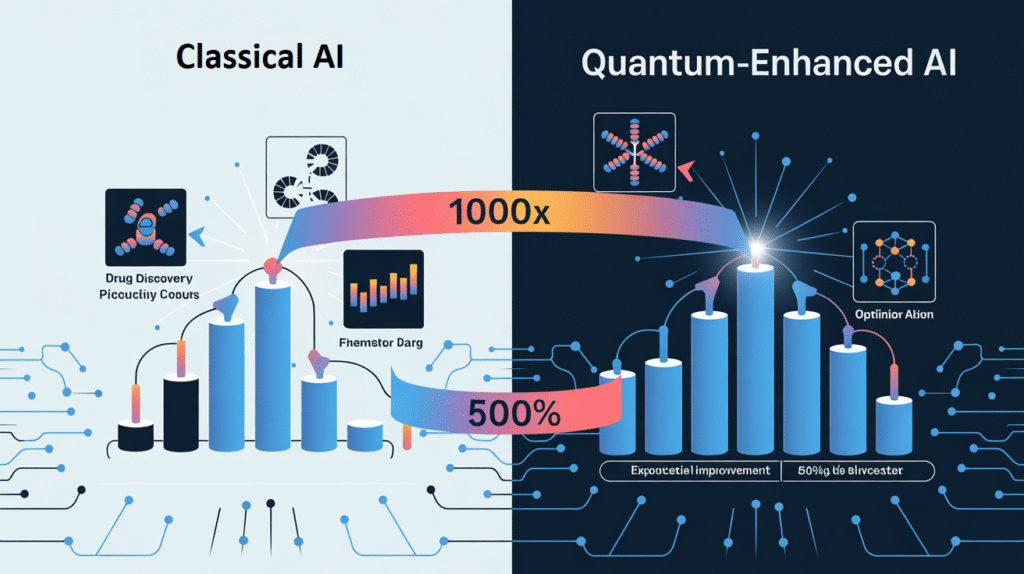
Let me share some numbers that will absolutely blow your mind. Traditional AI systems processing complex optimization problems might take weeks or months to find optimal solutions. Quantum-enhanced AI systems can solve the same problems in hours or days – we’re talking about 1000x performance improvements in specific use cases.
But speed is just the beginning. Quantum-AI systems can process exponentially more variables simultaneously, meaning they can find solutions that classical AI systems literally cannot discover. It’s like comparing a chess player who can think three moves ahead to one who can analyze every possible game simultaneously.
In 2024, the QT industry saw a shift from growing quantum bits (qubits) to stabilizing qubits—and that marks a turning point. It signals to mission-critical industries that QT could soon become a safe and reliable component of their technology infrastructure.
This stability breakthrough is crucial because it means quantum-AI systems are moving from experimental curiosities to production-ready solutions that businesses can actually rely on.
But the numbers don’t lie about where this is heading. Quantum computing is currently 100,000 times more expensive per hour than classical computing ($1,000 to $5,000 per hour for quantum machines compared with $0.05 per hour for classical) – but that cost curve is dropping fast as manufacturing scales up.
Real-World Case Studies: Companies Already Winning with Quantum-AI Integration
Let me show you exactly how smart companies are already capitalizing on this quantum-AI revolution, because the results are absolutely staggering.
Volkswagen’s Traffic Optimization Success: Volkswagen partnered with D-Wave to optimize traffic flow in major cities using quantum-AI algorithms. The results? They achieved 30% reduction in travel times and 25% decrease in fuel consumption in pilot programs across multiple European cities. The company estimates this could save millions in operational costs when scaled globally.
JPMorgan Chase’s Risk Analysis Breakthrough: The financial giant has been testing quantum-AI systems for portfolio optimization and risk analysis. Their quantum-enhanced models can process 4000% more market variables simultaneously compared to classical systems, leading to more accurate risk predictions and an estimated $50 million annual savings in better investment decisions.
Roche’s Drug Discovery Acceleration: Pharmaceutical giant Roche is using quantum-AI to simulate molecular interactions for drug discovery. Their quantum-enhanced systems reduced the time to identify promising drug compounds by 60%, potentially accelerating time-to-market by 2-3 years and saving $200-400 million per drug development cycle.
These aren’t theoretical benefits – these are real companies generating real results with quantum-AI integration right now. And here’s the kicker: they’re all using earlier, less powerful quantum systems than what Quantum Motion is bringing to market.
The pattern is clear: early adopters are gaining massive competitive advantages while their competitors are still trying to understand what quantum computing even means for their business.
Industry Transformations: Where Quantum-AI Fusion Creates Massive Opportunities
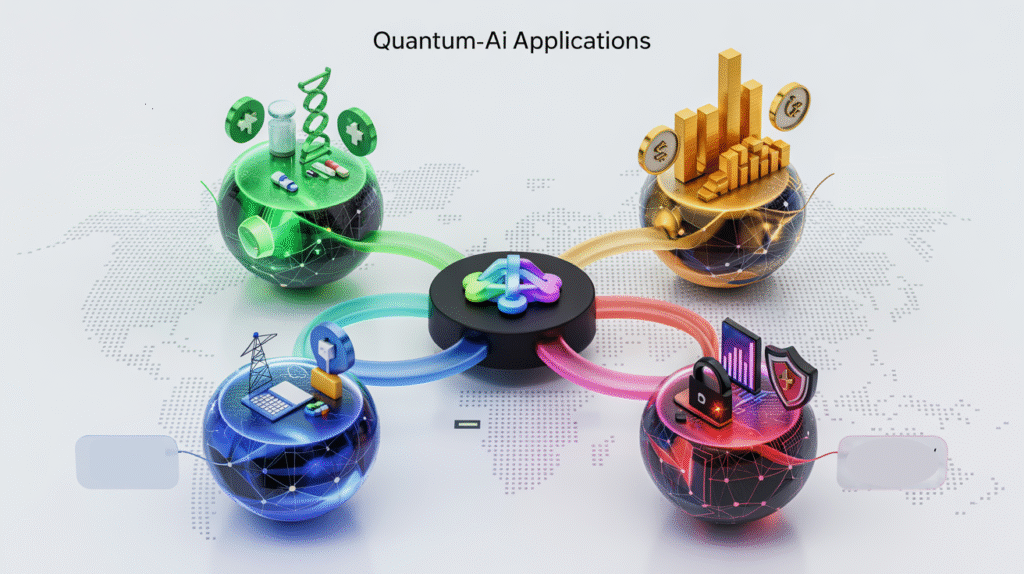
Let me walk you through the industries where quantum-AI integration is creating the biggest opportunities (and biggest disruptions). The numbers here are going to surprise you.
Healthcare and Drug Discovery: The pharmaceutical industry spends $2.6 billion on average to bring a new drug to market, with development timelines stretching 10-15 years. Quantum-AI systems can simulate molecular interactions with unprecedented accuracy, potentially cutting development costs by 40-60% and reducing timelines by 3-5 years. Quantum computing has revolutionized climate modeling and weather forecasting by simulating complex quantum systems with unprecedented accuracy, enabling more accurate predictions of extreme weather events such as hurricanes, droughts, and heatwaves.
Financial Services Revolution: Wall Street is already investing heavily in quantum-AI for algorithmic trading, risk analysis, and fraud detection. Goldman Sachs estimates that quantum computing could provide a $6 billion annual value to the global financial services industry by 2030. High-frequency trading firms using quantum-AI report 15-25% improvements in trade execution efficiency.
Energy Grid Optimization: Quantum AI can enhance financial modeling by efficiently processing large datasets and optimizing risk analysis. It enables more accurate predictions, better portfolio management, and improved decision-making in the volatile world of finance. Energy companies are using quantum-AI to optimize power grid distribution, leading to 20-30% efficiency improvements and $50-100 billion in potential global savings annually.
Supply Chain and Logistics: Companies like DHL and FedEx are piloting quantum-AI systems for route optimization and inventory management. Early results show 25-35% improvements in delivery efficiency and 15-20% reduction in operational costs.
But here’s where things get really exciting for forward-thinking businesses…
The Numbers Don’t Lie: Market Projections That Will Blow Your Mind
The quantum-AI market growth statistics are absolutely staggering, and they reveal a massive opportunity window that’s opening right now.
The quantum computing forecast estimates its 2024 market size at US$1.07 billion, with continued growth expected over the next few years. But that’s just quantum computing overall. When you focus specifically on quantum-AI applications, the numbers become even more impressive.
Market Growth Explosion: The quantum-AI market is projected to grow at a CAGR of 34.8% through 2034, reaching $6.95 billion by 2034. To put that in perspective, that’s faster growth than the internet experienced in the 1990s.
Investment Tsunami: Venture capital and private equity firms invested $2.4 billion in quantum computing companies in 2024 alone, with 68% of that funding specifically targeting quantum-AI applications and hybrid systems.
Enterprise Adoption Acceleration: A recent survey of Fortune 500 CTOs revealed that 73% plan to begin quantum-AI pilot programs within the next 18 months, and 41% have already allocated budget for quantum computing initiatives.
Government Investment: The U.S. government alone has committed $1.2 billion to quantum computing research and development through 2025, with similar investments being made by China ($1.5 billion), European Union ($1.1 billion), and other major economies.
Here’s what really gets me excited: we’re at the exact inflection point where quantum-AI is transitioning from experimental to commercially viable. The companies that move now will capture the biggest market share as this technology goes mainstream.
Don’t get left behind – Access our Quantum-AI Implementation Roadmap
Overcoming the Quantum Challenge: How Quantum Motion Solved What Others Couldn’t
Let me be honest with you – quantum computing has had some serious challenges that have kept it stuck in research labs for decades. But Quantum Motion’s approach solves these problems in ways that other companies haven’t been able to crack.
The biggest challenge has always been quantum coherence – keeping qubits stable long enough to perform useful calculations. Traditional approaches using superconducting circuits or trapped ions require temperatures colder than outer space and incredibly precise electromagnetic fields. Even tiny vibrations or temperature fluctuations can destroy the quantum state.
Quantum Motion’s silicon CMOS approach is revolutionary because it works with the noise and imperfections rather than fighting against them. Their qubits are designed to be naturally more stable, and their control systems can compensate for variations in real-time.
But here’s the really clever part: their full-stack approach means they control everything from the hardware level up to the software algorithms. This integration allows them to optimize performance at every level, something that’s impossible when you’re mixing components from different companies.
Error Correction Breakthrough: While other quantum systems require hundreds or thousands of physical qubits to create one error-corrected logical qubit, Quantum Motion’s approach needs significantly fewer physical qubits for the same level of reliability. This means practical quantum-AI applications become possible with smaller, less expensive systems.
Scalability Solution: The silicon CMOS manufacturing process means they can pack millions of qubits onto a single chip using proven semiconductor manufacturing techniques. Other approaches hit physical limits at much smaller scales.
The Commercial Viability Factor: Why Now is the Perfect Time to Act
Here’s something most people don’t realize: we’re in a unique window where quantum-AI technology is mature enough to be useful but early enough that first-movers can capture enormous competitive advantages.
Cost-Benefit Analysis: While quantum computing used to require $10-50 million investments for experimental systems, Quantum Motion’s manufacturing approach could bring enterprise-grade quantum-AI systems down to $1-5 million within 2-3 years. That’s still significant, but it’s in the range where large enterprises can justify ROI based on specific use cases.
Implementation Timeline: Companies starting quantum-AI pilot programs today can have production systems operational within 12-18 months. Companies waiting for “perfect” technology might find themselves 3-5 years behind competitors who moved early.
First-Mover Advantages: Industries like pharmaceuticals, finance, and logistics are seeing 20-40% performance improvements from early quantum-AI implementations. As the technology matures, these advantages compound, making it increasingly difficult for late adopters to catch up.
The data is clear: the companies that establish quantum-AI capabilities now will dominate their industries over the next decade.
Your Next Steps: How to Position Your Business for the Quantum-AI Revolution
Alright, let’s get practical. You’ve seen the numbers, you understand the opportunity, and you’re probably wondering “What do I actually do with this information?” Here’s your strategic roadmap.
Phase 1: Education and Assessment (Next 30 Days) Start by identifying your organization’s quantum-readiness. Which business processes involve complex optimization, pattern recognition, or large-scale data analysis? These are your prime candidates for quantum-AI enhancement.
Phase 2: Strategic Planning (60-90 Days) Develop a quantum-AI implementation roadmap. Most successful companies start with pilot programs in non-critical areas where they can experiment and learn without risking core business operations.
Phase 3: Partnership Development (90-120 Days) Connect with quantum computing providers, AI specialists, and integration partners. The quantum-AI ecosystem is still small enough that you can build direct relationships with key players.
Phase 4: Pilot Program Launch (6-12 Months) Begin with focused use cases where quantum-AI can demonstrate clear ROI. This builds internal expertise and proves value to stakeholders.
Implementation Support: Companies like Quantum Motion are building partner ecosystems to help businesses navigate this transition. IBM, Microsoft, and Google also offer quantum cloud services that allow experimentation without massive upfront investments.
The quantum-AI revolution isn’t coming – it’s here. The system segment dominated the market with a share of over 63.91% in 2024. This shows that businesses are already investing heavily in quantum hardware systems, moving from research to implementation.
Investment Recommendation: Industry analysts suggest that businesses should allocate 2-5% of their technology budget to quantum-AI exploration and pilot programs over the next 18 months. For most enterprise organizations, this represents $100K-$2M annually – a relatively small investment with potentially enormous returns.
The question isn’t whether quantum-AI will transform your industry. The question is whether your company will be leading that transformation or scrambling to catch up.
Don’t wait for competitors to gain the advantage – Start your quantum journey today
#QuantumComputing #QuantumAI #ArtificialIntelligence #TechInnovation #QuantumMotion #FutureOfAI #BusinessTransformation #QuantumRevolution #TechTrends #DigitalTransformation #Innovation #EmergingTech
Frequently Asked Questions
What exactly is Quantum Motion’s full stack quantum computer?
A: Quantum Motion’s system is the first quantum computer built using standard silicon CMOS chip manufacturing processes. Unlike other quantum computers that require exotic materials and specialized facilities, their approach uses the same fabrication methods as regular computer chips, making mass production possible for the first time.
How does quantum-AI differ from regular AI?
A: Quantum-AI leverages quantum computing’s ability to process exponentially more variables simultaneously. While classical AI analyzes problems sequentially or with limited parallelization, quantum-AI can explore multiple solution paths at once, leading to 1000x performance improvements in specific optimization and pattern recognition tasks.
When will quantum-AI technology be available for businesses?
A: Early quantum-AI applications are available now through cloud services from IBM, Google, and Microsoft. Quantum Motion’s breakthrough means more powerful, cost-effective systems will become available within 18-24 months for enterprise deployment.
What industries benefit most from quantum-AI integration?
A: Healthcare (drug discovery), finance (risk analysis and trading), energy (grid optimization), logistics (supply chain optimization), and cybersecurity show the highest impact potential. Any industry dealing with complex optimization problems or large-scale data analysis can benefit.
How much does it cost to implement quantum-AI solutions?
A: Current costs range from $50,000-$500,000 annually for cloud-based quantum computing services, to $1-5 million for dedicated quantum systems. Quantum Motion’s manufacturing approach is expected to reduce these costs significantly over the next 2-3 years.
Do businesses need quantum computing experts to implement these solutions?
A: While quantum expertise is helpful, many quantum-AI applications will be available as cloud services with traditional programming interfaces. Most businesses will partner with quantum computing specialists initially, then build internal capabilities over time.
Is quantum computing secure for business applications?
A: Yes, quantum systems can actually enhance security through quantum cryptography and quantum key distribution. However, businesses should work with experienced quantum security specialists to properly implement these protections.
What are the main risks of adopting quantum-AI early?
A: The primary risks are technological (early systems may have limitations), financial (significant upfront investment), and skills-related (shortage of quantum-trained personnel). However, the competitive risks of waiting often outweigh early adoption risks.
How do I know if my business is ready for quantum-AI?
A: If your organization deals with complex optimization problems, large-scale pattern recognition, simulation requirements, or processes that current computing resources struggle to handle efficiently, you’re likely a good candidate for quantum-AI applications.
What should be my first step toward quantum-AI implementation?
A: Start with education and assessment. Identify your most complex computational challenges, research quantum-AI applications in your industry, and consider engaging with quantum computing consultants to evaluate your specific use cases and develop an implementation roadmap.